Genealogy from the perspective of a member of The Church of Jesus Christ of Latter-day Saints (Mormon, LDS)

Thursday, March 12, 2015

5 Ways to Begin at the Beginning of Family History

It is easy for someone new to FamilySearch.org and all the partner programs to become quickly overwhelmed with starting out doing family history. In their enthusiasm, many of the more experienced family historians want to "dump the entire load" on the beginner as quickly as possible. In doing this we need to remember the scripture from Mosiah 4:27:
27 And see that all these things are done in wisdom and order; for it is not requisite that a man should run  faster than he has strength. And again, it is expedient that he should be diligent, that thereby he might win the prize; therefore, all things must be done in order.
As King Benjamin points out "it is expedient that he (we) should be diligent..." This certainly applies to family history. In the recent past, members of The Church of Jesus Christ of Latter-day Saints have been challenged repeatedly to "do their family history." But we also need to remember what President Spencer W. Kimball said in General Conference in April of 1978. He said,
I feel the same sense of urgency about temple work for the dead as I do about the missionary work for the living, since they are basically one and the same. I have told my brethren of the General Authorities that this work for the dead is constantly on my mind.
The key word here is "work." We cannot convert the living or the dead without doing the work that is necessary to accomplish that goal. So keeping in mind that doing our family history is work and also keeping in mind King Benjamin's caution, I think we need to remember these five things when we start out to "do our family history." Too many family history instructors want to make us all run before we have even learned to walk.

No. 1: Sign into FamilySearch.org and remember your login and password

I can say from spending more than ten years working with patrons and members of the Church in wards, stakes and in their homes, the one biggest obstacle to getting started in family history is that many, many of the members have never registered for FamilySearch.org (or any of the other LDS websites) and if they have, they have forgotten their login and password. There may be statistics showing the dramatic increase in the use of the FamilySearch.org website, but the majority of the members of every Ward I work with are completely unfamiliar with the program. This applies to Stake Presidents, High Councilors, High Priests Group Leaders, Bishops and most of the other members. If you cannot remember logins and passwords, write them down and keep the record in a place you can remember.

No. 2: Look at the FamilySearch.org Family Tree

I am constantly amazed at the number of members of the Church I encounter who have never looked at the Family Tree program on FamilySearch.org. I sat down with two Ward members yesterday and neither one of them had every even looked at the Family Tree before. When I say look at the Family Tree, I mean click on the link to the Family Tree and start exploring what is there. If you find yourself being the only person listed, then it is clear you have never seen the Family Tree at all. Start by entering in your parents and grandparents. You may have to search for them if they are dead, but you will need to add them in if they are living.

No. 3 Watch the instructional videos on getting started with your family history

Too many of the people that I work with as patrons in the BYU Family History Library and that I worked with at the Mesa FamilySearch Library wanted to run (i.e. take a name to the Temple) before they even understood what FamilySearch.org and FamilySearch itself were all about. You life will be a lot smoother in this regard if you will just take the time to watch a few of the many instructional videos that are available. Here are the links to places where you might want to start:
No. 4 Get to know your ancestors

38 And again, he quoted the fifth verse thus: Behold, I will reveal unto you the Priesthood, by the hand of Elijah the prophet, before the coming of the great and dreadful day of the Lord.

39 He also quoted the next verse differently: And he shall plant in the hearts of the children the promises made to the fathers, and the hearts of the children shall turn to their fathers. If it were not so, the whole earth would be utterly wasted at his coming.
The only way I know how to find out if my "fathers" have planted the promises made to them in my own heart is by turning my own heart to my fathers or ancestral family. This will not happen until I get to know who they are, where they lived and the struggles they faced during their life on earth. Taking a "name" to the Temple without doing the work necessary to turn your own heart does not, in an of itself, accomplish this purpose. We must become actively involved in the process of salvation for the dead. We can do this by learning about the people already in FamilySearch.org Family Tree or by adding them in ourselves. We cannot do this casually or on a one-time basis, we need to spend the time, do the work and come to know our family. When we do this, there will come a point in your learning when your heart will begin to turn and you will understand what the Angel Moroni was saying to Joseph Smith. Take some time just to look at FamilySearch.org Family Tree and click on all the menus. See how the program works and look carefully at the entries in your own family. Are they accurate? Do they make sense? Do you need to add a photo, document or story? Take time to look at the sources if any are listed. Become interested in your ancestors as people that you need to get to know.

No. 5 Persist in learning about your family

Remember the scripture in Ecclesiastes 9:11
11 I returned, and saw under the sun, that the race is not to the swift, nor the battle to the strong, neither yet bread to the wise, nor yet riches to men of understanding, nor yet favour to men of skill; but time and chance happeneth to them all.
 We all find ourselves at different levels of time and opportunity to become involved in family history. It is not something that happens in day. It is work over an extended period of time. I love this quote from former U.S. President Calvin Coolidge:
Nothing in this world can take the place of persistence. Talent will not: nothing is more common than unsuccessful men with talent. Genius will not; unrewarded genius is almost a proverb. Education will not: the world is full of educated derelicts. Persistence and determination alone are omnipotent. From Calvin Coolidge (1872–1933), U.S. president. Broadside distributed to agents of the New York Life Insurance Company (1932).
If I were going to suggest more ways to overcome our collective inertia in this work, I would suggest taking classes, watching more online instruction and using the help menus for all of the programs. If we are called to lead, let us lead. If we are called to follow, let us follow. But in either case, let us do the work.

Chrome Browser having trouble with FamilySearch.org

I have been noticing that FamilySearch.org is not working well with the Google Chrome browser. I have found several videos that will not show and other problems with the FamilySearch website that are instantly resolved by switching to Firefox. This is a good rule to follow if you encounter a problem with any website suddenly not working; switch to a new browser and try the same website.

Wednesday, March 11, 2015

Updates from FamilySearch - 11 March 2015

Every week, I get a flood of blog posts from FamilySearch on a huge variety of topics. I think it is helpful to my readers to get a list of the blog posts with links so all of you can see what is going on in one place. Here is my periodic list:

This is an impressive list, just since the beginning of the month. I can remember when we didn't get more than one or two a month. FamilySearch must have discovered blogging. 

Tuesday, March 10, 2015

The PAF Overburden of Family History

The term "overburden" refers to rock or soil overlying a mineral deposit. It is made up of less valuable or even worthless rock that must be removed in order to get to the minerals that have commercial value. As the title to this post indicates, family history has its overburden. A major part of that material is sitting in old PAF files. PAF or Personal Ancestral File was a fabulously popular, free to very low priced program, that began its long run of usefulness in 1984. The last revised version of the program, Version 5.2, was released on 23 July 2002 as a free program. Because it was low priced or free for its entire production run and because it was a good program and quite useful, it has survived for many years.

I used the program for many years and entered thousands of names into the program. Over the years, I have provided support to hundreds of Personal Ancestral File users. One of my early activities was providing support in transferring files from the Macintosh version of the program into the DOS version. In the past week, I have had two people come to me and ask questions about how to transfer their old Personal Ancestral File files into current programs. Many of these people are unaware that the information that they have in their old PAF file is now likely duplicated online. This is particularly true of members of The Church of Jesus Christ of Latter-day Saints.

Why do I consider the existing PAF files to be an "overburdened?" There are several reasons for my opinion.

Beginning in about 1894, the Church began its process of accumulating genealogical information from around the world including submissions by members of the Church. Members of the church were consistently urged to submit the names of family members for Temple ordinances. Ultimately, the work of most of those members was accumulated in several large databases. These databases included the Ancestral File, the International Genealogical Index, the Pedigree Resource File and other such databases. As an example, the Family Group Records Collection, Archives Section, 1942 to 1969 contains 5,337,178 images. These records consist of Family Group Records submitted by Church members to the Genealogical Society of Utah. The Ancestral File contains about 40 million records. The Pedigree Resource File contains about 200 million records. All of these records were primarily submitted by members of the Church.

In my personal experience, nearly all of the records contained in the old PAF files I examine have been previously submitted into one of these huge, now readily available, databases. In addition, most of the records set forth above, have been incorporated into the FamilySearch.org Family Tree. So why are PAF files an overburden? Because the people who have these old files are almost always unaware of the content of their own records on Family Tree. In fact, many of the inquiries I get are from people who have forgotten entirely the nature of the contents of the files they are trying to recover.

In making these kinds of statements, I am perfectly aware that there are notable exceptions. For this reason, I am still involved in the process of trying to recapture of these old files. Here is where the analogy of the "overburden" comes into play. Even if there are some records that are unique and have yet to be preserved in any other fashion, there are usually a series of names that are currently freely available in the Family Tree the overburden is the effort it takes to sift through these old files and find the nuggets of valuable information that are buried in the large number of names already available online.

Many of these family historians who were entering their data into the PAF program were automatically submitting all of their names for Temple ordinances. In this case, all of the information in their files is duplicated online. For example, my early efforts at surveying what had previously been done in my own family involved entering content of thousands of family group records into the PAF program. All of my information was already available in the Archives Section of the Family History Library. In fact, that's exactly where it came from.

The analogy to a mineralogical overburden is somewhat faulty in that the information in these old files contains valuable information but the reason for the designation as "overburden" is that the information is duplicated online but there is no way of knowing what part of the file is "original" and which parts of the file are already duplicated. In fact, most of the people who approach me with the problem of an old PAF file have made no effort whatsoever to determine what is already online.

If you are aware of the existence of any of these old PAF files, please take the time to move the files to an updated program so they can be reviewed. There are still a number of programs that advertise their ability to open and restore old PAF files. While this is still the case, it is imperative that these old files be transferred. Of course, there is the challenge that many of these files reside on obsolete media. In some cases, there is likely no way they can be restored. But presently, floppy disks are still readable by available devices. However, some of the earliest versions of the PAF program were stored on multiple discs and without access to the program itself, may be unreadable.

Time is running out. These old files will likely soon be unreadable. But even if it is possible to restore an old file the difficulty still remains of determining which portions of the file have any value. None of these old files should be automatically copied into current family history data files without a careful examination of the duplicates.

Monday, March 9, 2015

FamilySearch Partner Highlight --


One of the categories on the relatively new FamilySearch.org App Gallery is Family tree software. Currently, there are 20 Apps listed in this category. They are listed in absolute alphanumeric order with their accompanying icons and logos.

If you are not already familiar with a program, you can click on the different Apps' icons and see a more detailed explanations of the products. Most of these Apps are free, but some are commercial programs so check carefully. Don't get the idea that because a program is shown here as an "App" that it is someone limited in its features. The term "App" has come to be used to refer to any application or program, not just those that run on mobile devices. Most, if not all, of the mobile apps are also available through the Apple App Store and the Google Play Store. The Apps may also be available from the developer's website.

Another consideration in using or purchasing an App is to see what type of connection it has with the FamilySearch.org website and particularly the Family Tree. Similar Apps may differ in their degree of connectivity. You may wish to see some reviews of some of these products, although some of them are too new to have many, if any, reviews. I suggest looking at GenSoftReviews.com for the most complete set of reviews for different products.

Sunday, March 8, 2015

The Old and the New -- FamilySearch Family Tree


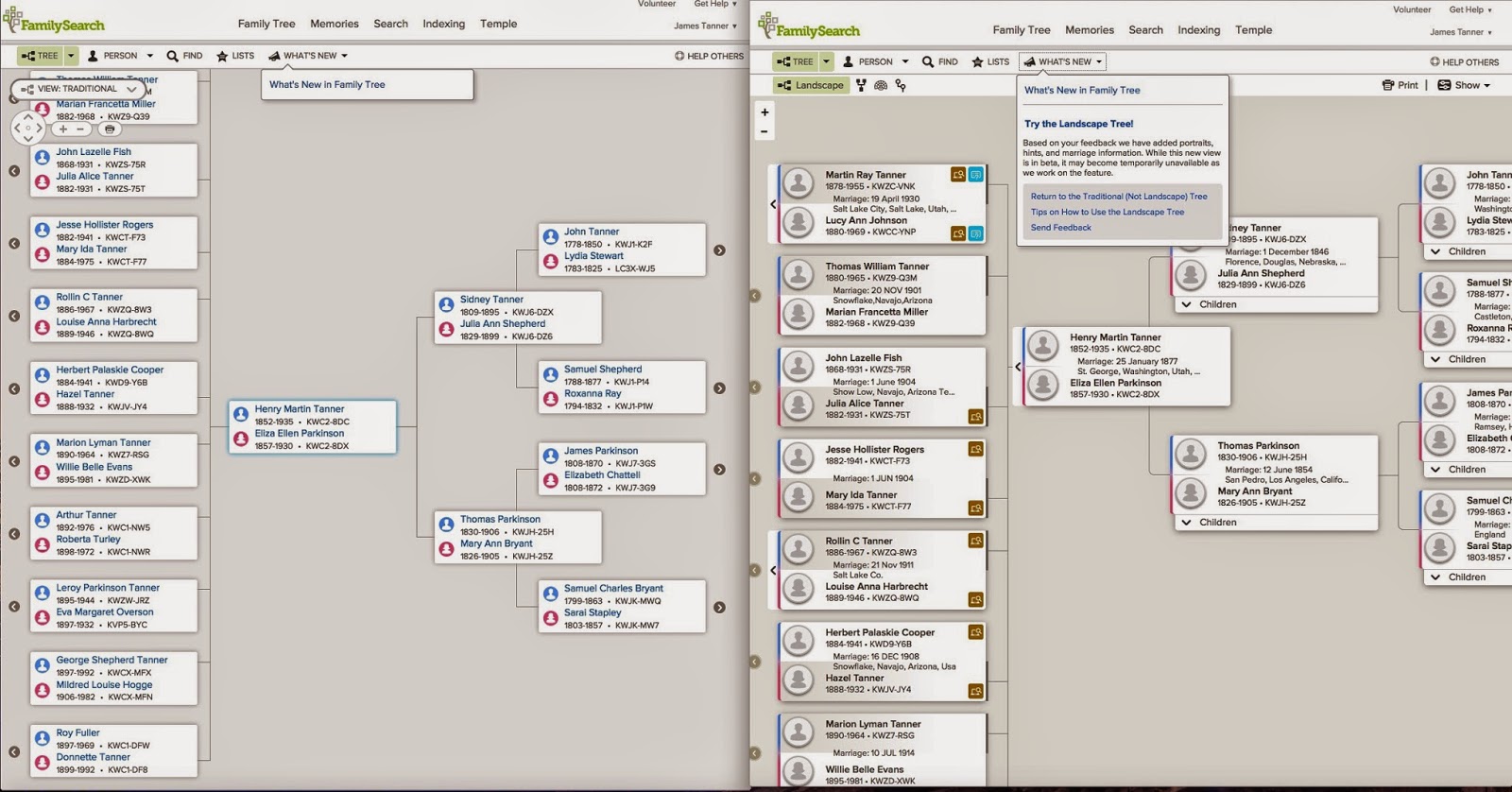
I happened to have two different browsers open at the same time and opened two different windows of FamilySearch.org's Family Tree. I was surprised to see the new Landscape Family Tree view on the Firefox Browser and the older Traditional View on the Chrome browser. Yes, I can log into the program in two different browsers at the same time on the same machine. I like the new interface much better than the old one, but I haven't had much of chance to do anything with it since it just showed up this evening.

Note Added later: Apparently, this was a temporary phenomena. I tried getting into FamilySearch.org with the new website using both the Chrome browser and the Firefox browser the next morning and had the old Traditional view on both. I guess I am still not in any of the 5% increments. Of course, the new interface is viewable in the Beta.FamilySearch.org version, but I will wait to comment on the details of the new interface until I have the real thing.

Don't Fall Into the Duplicate Trap on FamilySearch Family Tree

I was recently reviewing yet another program affiliated with FamilySearch.org that purported to review your ancestors on the FamilySearch.org Family Tree and indicate which of them needed their Temple ordinances done. For the time being, the program will remain anonymous because it does not differentiate between valid Temple opportunities and where there are obvious duplicate issues. Following is an example of exactly what I mean by this statement.

Here is a screenshot of the family where the son is shown as needing to be sealed to his parents by the program. Clearly, the anonymous program is merely following the directions from FamilySearch.org but blindly ignoring obvious problems.


In Family Tree, the son, Marinus Christensen is shown as the child in two marriages, one with a mother named Karen Marie Johannesen and a father named Jens Christensen and one with no father and a mother named Marie Christensen. Here are the details on the two mothers:


As you can see, there is no data whatsoever about the second mother, Marie Christensen. There is no birth information and only the word Deceased as a death date. Some one, in the past, failed to do adequate research and entered the mother in without this information. By the way, FamilySearch.org has stopped showing a list of the last few changes made and merely has a link to the "Show all Changes" page. If I go to that page, I see that the changes made page has changed considerably and now includes a lot more information, including the addition of items to the Memories section such as photos. Here is a screenshot of the new Changes Made page:


Looking back through the entries, it is impossible to determine exactly when or who added this new mother to Marinus Christensen but if you look at the page for the new mother, Marie Christensen, you can see that there is no information at all about this person including now sources. Here is a screenshot showing the lack of information:


The new mother's changes page under the link to "Show All Changes" indicates the following. The source of every change is indicated to be FamilySearch. I am listing them from the earliest change to the present.

  • Gender Added 2012
  • Death Added 2012
  • Name Added 2012
  • Wife Added 2012 Marie Christensen
  • Father Added 2012 Christian Christensen
  • Father Relationship Type Added: Biological 2012
  • Mother Relationship Type Added: Biological 2012
  • Couple Relationship Deleted 2013
  • Father Relationship Type Removed 2013
  • Father Removed 2013
  • Living Status Added 2014 Deceased
OK, so far, we have no one to contact for an explanation. We have no sources or explanation why someone thought that Marinus Christensen had another mother with an unknown father (which may have been true or not) and we know that he is shown as a child in with both parents identified and at least ten sources. 

Now, an inexperienced user of the program might conclude that because all this information was entered by FamilySearch that it must be correct and the sealing to parents ordinance needs to be completed. This would be especially true if the inexperienced person knew nothing at all about the family. As a matter of fact, there is a question about the status of Marinus Christensen in that family. One family tradition is that he was "adopted." But years of research has not disclosed anything but the fact that he shows up as a child in this family. In any event, if he was adopted, there are no documents showing who his biological parents are. All of this information, of course, is not recorded in FamilySearch.org. Here is what the ordinance status shows:


Now, we can do several things with the information as it now stands:
  1. We could go ahead and do the sealing ordinance
  2. We could look for duplicates (even though we see obvious duplicates)
  3. We could do more research and see what other information comes to light and meanwhile reserve the ordinance until the research is completed
  4. We could do nothing at all
I elected to take the first step and look for duplicates. There are no duplicates found for Karen Marie Johannesen. Here is the screenshot.


There are no duplicates found for the new mother, Marie Christensen:


Under the rules of the Family Tree, I would be perfectly justified in doing the sealing to parents ordinance for the new mother and her son Marinus Christensen. What saves this from happening? FamilySearch has the comment on the ordinance that it "Needs More Information." The further comment is made, "This person must be linked to the parents before the sealing can be performed."

A complicating factor is that all of these names are exceptionally common in Denmark. Now I am in a quandary. Do I delete the relationship or merge the two mothers together? My initial reaction was to merge the two mothers. But upon reflection, I am concerned that the new mother, Marie Christensen, is not really a duplicate at all, but an attempt to include Marinus Christensen in an entirely different family. In other words, the mistake isn't in adding a mother but in including Marinus in the wrong family. Also, because of the family tradition, there is the thought that maybe someone thought they had identified a biological mother and father and then changed their mind but not completely.

In this situation, the suggested ordinance cannot be performed, but what if it could be? How would an unsuspecting inexperienced user of the program even know that all these issues existed? As you can see from this example, going back to the beginning of this post, having a program that simply shows you that there is an ordinance opportunity and does not disclose all of the other issues can arise is not at all helpful. To add even more complexity to the situation, Jens Christensen, Marinus Christensen's father is shown with three wives and a total of ten children. One of the supposed wives was married before she was 12 years old. The sources shown for Jens Christensen show entries for a "Jens Peter Christensen" gleaned from Danish baptismal records for four of the children with the less-than-twelve-year-old wife.

Unfortunately, the program mentioned above, does not address these issues at all, at least in its free version. But FamilySearch does indicate these problems in the Descendancy View. Here is a screenshot showing the Red error icons.


This is a situation that needs to be resolved, but not by offering a user the opportunity to do an ordinance.