Genealogy from the perspective of a member of The Church of Jesus Christ of Latter-day Saints (Mormon, LDS)

Thursday, June 18, 2015

The Issue of Combined Records on FamilySearch Family Tree

Here is part of a recent comment from commentator, Gordon Collett:
Here is the answer for this blog. Incorrectly combined records from New Family Search are a major concern. Sometimes wildly incorrect alternate names in Family Tree are the last remaining clue that an incorrect merge occurred. Take your example of Jeane Cheverill and Jane Richard. Those two last names are so different that it is highly likely that a bad merge took place in New Family Search. This means that without checking, you don’t know what information in the Family Tree record, including birth information, death information, marriage information, spouses, and children are Jeane’s and which are Jane’s. These are all fairly easily to correct by going back to the records, correcting the information for your ancestor, and letting the descendants of Jane recreate a record for Jane, or work of an existing duplicate for her, and correct her record. What is not so easy to correct, however, is the ordinance page. Currently, looking at that page, there is no way to tell which ordinances are Jeane’s and which are Jane’s. For all you know, Jeane has never had any ordinances done at all even though they look complete, because all the ordinances showing are Jane’s. 
We’ve been told on the Family Search feedback boards that at some point in the future, Family Search will give us the ability to look up our ancestors in the ordinance database and verify that the ordinances showing in Family Tree really belong to our ancestors and that we will be able to request corrections in Family Tree. At this point, where there has been an obvious bad merge in Family Tree, I am putting a note to that effect, warning that the ordinances showing may not be valid. Also, I am very glad that I have never gotten around to copying any ordinance information from New Family Search or Family Tree into my personal home computer genealogy program (except for ordinance work my family has personally done) so all the dates there are from the IGI, that is pre-NFS, and I know those dates are correct. 
This is a screenshot of the list he is referring to a person named Jeane (Jane) Cheverill b. 1674:


Let me point out a few additional comments and issues.

Most of the names appearing in this particular list are obvious mistakes. For example, Mrs. Morgan. However, let's suppose that there are two entries that have been wrongfully combined; one for a person named Jeane Cheverill and another for a person named Jane Cheverill. Since there are no sources attached to this person, how can I tell, from this record, that there are, in fact, two different people combined in this record?

In some cases, this may be very difficult to determine without access to the list of combined individuals. Are we then to assume, in all these suspicious cases, that ordinance work needs to be redone to assure ourselves that it has been completed for both combined records? I think not. This case is probably more typical than it is unique.

This particular line was part of my initial survey beginning over thirty years ago. In fact, as far as my records are concerned, my extended line differs considerably from what is presently in the FamilySearch.org Family Tree. For all practical purposes, my line ends some generations before the one shown on the Family Tree. I suggest that as I begin working on this particular problem, which presently is not on my short list of things to do, that the issues will be resolved. I am guessing that this particular line will "disappear" from my pedigree with further research.

The combined person issue has some other aspects. Given the origin of the information poured into new.FamilySearch.org, the ordinance work for these individuals with multiple submissions, as evidenced by the number of alternative birth names, was more than likely done multiple times. Arguably, if this is not the case and your ancestor was wrongly combined with one of these multiple combination people (aka IOUSs) then you will not see that all the ordinances have been done for your person, they will simply not be in the Family Tree.

Essentially, there may well be a good reason to verify that all the ordinances have been done when and if, such a list becomes available, but presently there is really not a great need for concern. Not only were the ordinances done for these individuals, but what is more likely, the ordinances have been done multiple times for all of the combined individuals, both real and imaginary on this list.

The real solution to this problem is what I am in the process of doing, working systematically through my pedigree on all my lines, adding copious sources and verifying every possible date and event. Right now, I see no need to be concerned about the fact that one of my ancestors may have missed an ordinance when the opposite, multiple ordinances, has been the case for many years.


Wednesday, June 17, 2015

Birth Names on FamilySearch Family Tree

Some of the common artifacts left over from 150 years of accumulated family history submissions to The Church of Jesus Christ of Latter-day Saints (and all their various subdivisions and associated organizations) that show up in the FamilySearch.org Family Tree are some strange entries labeled as "Birth Name." Here is a screenshot of an example from one of the people in my own ancestral lines:


Many users of the Family Tree are baffled by these names and assume that because they are a legacy of FamilySearch, therefore there is some reason they are there and they should be preserved. Others view them as a burden that forces them to research the real birth name of the individual and spend a huge amount of unproductive time. Yet another reaction to this list is that the list is ignored completely. Where did these "Birth Name" entries come from and why do they appear in the Family Tree?

Over the years, as people submitted names to the Church (Genealogical Society of Utah, etc.) there were, of course, variations in the way that people were identified. After many years of submissions, much of that accumulated work was included in the new.FamilySearch.org program. There were a myriad of duplicates. Unfortunately, many of the entries, even though they were duplicates, had slightly different to significantly different names for the person submitted. What you see above is a summary of the differences in the way the name of this person were submitted. Some people have only one or two variations, some have dozens.

Because the information in the new.FamilySearch.org program was all essentially moved over into the Family Tree, these names showed up. Because they were submitted as the "primary" name of the ancestor, they are designated as "Birth Names" even though most of them are obviously wrong.

The main entry for each individual should reflect that person's name as it is shown on the earliest document or record recorded for that individual. If there is a record of the birth, then this is the name given at birth. This name should be entered as the main name of the individual in the "Vital Information" section. For example, supposing that the only record of a person is a burial record. Since that is the only record, the name shown on the burial record becomes the primary name recorded in the Vital Information section. If a different, earlier name is discovered, it should take the place of the later recorded name.

If the person went by several names during their life time, the earliest recorded name is the name recorded in the Vital Information section. All of the other names are added as Alternative Names in the Other Information section.


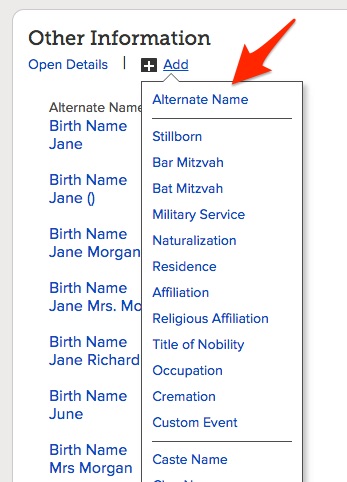
The Alternate Name  option gives you several choices for categorizing the name in a pull-down menu.


The options are:

  • Also Known As
  • Birth Name
  • Married Name
  • Nickname 
  • Other
It is possible that a person may have had more than one name recorded in birth records but this is fairly uncommon. The source of any name variations should be recorded. 

What do we do about the list of alternate birth names, especially those that are obvious errors? They fall into one or more of three categories. They are either:
  1. Duplicative of the name in Vital Information section
  2. Inaccurate 
  3. Inappropriate
  4. Or all three
Let's look at the list of names for Jeane Cheverill shown above:

  • Birth Name: Jane (this name is likely a spelling variation or a nickname and should be designated as such)
  • Birth Name: Jane () (This is the same as the first entry except for the typographical error of adding parenthesis)
  • Birth Name: Jane Morgan (This is obviously wrong. She was not given her married name at birth)
  • Birth Name: Jane Mrs. Morgan (Same issue with the married name)
  • Birth Name: Jane Richard (Just plain wrong)
  • Birth Name: June (Perhaps a spelling variation, but maybe just a typo)
  • Birth Name: Mrs Morgan (Married name again)
  • Birth Name: Mrs. Jane Morgan (Married name again)
  • Birth Name: Unknown (Morgan) (Married name and wrong)

I suggest that all of the wrong or married or whatever names need to be deleted so that there is no unnecessary confusion over the birth name. It would be nice if there was even one source for this person's identity that would help us decide if any of the other variations need to be preserved. Be sure and add a detailed reason for deleting the names if that is appropriate. 


New Infographic on the Freedmen's Bureau Project

The FamilySearch.org Blog has a post by Thom Reed entitled, "Breaking Through the 1879 Brick Wall: The Significance of the Freedmen's Bureau Records." The post includes the following infographic. 


If you have any interest at all in African American genealogy, you need to be aware of the value of these records. Please take time to read the post from Thom. 


Monday, June 15, 2015

Photos on FamilySearch Memories gets new look

The People selection of the Memories on FamilySearch.org got a new look but like many updates, it has appeared and then disappeared. Last night, the new look showed up briefly on my computer and today it is gone. Here is a screenshot of what I can see today:


This is the regular view. I have highlighted the little information link added that explains the different views available from the pull-down menu at the top of the page. I guess I need to learn to quickly grab a screenshot of any new FamilySearch.org development because it just might disappear the next day.

There is also a newly added filter that lets you see which of your photo people are not linked to the Family Tree:


The new view increased the size of the photos into something approximating the portrait view and also added some tiny thumbnails of other photos. You can set your preferred portrait by clicking on the image and then clicking on the thumbnail view in the individuals detail view. Here is a screenshot showing a detail view and a selection of possible changes:


Oh well, I will just have to wait until the new view shows up again, if it ever does, and write about the change then.

Wait, my wife showed me how to get to the new view. Here it is:


More about this later.

Sunday, June 14, 2015

The Question about "of"

I received the following comment from Gordon Collett,
Something I find just fascinating is how many of these corrections we are doing now were not only acceptable but required in the past. It makes me wonder how much people fifty years from now will be shaking their heads over how we enter data. “Of” is a case in point. To quote from Lessons in Genealogy. (Salt Lake City, Utah: The Genealogical Society of Utah, 1915): 
“Use of ‘of.’ Going- back to our sample record, we see that there is very little data regarding the names we have. There are no dates regarding John Young. The only fact we have is that he lived in Leeds, Yorkshire, England, and this we may record in the space under ’Where born.’ We do not know he was born in that place, so it will not do to leave the record without some qualifying statement. We therefore use the word ‘of' before the name of the town, Leeds. This shows us that John Young was a resident ‘of' Leeds, the only fact we have to identify him as regards place.”

This raises a question. What should we do with all those place names preceded by “of”? Since “of” means “was a resident of,” should we delete the place name entirely from the birth field, enter it into the custom events section as a residence and add the years of residence if known? 
Just for information sake, the reference work which Gordon refers to is the following:

Genealogical Society of Utah. Lessons in Genealogy. Salt Lake City, Utah: The Genealogical Society of Utah, 1915.

The complete book is available on Archive.org


The problem of using "of" to designate an unknown birth place is much more complicated today than it was in 1915. One of the considerations is the issue inserting a non-geographic term in a location description and the effect this might have on a search engine. Translated into English, this means the Family Tree program cannot search the locations containing an "of" designation. 

The addition of the word "of" to designate a place that the person lived during his or her life time is a result of using a standardized form. Today, you can use the "Other Information" section to add a residence and leave the birth field blank. Here is a screenshot showing the selection for "Residence."


If you find entries stating a location with the word "of" you can simply copy the information into a residence entry in Other Information and then delete the "of" location in the birth information field. 

Ten Common Areas of Concern on the FamilySearch Family Tree - Part Two

In the first part of this series, I used one of my own ancestors in the FamilySearch.org Family Tree as an example of the common areas of concern. These are areas that need to be "cleaned up" because the overall accuracy of the Family Tree entries rely completely on the accuracy of each individual entry.

The Morgan line I choose for my example has been "researched" for over 100 years. Here is the couple in the Morgan line I am using as an example of the issues of concern:


Note the red exclamation point warning on this couple.

Concern Number Six:

FamilySearch.org has provided us with warnings about the information in our ancestral lines. Most of these warnings have to do with one important aspect of family history: do the math! This means that you need to be aware of the effect of putting dates and other numbers into the Family Tree. The example above is exactly on point here. The information in the Family Tree has Jeane Cheverill born in about 1674, however, if we go to the list of her attributed children, we see the following:


This list is a problem in itself, as I pointed out previously. The last child was supposedly born when Jeane Cheverill was 71 years old. But we need to go to the husband's entries to see further problems. Here is a screenshot of the husband, Richard Morgan, (b. 1676, d. 1763).


Richard Morgan has three more wives. Notwithstanding his marriage to Jeane Cherverill that lasted until she was 71 years old, he supposedly had three other wives. This one Jane Taylor, had her first child fourteen years after her marriage. Of course, she was married when she was five years old and her husband had to wait until she was nineteen before they had their first child. My, this is an interesting early American family! Of course, this is only the start, Richard Morgan's fourth wife, Unknown, had eleven children starting in 1712 and ending up in sometime after 1732 when Richard, himself, was 56 years old. In any event, he is supposed to have lived to be 87 years old.

The point here should be obvious. We all need to be careful that what we enter into the Family Tree makes some sort-of sense when you look at the dates events were supposed to happen.

Concern Number Seven:

For this concern, we are back to Jeane Cheverill. I have already mentioned the problem of dates, but next we need to look at the issue of the children. Jeane's children are listed as follows:

  • Jacob Morgan b. 1700
  • Olive Morgan b. 1704
  • Isaac Morgan b. 1708
  • Mary Morgan b. 1710
  • Jean Morgan b. 1711
  • Abel Morgan b. 1712
  • Sarah Dossett Morgan b. 1712
  • William Morgan b. 1732
  • Abel Morgan b. 1745

What is wrong with this list? Pretty much everything. Even if we ignore the age of the mother, we see that the first child was supposedly born 45 years before the last child. Look at the dates here. We are in the early 1700s. In the early 1700s, the average person lived to be about 36 years of age.

Another issue, from a family history standpoint, is the gap between the children. The largest gap is twenty years between Sarah born in 1712 and William born in the 1732. This suggests that William and his brother Abel were not the children of Jeane Cheverill and Richard Morgan. There is a need here for much more research about this family.

Concern Number Eight:

There are no sources attached to this family at all. There is not one place we can go to see how all of these marriages and children were discovered. Without documentation, we must assume that all of the information is subject to serious question. This means the names, the dates, the relationships, the children, the places, every last item recorded here is subject to serious concern.


Concern Number Nine:

Despite all of these problems and concerns set forth in the first eight examples, this pedigree extends indefinitely into the past.


In addition, there are extensive data problems as indicated by the red icons at every generation of the extended pedigree. Notwithstanding all of these problems, temple ordinances have been performed for the families and all of the marriages and individuals included at every level. Perhaps we need to think about what we are doing when we blindly start listing people as ancestors.

Concern Number Ten:

This is far from the last of my concerns, but this list had to end somewhere. In this case, I merely extended out this Morgan line to its ultimate conclusion. So, despite all the problems and despite the fact that there was no documentation at all at most of the levels, this pedigree goes back to an Edward Morgan, born in 1600 in Llantamin Abby, Monmouth, Wales, United Kingdom. Interesting that the line ends with Edward Morgan whose son, Edward was born when he was five years old. Here is a quote from Wikipedia about the Llantamin Abby:
It was founded as a daughter house of Strata Florida Abbey, Ceredigion, in 1179. After its dissolution in 1558, it was used as a private residence, being initially acquired and rebuilt by a local landowner. William Morgan of Llantarnam (Lanternam in some old documents) bought the abbey in 1561 and the family became great landowners in Monmouthshire around this time.
But apparently, whoever extended the line to this point could not read because here is the lineage of Sir Edward Morgan from Sir Edward Morgan, 1st Baronet, Wikipedia

Sir Edward Morgan, 1st Baronet of Llantarnam (died 24 June 1653) was a Roman Catholic supporter of Charles I during the Bishops' War and the English Civil War. Charles created him a baronet in recognition of his services, but his capture during the English Civil War led to his estate being sequestered. Morgan was one of the Morgan family of Llantarnam in Monmouthshire, Wales, an established Roman Catholic family: his great-grandfather William Morgan was a MP in the reigns not only of the Catholic Queen Mary but also of the Protestant Queen Elizabeth, and allowed his house to be used for the celebration of mass. Morgan's parents were Thomas Morgan and Frances, daughter of Edward Somerset, 4th Earl of Worcester, and both supported Catholic activities in Wales. He was educated at Jesus College, Oxford, matriculating in 1616 and obtaining his Bachelor of Arts degree in 1619. He was involved in the Welsh Jesuit headquarters being set up in 1635 in Cwm,Herefordshire. He was commissioned in the second Bishops' War in 1640 and given permission to obtain contributions from fellow-Catholics. This caused controversy in the Long Parliament, and Charles I's reaction was to make Morgan a Baronet in 1642; he later renewed Morgan's commission during the English Civil War. Morgan was captured at Hereford on 18 December 1645. The Rump Parliament removed his baronetcy and his estate was sequestered. He died on 24 June 1653; it was not until 9 November 1654 that his estate was discharged. His heir, Sir Edward Morgan Jr., 2nd Baronet of Llantarnam, became a Protestant. The Baronet title fell to his son Sir Edward Morgan III., 3rd Baronet of Llantarnam until his death, he was without male heirs and the Baronet title then went to his uncle: Sir James Morgan., 4th Baronet of Llantarnam, James was the younger son of Sir Edward Morgan., 1st Baronet of Llantarnam and was the last Baronet of Llantarnam, as his surviving heirs immigrated to America.
Hmm, make me think it is time to go back down the line and see where this connection is made.

The first part of this series is here:

http://rejoiceandbeexceedingglad.blogspot.com/2015/06/ten-common-areas-of-concern-on.html

Thursday, June 11, 2015

Ten Common Areas of Concern on the FamilySearch Family Tree - Part One

Part of what is going on with the FamilySearch.org Family Tree is our "inheritance" of 100+ years of accumulated family history. A certain percentage of the users of the program find that their ancestors have accumulated a huge amount of information. However, some, especially those who families joined The Church of Jesus Christ of Latter-day Saints more recently (after 1900), will find a virtual open field for entering information. However, even those with relatives who joined the Church more recently, there is always the possibility that extensive information about certain family lines has already been accumulated in the program.

I decided to choose an arbitrary number (ten) of areas I commonly see as needing attention. Many of these areas are ignored by those working on the program and can and will cause problems in the future. Each of these areas are details that need to be "cleaned up." It is significant that all ten concerns are illustrated in this one entry. I will be splitting this post into two parts with the first five concerns in this post and the next five concerns in a second post to come. Here is the list:

Concern Number One


This screenshot actually shows the first four areas of concern. But, first, comes the name of the ancestor. It took me only a few seconds of clicking on my pedigree to find this example. The problem her lies with adding in extraneous information to the name of the ancestor. The Family Tree search engine will consider the part of the name in parenthesis to be "part of the name" and will not find records for this person. The extra name is intended to be an "Alternative Name" and should be added to the Other Information section. There is a pull-down menu of suggested other information categories that can be chosen. This is not a trivial issue. In addition, the name here in the Vital Information section should be the actual birth name, i.e. the name given at birth. Any alternate names adopted by the deceased person should be put in the Other Information section. There are exceptions to this rule. For example, there is a possibility that the person actually changed their name during their lifetime. In these cases the additional names may be added in. My Great-great-grandfather's name was Charles Godfrey DeFriez. He changed his name to Charles Godfrey Jarvis. All of his children went by the name of Jarvis. To avoid a search for another father, we reflect that change by putting the Jarvis name at the end of his name, i.e. Charles Godfrey DeFriez Jarvis. 

Concern Number Two

There really a lot I can say about this second type of entry. Initially, abbreviations are unacceptable. Again, the Family Tree search engine is not going to recognize this particular abbreviation. I could write an entire book about the rest of the problems with this entry. For example. the date is 1674. West Virginia, Shepherdstown, and Berkley county did not exist. Where was this person born? Additionally, an invalid, but very common assumption has been made that because a person's name is associated with a particular place, that person was born there. This entry is an admission that there is no information about this person. Abbreviations need to be expanded into complete place names, but more importantly, the correct place needs to be identified. There is no way to tell if this is the correct person without more specific information. Hint: West Virginia did not become a state until 1863. 

Concern Number Three

Dates can be slippery. This is especially true of the date here: 1674. In about 1752 the Gregorian Calendar replaced the previously used Julian Calendar. Does this change affect the date? We cannot know or tell because the date is listed as approximate. This is another admission that nothing is really known about this person. There are online calendars that will calculate the difference in the dates. See timeanddate.com. Less obvious, is the fact that children of this person are shown being born as late as 1745 when Jeane Cheverill was 71 years old. This is really another concern that I will write about below. 

Concern Number Four

The death place is shown as "Frederick, Virginia." This is a county formed in 1743. By this time, Jeane Cheverill would have been 69 years old. This age is not impossible for the time period, but very unlikely. Of course, there are no sources substantiating this advanced age or place. The real issue here, however, is that without a death date, it is nearly impossible to tell where this person actually died. Here is a quote from Wikipedia about Frederick County, Virginia that illustrates the problem:
Frederick County was established in 1743 from parts of Orange County. (At that time, "Old Frederick County" encompassed all or part of four counties in present-day Virginia — Shenandoah, Clarke, Warren, and Frederick — and five in present-day West VirginiaHardy, Hampshire, Berkeley, Jefferson and Morgan.)
That is a lot of territory to cover trying to research a death place and date.

Concern Number Five


This list of Alternative Names is misleading and inaccurate. She did not have all these names at birth. Additionally, the real birth name, if it is known, should be in the detail section shown above in the first screenshot. What do we do about all these supposed birth names? This is a difficult issue. Some of them are obviously wrong. She was not called "Mrs. Jane Morgan" or "Unknown (Morgan)" when she was born. These can readily be deleted with a comment about the fact that they are simply inaccurate. Taking that step, in this case, actually removes all of the names from the list. The name "Jane" might be re-entered as an Alternative Name if there are records to show that she used or went by that name.

That is all five of the first concerns. Stay tuned for the next batch.