Genealogy from the perspective of a member of The Church of Jesus Christ of Latter-day Saints (Mormon, LDS)
Wednesday, April 12, 2017
New FamilySearch Office in Lehi, Utah
Thanksgiving Point in Lehi, Utah is the home of a new office for FamilySearch. There is also a new Stake Building going in right next door. The office is about a block away from the Lehi FrontRunner Train stop and on the west side of the tracks. It is only a short train ride from downtown Salt Lake City, Utah and the main FamilySearch offices.
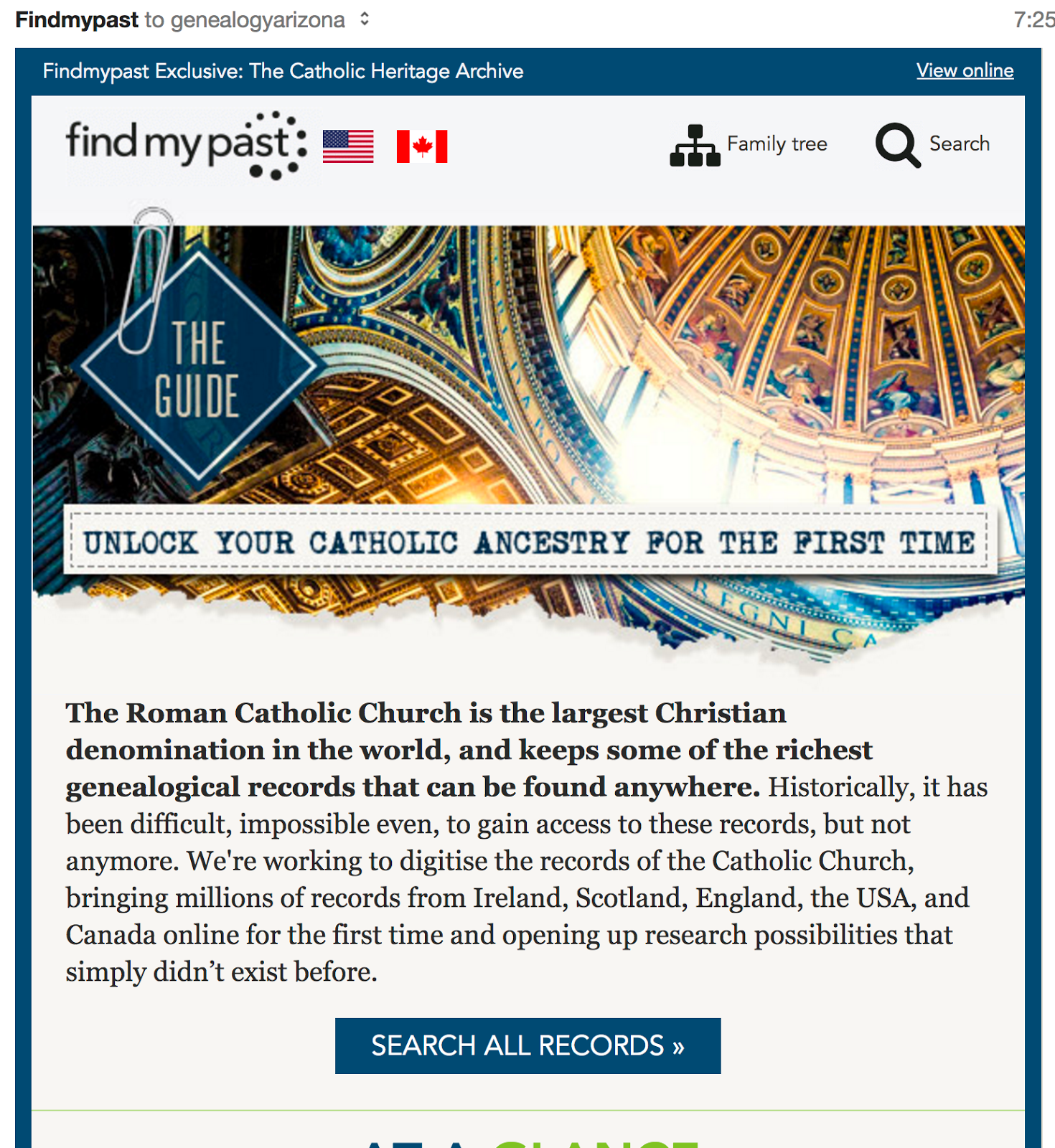
Millions of U.S. Catholic Church Records on Findmypast.com
I am still finding that usage of the FamilySearch.org Partner Programs is just barely gaining traction among the members of The Church of Jesus Christ of Latter Day Saints. This seems surprising to me since the members receive free access to these subscription-based websites. Among the most useful of these websites is Findmypast.com. Many members of the Church have English, Scottish, Welsh, or Irish ancestry and Findmypast.com has the largest collection of records from these countries online.
Currently, Findmypast.com has begun digitizing Catholic Church records from the United States and from its early origin as British colonies.
As this graphic shows, there are now millions of records online and completely searchable for Catholics that lived in America. Previously, these records have been entirely unavailable online. In addition, it is important to understand that after Germans, Irish immigrants constitute the largest number of immigrants to America.
I'm certain that during the upcoming week or so I will once again find someone who has English ancestry and has yet to register or take advantage of access to Findmypast.com. To register for the partner programs go to the following link:
Tuesday, April 11, 2017
Grandma never lied...
Until quite recently, access to genealogical records was severely limited, absent a visit to a large genealogical library such as the Family History Library in Salt Lake City, Utah. Much of what was accomplished in the way of research consisted of letter writing to relatives or writing for information and making requests to record repositories. When I first started doing my own research about 35 years ago, the only access I had to the U.S. Census was in Salt Lake City on microfilm. So any research I did took place during those once-a-year visits to the Family History Library. So there is a whole generation of would-be genealogists that are relying completely on genealogical research done before the advent of online records and family trees.
The plain reality is and was that genealogical researchers in the 1800s and for most of the 1900s relied on family connections and letter writing for nearly all of their information. Those in Salt Lake City could take advantage of the limited collection of records in the Family History Library, but until the advent of the large microfilm collections and the ability of local libraries to obtain microfilm from Salt Lake City, there were very few resources available to those who lived outside of Salt Lake City. It is the case that some families with the economic means were able to employ researchers, but even these researchers were limited by the availability of records.
One important fact is that those researchers in the 1800s were acquainted with people who were born in the 1700s and got some information first hand. But even this "first hand" information was spotty and subject to errors. During this period of time and continuing into the present, diligent researchers felt a need to publish their findings in book format usually referred to generically as "surname books." Over the years, tens of thousands of these books have accumulated. Many are very limited printings with only a few copies. Some have passed into the online world through digitization and are readily available online. For example, the FamilySearch.org website has a Books section that contains thousands of these books.
Some of these surname books are genealogical treasures and contain extensive documentation. However, documentation in the vast majority of the books is spotty or nonexistent. It is not wise to dismiss these books as useless because they were often compiled, as I already pointed out, by people who were personally acquainted with those featured in the books. Unfortunately, some of these books have taken on the trappings of "scripture." The stories have been told and retold so many times that they as passed on as "true" irrespective of the documentary evidence that has since been discovered.
Why do I have this apparently negative opinion of the traditional genealogical research? The main reason is that I am the recipient of multiple lines of people who did "genealogy" their entire lives. As I have mentioned in past posts, I also have access to multiple surname books on several of my family lines. Over the years, I have spent innumerable hours evaluating and correcting the information contained in these books. Some of the research was first rate but lacked any substantiating documentation. Some of the errors and false traditions have become so embedded in my greater family, that they may never be entirely corrected.
If you have a "genealogist" in your family line or lines, you need to carefully evaluate your inherited genealogical data. If the traditional information comes with source citations, check those references to verify their accuracy. If the information is in the form of stories or pedigrees and family group records with no sources, be sure and find sources that either support or refute the information contained in the books. But be careful not to take the position that the information you received from a genealogist ancestor may be entirely wrong.
Many members of my immediate family are actively involved in genealogical research. Using the tools available today, we have broken through many of the "brick wall" situations that existed for the past one hundred years or so. However, much of the genealogy as presently reflected in the FamilySearch.org Family Tree is a mess, to use an understatement. It will likely take many more years to untangle all of the inaccurate and incorrect information. But as I often say, the Family Tree is the solution, not the problem. We are slowly making progress and are adding a huge amount of documentation. Do not be discouraged. It is worth the effort and has the benefit of providing an almost endless supply of the names of ancestors and relatives that need temple work.
The summary and the key: add only information to the Family Tree that is supported by valid and well evaluated sources.
Learn the Principles of Peace from the Prince of Peace
The Church of Jesus Christ of Latter-day Saints is beginning the week of Easter 2017 with a focus on our Lord and Savior Jesus Christ as the Prince of Peace. This title comes from the Bible in Isaiah 9:6 which says:
6 For unto us a child is born, unto us a son is given: and the government shall be upon his shoulder: and his name shall be called Wonderful, Counsellor, The mighty God, The everlasting Father, The Prince of Peace.When I was attending the University of Utah before I got married, I lived in an apartment with a former missionary friend. Every day, we would start the day listening to a Tabernacle Choir recording of Handel's Messiah. You can hear the Choir on their YouTube Channel.
This Easter focus on the Principles of Peace from the Prince of Peace.
![]() |
| http://www.mormonnewsroom.org/article/easter-2017-prince-of-peace-jesus-christ?__prclt=RaeCxqZ8 |
Friday, April 7, 2017
We will never surrender - The Battle Cry of the FamilySearch Family Tree
After reading one of my recent posts, someone asked me if I were going to give up on the FamilySearch.org Family Tree. The real question is whether or not we are going to give up to the bullies, the dogmatist and those who put in unsupported and undocumented entries. Here is my response:
No not at all, but some are. I am too English for that. I would paraphrase Churchill, We shall go on to the end. We shall fight with sources, we shall fight for ancestry and consistency, we shall fight with growing confidence and growing strength on the internet, we shall defend our family lines, whatever the cost may be. We shall fight in the archives, we shall fight in the libraries, we shall fight in the repositories and in the microfilm records, we shall fight in our homes on our own computers; we shall never surrender. The FamilySearch Family Tree is the solution, not the problem.
Exactly and carefully documented to the best of our ability. We will save ourselves and all OUR dead.
Will we save ourselves and all our dead?
![]() |
| By Jake from Salt Lake City, United States - Salt Lake City Panorama from Ensign Peak, CC BY-SA 2.0, https://commons.wikimedia.org/w/index.php?curid=42765173 |
For there we shall be taughtThis reference to saving ourselves with all our dead refers to Verse 15 of Section 128 of the Doctrine and Covenants, which states:
The law that will go forth,
With truth and wisdom fraught,
To govern all the earth.
Forever there his ways we'll tread,
And save ourselves with all our dead.
15 And now, my dearly beloved brethren and sisters, let me assure you that these are principles in relation to the dead and the living that cannot be lightly passed over, as pertaining to our salvation. For their salvation is necessary and essential to our salvation, as Paul says concerning the fathers—that they without us cannot be made perfect—neither can we without our dead be made perfect.The opening message of the Saturday Morning, April 1, 2017, General Session of Conference, by President Henry B. Eyring is summarized on LDS.org as follows:
General conference has always been a time of gathering for the Latter-day Saints. …
I have felt impressed to speak to you today about another kind of gathering. … I refer to the gathering of the family of God. …
… Our Heavenly Father is anxious to gather and bless all of His family. While He knows that not all of them will choose to be gathered, His plan gives each of His children the opportunity to accept or reject His invitation. And families are at the heart of this plan.
Centuries ago, the prophet Malachi said that in a coming day, God would send Elijah to “turn the heart of the fathers to the children, and the heart of the children to their fathers” (Malachi 4:6). …
… The hearts of the children—of you and me—have turned to our fathers, our ancestors. …
The youth have caught the vision admirably; now their parents need to catch up. There are now many people who have accepted baptism in the spirit world because of the work done by the youth, and they are waiting for other ordinances that only adults can perform in the temple. The work of gathering Heavenly Father’s family is not just for young people, and it is not just for their grandparents. It is for everyone. We are all gatherers. …
I testify that God the Father wants His children home again, in families and in glory. The Savior lives. He directs and blesses this work, and He watches over and guides us. He thanks you for your faithful service in gathering His Father’s family, and I promise you the inspired help that you seek and need.I suggest that all those who are involved in gather the dead through work in family history need to read his entire talk again. We have those of our "dead" who have already accepted the Gospel of Jesus Christ and are ready and waiting for their ordinances to be performed. It is our opportunity and out duty to find them, identify them through proper evaluated records and take their names to the temples to do their ordinances.
Thursday, April 6, 2017
Is your family tree bound by dogmatism?
Dogmatism is defined as the tendency to lay down principles as incontrovertibly true, without consideration of evidence or the opinions of others. For the last hundred years or so, genealogists have lived isolated and cloistered lives. Unless they purposely shared their paper-based family tree, no one could ever question their conclusions. They could adhere to every possible family tradition without the bother of referring even to one substantiating document or record. They could claim that they had traced their ancestry back to Adam and everyone would be dutifully impressed. The genealogical life was simple and good.
Then things began to change. A few rogue genealogists had the audacity to suggest that genealogy ought to be source-centric. They actually suggested that entries in a family tree should be supported by validly evaluated documents and records. Nevermind, the dogmatic genealogist could easily ignore their platitudes. Then came the revolution. Family trees could be put online for everyone to see! In fact, FamilySearch.org and other online websites had the temerity to make unified, source-centric family trees.
Of course, there was always an option to stay paper-based, but now showing the heretofore private family tree to anyone risked the possibility that they had already seen their own ancestral lines on a public family tree and knew that the revered family traditions and unwarranted temporal extensions were fantasy and further, they were not afraid to say so in a very public way.
What could the tradition-bound genealogical dogmatists do to fight back? Hmm. They could dump all of their unsupported family traditions into the FamilySearch.org Family Tree and play "King of the Hill." If anyone had the courage to claim that their dogmatism was unsupported, they could claim otherwise and refer to their "years of research" and the fact that they had "hired a professional genealogist" to support their conclusions. When asked to produce some documentation, they could ignore the requests and simply repeat the fact that they knew in their hearts that their version of the family tree was correct.
Will the dogmatists win? Will online family trees become even more unreliable as they are taken over by the dogmatic bullies of the playground? Will the source-centric genealogists abandon the unified family trees in favor of creating their own playground where they can make everyone play by their rules?
This whole situation would be ludicrous if it weren't a rather accurate statement of the current conditions in the online family tree programs. This is something I write about regularly because the problem comes up with the same regularity. Is there a solution besides abandoning the Family Tree? The real issue is whether or not the Family Tree will reflect some semblance of reality or become a dumping ground for every unsupported family tradition and dogmatic and unsupported theory?
Subscribe to:
Posts (Atom)