Note: You can do a Google search for "A Family History Mission" to see all the previous posts in this ongoing series. You can also search for "James Tanner genealogy" and find them.
There are six couples of Senior Missionaries working in the Maryland State Archives at the present time. There are also two Church Service missionaries and a number of volunteers. Some of the full-time missionaries will be finishing their missions and leaving so it is planned that there will be some overlap. This is wise because we need a lot of training. It will take Ann and I some considerable time to learn what we need to know to be in a position to teach other new missionaries. We always need volunteers, so if you know anyone who would like to volunteer, please let me know.
The Archives is a very nice place to work. We have two rooms assigned to us. One has the cameras and the other is used to prepare the documents for digitizing. It is hard to see in the above photo, but the facility is called the "Hall of Records." It is quite a large building even though the photo does not seem to indicate that.
The full-time missionaries start work at 7:00 am when it is still dark and very cold. We are expected to work 40 hours a week. The Church Sevice missionaries should work about 8 or more hours per week. Volunteers can set their own times and hours.
The first thing we do upon arriving at work is to sign into the Archives. We work in the "Staff" areas not usually available to the public, but everyone who visits the Archives needs to sign in. Those doing research need to fill out an application for research also.
We need to turn on the lights, cameras, and computers and wait while they all warm up and boot up. Then we get back to work where we left off the day before. We work all morning, take a break for lunch and then work again in the afternoon. We are slowly getting into a routine and adjusting to being out and working all day again like we used to do.
The full-time missionaries get together from time to time to have dinner at a local restaurant or for other gatherings. It is interesting to get to know the people who come from all over the U.S. and have very different backgrounds. For some, this is their second mission.
Ice has 90% of water's density so 90% of an iceberg (or an ice cube) will be underwater and not visible from the surface. Interestingly, these percentages approximately apply to the number of records on the FamilySearch.org website. For those of you out there that are caught up in the "search by name" syndrome, you are only searching (or seeing about 10%) of the records that are available on the website.
What does this mean in numbers? Well, it really means that the numbers of digital images, searchable names are so vast that they defy our individual ability to comprehend. For example, there are presently about 5.84 billion searchable names in the Historical Records on the FamilySearch.org website. A billion is a one followed by nine zeros.
1,000,000,000
Here is a short video showing a graphic representation of 1 billion. Remember, there are over 5 billion names in the FamilySearch.org database on the website.
In order to search through all of these records with a computer program, it is necessary to convert the information in the records into some searchable format, i.e. text files. Nearly all the records on the website are images in either microfilm or digital format. For example, here is a reference to a record in the FamilySearch.org Catalog that is only available on a physical roll of microfilm:
The little icon of a spool of microfilm on the right-hand side of the image indicates that this particular record has not yet been digitized so the only way to view this record is at one of the Family History Centers or Libraries that have a physical copy of the microfilm. Here is the list of available locations for this particular record.
If this particular record has information about your ancestors or relatives, the only way you can find out is by physically examining the record with a microfilm reader in one of the Libraries or Centers listed. This is one reason why the iceberg analogy works in describing the records that are available as opposed to those that are searchable online from your home. As an additional point of interest, when I searched online for this particular book in WorldCat.org, the largest book catalog in the world, it turns out that the only copy of this particular book is in the Family History Library in Salt Lake City, Utah.
This gives us all something else to think about. How many unique records are there that exist in only one copy in one record repository?
Now, we could wait until this particular microfilm is digitized or we could go to one of the places that has a microfilm copy and search through that copy page by page. Either way, a name search on the FamilySearch.org website will not tell us whether or not our ancestor or relative is mentioned in this book.
Now back to the iceberg analogy. Literally, only about 10% of the records available from FamilySearch are searchable by name online. What about the digitized records? Well, if the water book above had been digitized and made available on the website, we would not have to travel to Salt Lake City or some other place to see a copy. That makes our lives much easier as genealogists. Also, keep in mind that we need to search online generally for any one of the items in the Catalog to see if some other entity has the item digitized online. That is one of the main benefits of having the FamilySearch Partner Programs.
But let's look at another entry from the FamilySearch.org website.
Now, let's see if we can search this huge record by the names of our ancestors.
Nope, this record is not indexed. Indexing is the process where we look at the images and type out the information so that the record can be searched, i.e. we create a text version of some of the information in the record.
The only way I am going to see what is in this record with over 400,000 images is to start looking at the record. Perhaps, there is an index or table of contents to the record, but absent those types of helps, I will be looking through the online images just like I would with a microfilm. But, of course, I can do this from my home computer.
Perhaps you can now begin to understand more completely the iceberg analogy. We have a huge number of records available in one form or another, but the number of those records that a name search actually searches is very small compared to the total number of records available on just this one FamilySearch.org website.
Now, I am working in the Maryland State Archives helping to digitize records. How many of those records were previously available anywhere but in the individual counties of Maryland as paper copies? None of them. Think about it.
Note: You can do a Google search for "A Family History Mission" to see all the previous posts in this ongoing series. You can also search for "James Tanner genealogy" and find them.
One of the tasks we encounter at the Maryland State Archives is preparing the documents for digitization. These are Court Proceedings, primarily probate, guardianship and other court records, from the early 1800s. Our task is to sort and partially waypoint these documents and open them up so they are flat and can be scanned. The paper is in surprisingly good shape. The real challenge is the handwriting.
This particular record happens to be an Indenture contract. A young boy, with the permission of his father, is being "indentured" to another person for a period of three years. The document does not say how old the boy was, but he was likely between 12 and 14 years of age but could have been younger. For all practical purposes, the indentured servant was a slave for a term of years.
The handwriting above is typical of the early 1800s. It is not easily readable unless you have become accustomed to reading it. Reading old handwriting is a skill that is obtained by simply working at learning the styles and letterforms combined with a lot of practice. This document is essentially a contract between the boy's father and the potential "owner" of the indentured servant.
Here is another example. This is a more formal court hand used in a probate accounting report.
There are a number of letterforms that are now out of style. Of course, today, except for those involved in formal calligraphy, handwriting is quite dead. You should take note of the signature at the bottom of the document.
Here is another example of a probate accounting. This is lovely enough to frame and put on your wall.
The brown color of the ink results in the fading of the old black ink and its interaction with the paper. The degree to which the ink changes color and fades depends on the particular formulation of the ink and the conditions of storage. These documents are in excellent condition and the digitization process will preserve images of them for far longer than they will remain legible even under ideal storage conditions.
Temple and Family History Consultants at the Ward or Stake level have a clear mandate as set forth in Understanding Your Calling on LDS.org:
The primary responsibility of all temple and family history consultants is to give personalized help to leaders and families, enabling them to:
Find the names of deceased ancestors, and gather their families on both sides of the veil.
Take the names to the temple, and provide necessary ordinances for them.
Teach their family members and others to do the same.
Once you have been called, you should start doing your job. See the links and instructions on LDS.org. During the years I have been a Family History Consultant and then a Temple and Family History Consultant, I was mostly ignored by the Ward leaders. But I recognized that I didn't need their help or support to do my calling. I could talk to Ward members personally and offer my help in finding names to take to the Temple. I could help them in their homes, in my home or at a Family History Center or Library. I had all of the tools on LDS.org including The Family History Guide to help me with my work in the Ward.
Before Church meetings and during times when I am with Ward members, I ask them if they need help in finding their ancestors' names to take to the Temple. Most of them respond negatively at first, but by persisting in friendshipping them and offering to provide support and help, ultimately my efforts always result in lots of opportunities to assist.
Now I am a Full-time FamilySearch missionary. Now, I can help even more people to have a Find-Take-Teach experience. I had several such opportunities while in the Missionary Training Center and now I am starting to have those opportunities with those around me in Maryland.
Temple and family history consultant: Temple and family history consultants have the primary responsibility to proactively help members have personalized, one-on-one experiences finding their ancestors, performing temple ordinances on behalf of those ancestors, and teaching their family members or friends to do the same. Some temple and family history consultants at the area, stake, or ward level may be assigned to support indexing efforts, serve in the family history center, or train other temple and family history consultants.
Do your own job, don't expect help from others but feel grateful and blessed if you do receive help.
Note: You can do a Google search for "A Family History Mission" to see all the previous posts in this ongoing series. You can also search for "James Tanner genealogy" and find them.
Depending on where full-time Senior Missionaries are assigned, we either get to take our own car and load it up with stuff or if air travel is required, we are limited to whatever we can carry and check through the airport. As I may have already reported, we were "required" to supply our own transportation. For many years, because my wife and I both worked, we had two cars. But by coming on a mission we had to consolidate and we sold one of our cars. We kept our all-wheel-drive Subaru Outback and loaded it up with everything we could cram into the back.
One suggestion from a daughter was to preview putting all the stuff in the car by loading the empty boxes before we actually got to the point of the final loading. This helped immensely in planning and visualizing what we could and could not take. Unlike like many missionaries, we have a pile of computer stuff so that had priority. Otherwise, we had to guess what we might leave and what we could afford to purchase on arrival across the country.
Now, if the missionaries are assigned to live at home and serve, they avoid all this. However, some missionaries who we met were going to places such as New Zealand or Europe and had real challenges. Some discovered airline limitations they were unaware of while in the Missionary Training Center and spent days trying to figure out what to leave and what to take. Since we knew exactly how much room we had in our car and definitely did not want to pull a trailer, we could bring a lot more stuff.
In our case, the wonderful Senior Missionaries at the office of the Washington, D.C. North Mission arranged for an apartment (of course, we had the problem of being notified of the wrong apartment number, but that is now being worked out) and furnished it. They did an excellent job. We had more than expected and almost all the things we needed for the apartment. We did make a trip to the Mission Office to stock up on a few more things.
Some Senior Missionaries have to find their own accommodations. Previously, the cost of apartments varied considerably from mission to mission. But, now, there is a fixed amount paid by the Senior Missionaries that varies from place to place around the world. You can go on LDS.org and find a list of the current costs for every mission in the Church.
In our case, some of the major challenges of moving for a year included mail service and medical prescriptions. But those things are being slowly worked out. We did arrive with very little food and other necessities and we have spent the first full week of our mission with frequent visits to local food stores and other stores to obtain some of the things we need.
As seniors, we need to eat, sleep and rest. We find the change from a less structured life to one where we go to work every day requires our combined organizational skills. One of the biggest challenges is moving into a very busy, big city with roads that never seem to meet at right angles. Without GPS assistance we probably still be lost.
Note: You can do a Google search for "A Family History Mission" to see all the previous posts in this ongoing series. You can also search for "James Tanner genealogy" and find them.
FamilySearch Record Preservation Specialists aka missionaries are trained to digitize books, records, and documents of genealogical and historical value. As FamilySearch obtains permission and contracts with individual archives, these volunteers (including me and my wife, Ann) are assigned to do the actual work of digitization. With a specialized digital camera on a custom-made stand, the images are transferred directly to a computer for further processing and ultimately for online access on FamilySearch.org. Here is an example of one of the books we worked on today.
Court records from the Maryland State Archives
We use black clamps to hold the pages stationary while imaging and black cardboard rectangles to mask those portions of the area around the book that might show in a final online image. The software automatically crops the image of the book and leaves a small margin of black. You can see a final image from the FamilySearch.org website at the beginning of this post.
We can stand or sit to do the imaging or alternate between standing and sitting. We take frequent breaks to walk around and a longer break for lunch each day.
Of course, in our assignment, the Archive is a pleasant place to work and the Archive employees are very friendly and helpful.
The documents we are working on right now are court documents pertaining to probate and guardianship cases. These files are extraordinarily useful to genealogists because they can list entire families with their relationships. These are the type of documents that have previously only been available to those genealogists searching in person in each of the Maryland counties.
In our second day at the Maryland State Archives, we worked on digitizing hundreds of pages of books like the one shown above on the copy stand.
Note: You can do a Google search for "A Family History Mission" to see all the previous posts in this ongoing series. You can also search for "James Tanner genealogy" and find them.
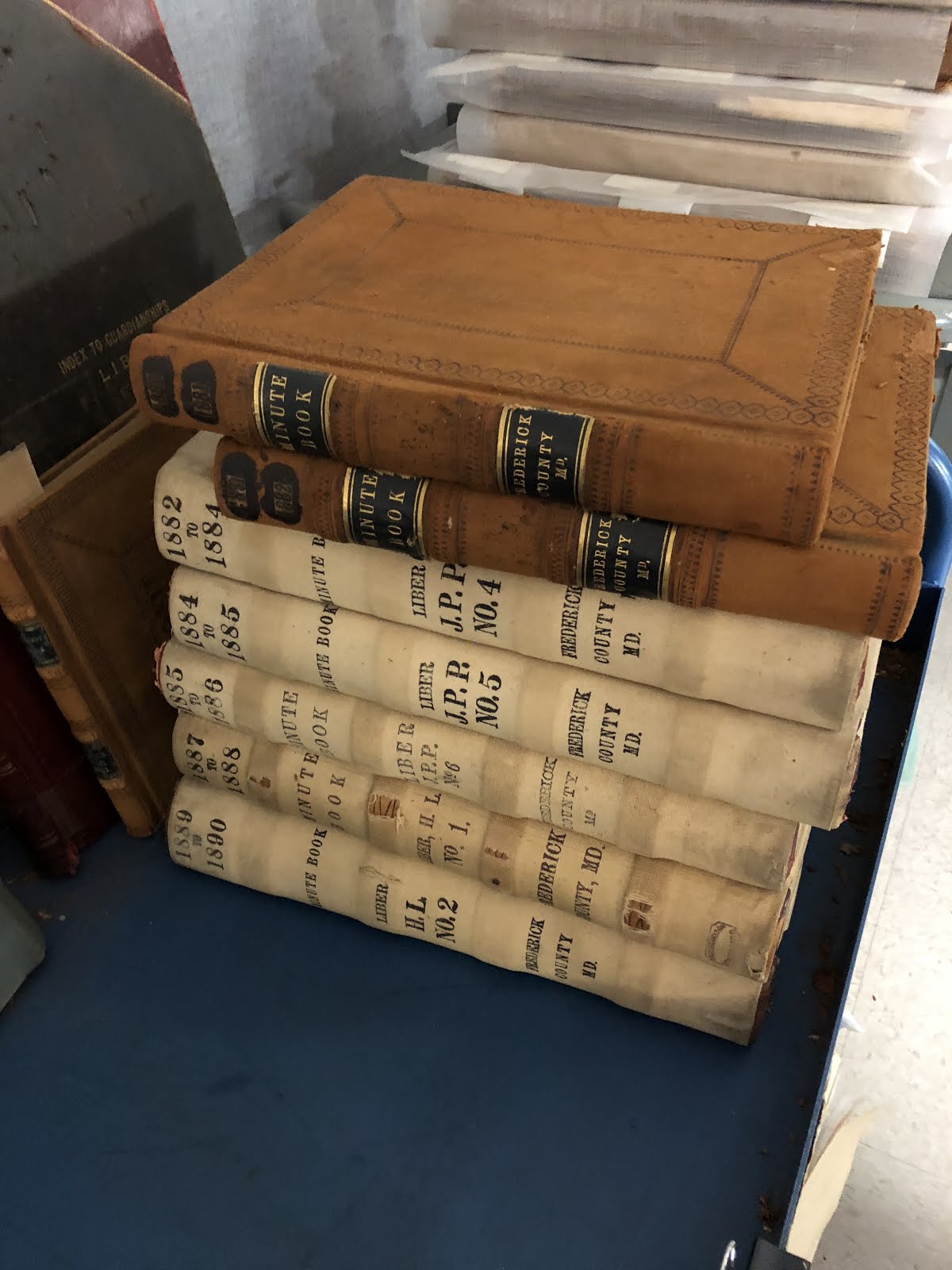
Following an enjoyable Christmas break spent with one of our daughters who lives near Washington, D.C., we got up very early to be at the Maryland State Archives at 7:00 am. By the way, it is very cold and dark here in Maryland at that hour in the Winter. We started out being trained to digitize large books of court records. Here is a sample of the type of books we are scanning:
The project is scheduled to last for quite a few years and so this is only one small increment of the endless stream of documents and books to digitize. We work about 8 hours a day for four days and about five hours on the fifth day. The goal is to work 40 hours a week.
Above, you can see the camera setup. The large lights are LEDs and are really bright. Ann and I have started wearing ball caps to cut down on the glare from the lights. When I mentioned that we were going to be working at the Maryland State Archives to someone I was talking to, the response was "how boring!" From my perspective no worthwhile work is boring. People determine whether or not they get bored. I do not get bored simply with repetition. In fact, I cannot get bored. If I have nothing to do at all, I usually go to sleep. But otherwise, I become absorbed in any activity, especially ones that have a goal.
These Maryland records are full of names of individuals who possibly can be found no other way than by looking at these records. I am not just digitizing a stack of books, I am assisting genealogists and family historians to find their ancestors. I may get physically tired, but I never get bored with working at genealogy. If you think of me sitting in the Family History Library looking at microfilm day after day, you can get some idea of my level of tolerance for repetitious family history activities.
Now, not all Senior full-time missionary activities involve repetitious activities. I have had friends who worked on Church history sites and spent their missions planting trees and flowers. There are many mission opportunities that involve physical labor outside doing construction, farming or other associated tasks. I happen to enjoy working with records.
Our first day went well and we managed to digitize three of the brown leather bound books which are shown above plus start a fourth. We are on our way to being productive. These books are Orphan Court Proceedings. More about the records later.


 Posts
Posts