Genealogy from the perspective of a member of The Church of Jesus Christ of Latter-day Saints (Mormon, LDS)

Monday, October 1, 2018

Still Waiting for the Golden Years: Dementia and Alzheimer's


First a few definitions. Dementia is the umbrella term for any chronic or persistent disorder of the mental processes caused by brain disease or injury and marked by memory disorders, personality changes, and impaired reasoning serious enough to interfere with daily life. Historically, it was often referred to as senility or mania and was considered to be a form of insanity. It was also called softening of the brain. Alzheimer's is a particular form of dementia. There are many forms or manifestations of dementia in addition to Alzheimer's. However, Alzheimer's is the most common cause of dementia and accounts for 60 percent to 80 percent of dementia cases.

Because dementia is a progressive disease and worsens over time, measuring the number of people who have the disease is nearly impossible but estimates range as high as 50 million people with about 10 million new cases every year. Here are some facts from the Alzheimer's Association website:
  • Alzheimer's is the 6th leading cause of death in the United States
  • 16.1 million Americans provide unpaid care for people with dementia
  • Between 2000 and 2015, deaths from heart disease had decreased by 11% while deaths from Alzheimer's have increased by 123%
I have had a very long and very involved experience both personally and professionally with dementia. Both my parents died of dementia-related disease and my wife's mother also died of dementia. I also worked as an attorney investigating and dealing with the issues associated with clients and potential clients with dementia-related problems including people who were the victims of exploitation and adult abuse. I spent about 15 years working directly with people with dementia and to become knowledgeable, I spent a considerable amount of time researching and studying all of the aspects of the diseases that fall into the category of dementia. 

The demographics of genealogists puts us squarely in the category of higher risk for dementia-related issues. I am certain that many of us have an unresolved, background concern that we may be next in succumbing to the disease.

Unfortunately, even though more than 25 years have passed since I first started to become acquainted with dementia, not a lot of progress has been made in curing the disease if it really is a disease that can be cured. Alzheimer's, for example, can only accurately be diagnosed after a person has died. 

One of the earliest signs of dementia is short-term memory loss. I have observed a marked decline in people's ability to operate a computer and I have subsequently seen that decline evolve into the full-blown symptoms of Alzheimer's. Using a computer with a window or graphical user interface requires multiple short-term related activities from remembering passwords to remembering where items are located when covered by open windows. Unfortunately, I also run into dementia-related symptoms when I am helping people work on a family tree due to the requirement that the person be able to remember information as they move through adding or correcting entries. I also suspect dementia-related issues when I see people add or correct the same information over and over again. 

All of these computer and genealogy related issues fall directly into the 10 categories of signs and symptoms listed by the Alzheimer's Association. I just see these symptoms more frequently because I am working with people all the time and helping them with their genealogical activities. 

From my own personal standpoint and because of my long experience with the progression of the disease, I am very sensitive to small changes in cognitive ability. Unfortunately, I can usually detect that person has a problem with dementia within a few minutes of talking to them or helping them with computer-related activities. I never say anything to the person or their family members unless specifically asked to make an evaluation. 

As an attorney, I have further observed that some of the side effects of dementia on family members and their relationships can suffer almost as much damage as the disease itself. 

Sunday, September 30, 2018

A Family History Mission: Down the Stretch


No. 84

Note: You can do a Google search for "A Family History Mission James Tanner" to see all the previous posts in this ongoing series. You can also search for "James Tanner genealogy" and find them or click back through all the posts.

The temperature began to drop here in Annapolis, Maryland. When we arrived in December 2017, the trees were bare and it was cold and snowy. We have watched the Winter end and the arrival of the new leaves and flowers. We have made it through the heat and high humidity of the Summer and are now seeing the first signs of leaves turning colors. We are used to the traffic and have become experts in using a combination of cars, buses, and trains to get to about anyplace we need to go. We have solved the challenges of stores, doctors, car repair, haircuts, and many others. We have gone through the transitions at the Maryland State Archives of missionaries coming and going. We have walked in the rain, snow, sleet, hail, wind, heat, and everything in between.

Even with all this, the Archives and the rest of living in Annapolis can still throw some challenges our way. This week the lights in our apartment complex went out after there was a loud bang. I guess I should be used to power outages, but I was surprised that we had one here in Maryland. I thought this was a developed part of the country. Anyway, the lights were back on in a couple of hours and we were back in civilization.

We said goodbye to one of the missionary couples and are looking forward to their replacements arriving within the next few days. We get some interesting questions from the missionaries who are trying to find out about what to expect. Apparently, some of the things they tell them and of course, told us, in the Missionary Training Center are not appropriate to Maryland, but we are interested to know why some of the missionaries would have those strange issues to deal with.

To review a little, we have four pairs of missionaries operating cameras at the Maryland State Archives. We also had one pair of missionaries assigned to doing preparation work, i.e. working with documents like those in the photo above. The missionaries that just left to go home were in charge of the preparation work so we have been making adjustments to reorganize our workflow so the preparation area gets the attention required by the Archives and necessary for doing the work.

We work about eight hours a day, five days a week and we are usually too tired to move by the time Friday rolls around. We have Saturdays to plan activities and have taken advantage of the museums and other attractions in the Washington, D.C. area. We have focused on helping members find their ancestors so they have names to take to the temples and this has been a highlight of our mission. We decided to attend the Spa Creek Branch (Spanish) and that has been a major part of our missionary experience. We really enjoy working with the members. I do feel sorry for the Senior Missionaries who do not take the time to become involved in doing their own family history and also do not take time to help the members.

Outside of the missionaries assigned to the Maryland State Archives, we have almost no contact with any of the other Senior Missionaries in the Washington, D.C. North Mission. We have had a couple of Mission Senior Activities, but that about sums up our contact. We have also had little contact with the young missionaries. We have been asked to do missionary apartment inspections and that will continue about monthly. The only young missionaries we see at all regularly are those assigned to the Branch we attend on Sunday.

We have to do all the things we would normally have to do to live. That is the bottom line of being a Senior Missionary. As you can tell from this post and all the preceding ones, we will not be coming back with a pile of photos of people smiling and waiting for baptism or smiling with investigators. Our experience has been challenging and interesting. We have had some amazing experiences. We will be leaving our mission right before Thanksgiving.

Thursday, September 27, 2018

Evaluating the Changes to the FamilySearch Family Tree


I have been working with the most recent changes made to the FamilySearch.org Family Tree now for some time and I thought it would be a good idea to evaluate the changes in terms of my previous experience.

The most obvious change is to the position and content of the menu bars on the Detail pages. There are now four different menu bars in addition to a side menu.
This is in addition to the menus in the upper right-hand corner of the screen.
OK, I am very familiar with the Family Tree program. I use it almost daily. Despite the recent changes, some of the most confusing issues of all these menus have been preserved. For example, there is a "Tree" menu item and a "View Tree" menu item. Despite the very similar names, they have completely different functions. The "Tree" menu item returns the user to the main Family Tree view and the "View Tree" item focuses the Family Tree on the principal individual who is selected in the Detail view.

In addition, the items in the menu bars #1 and #2 above, are a mixture of drop-down menus with several individual selections and links. Some of the link menus are duplicated in the drop-down menus. For example, there is a "Find" option in the Menu #1 Family Tree menu that is a duplicate of the Find link in Menu #2. The "Person" and "Lists" options are also duplicated between the two menus.

Redundancy in a program is not necessarily undesirable, but it can be confusing. I do not really use some of the options because even though they are more prominently featured, I simply have no use for those specific features. By the way, if you really want to see what is happening with your portion of the Family Tree, look at the Lists items and choose "Changes to people I'm watching." Here is my example.


Those 481 changes are only for September 2018.

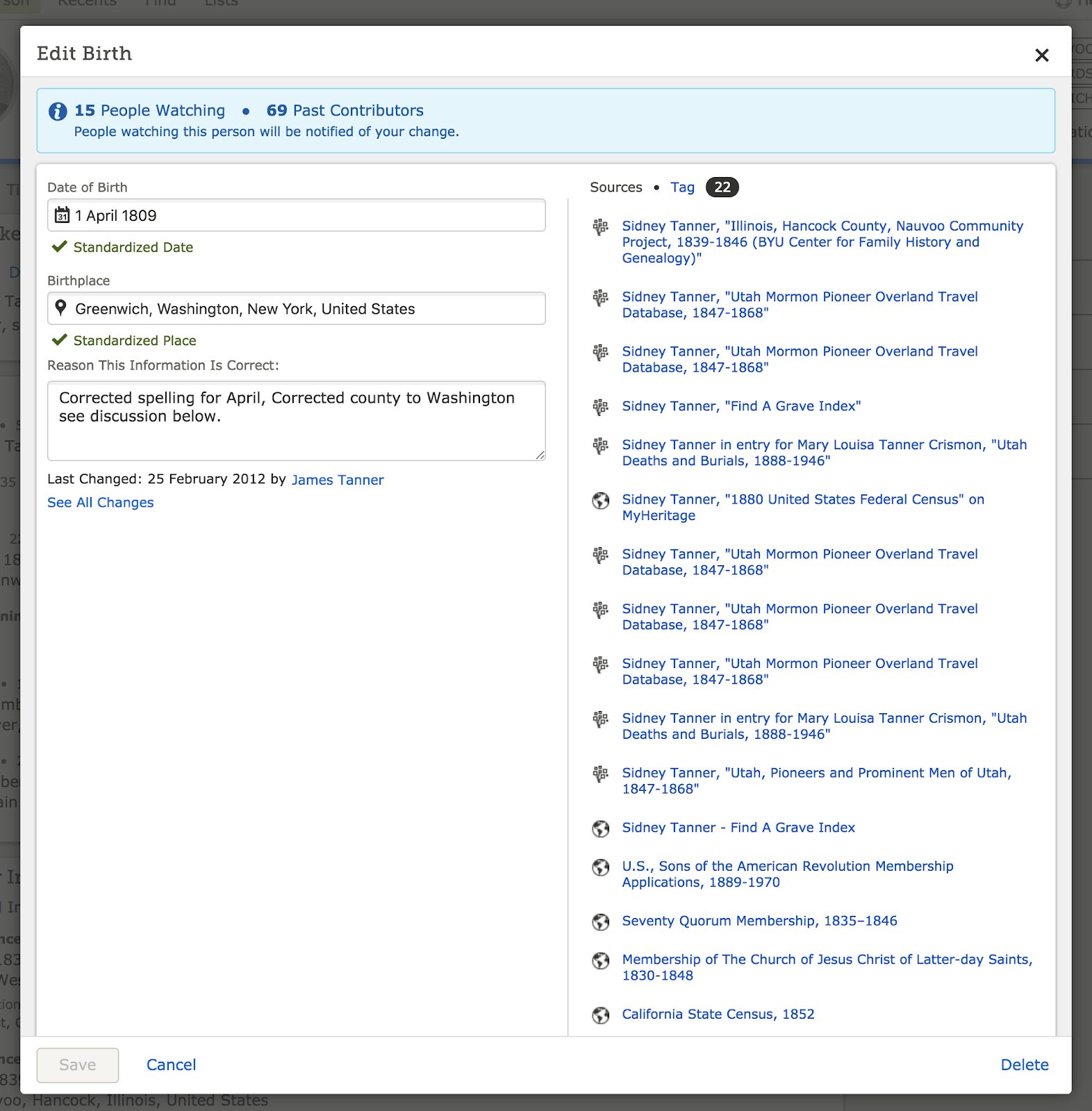
One change that makes my workflow more difficult is the fact that viewing Sources and Details are now on different pages, so I have to either have two windows open at the same time or switch back and forth to see the existing data.

The Time Line and its included map feature is a significant help. But I do not use it very often because it reflects work that has already been added to the program and I use maps to do research for records that are not yet added to the people in the Family Tree.

The rework of the details about each person is a neutral change. For me, it is not either more convenient or more difficult to use. I do like changes to the edit options.


Having all the sources for the entry readily available may possibly act as a deterrent to those who are trying to make changes without a supporting source. I am still getting used to the changes to the Standardization menu. I think it makes standardizing an entry easier but I am still not sure how it is supposed to work.


I will probably have a few more comments as time passes and I keep working on the Family Tree. Overall, it is a very useful and well-organized program. I like most of the changes and can live with the rest.


Monday, September 24, 2018

Still Waiting for the Golden Years: Living with Old People


Quoting the U.S. Census Bureau's article, "Sixty-five plus in the United States:"
America's elderly population is now growing at a moderate pace. But not too far into the future, the growth will become rapid. So rapid, in fact, that by the middle of the next century, it might be completely inaccurate to think of ourselves as a Nation of the young: there could be more persons who are elderly (65 or over) than young (14 or younger)!
According to the Census Bureau's "middle series" projections, the elderly population will more than double between now and the year 2050, to 80 million. By that year, as many as 1 in 5 Americans could be elderly. Most of this growth should occur between 2010 and 2030, when the "baby boom" generation enters their elderly years. During that period, the number of elderly will grow by an average of 2.8 percent annually. 
I do not think of myself as "elderly." But to most people under the age of 30 or so, I am positively ancient. I passed the Census Bureau's definition of elderly a very long time ago. However, one indication of my age is that many of people I have known for years are dying off and the pace of die-off seems to be increasing. When we return to Utah, we will be living in a state where the number of people in the Census category, i.e. over 65, is under 12%. In some states, like Florida, the percentage is over 14%.

I guess I will start thinking about being old when I decide to slow down and take life easy. Hmm. That is not likely to happen. So, when will I be old? One thing I can tell is that all the intense activities of my youth are culminating in a bundle of physical consequences that translate into pain. I have to guess at which of the injuries is presently causing pain; falling off of cliffs, avalanche, car accidents major and minor, skiing accidents, or just all around falls. At least I don't have any basketball or football injuries, just rock climbing, spelunking, water and snow skiing, and years of hiking on rough trails. When I fall, it is usually pretty spectacular.

Both of my parents died from dementia-related diseases so there is always a possibility that I will start having those kinds of problems. Basically, one of the major issues with getting older is that you start associating with old people. Old people are a lot easier to get along with than young people. At least they can relate to your challenges and viewpoint. But, as I have mentioned before, becoming old in the United States is essentially becoming invisible. I can literally have people walk into me because I am so invisible.

One thing I do not have to worry about is looking for a job. I have more than three strikes against me. Not just my age, but also my former occupation as an attorney and my advanced degrees. I don't think I could even qualify as a Walmart greeter. Plus smiling at people all day would probably drive me over the edge.

One of the major benefits of old age is that you have a better idea of what you like and what you don't like. In my case, another benefit is that I have been so many places and done so many things that I don't feel compelled to travel or make up for lost time. So, I will just keep writing and teaching as long as they will read and listen. That makes up for the age, by the way.


Sunday, September 23, 2018

#RootsTech 2019 is Coming Up Fast

RootsTech.org?cid=tp-rt-6517
RootsTech 2019 is coming up fast. Registration is now open and there is both Early Bird pricing and special pricing for Temple and Family History Consultants. For special pricing for Family History Callings see RootsTech 2019 Discounts for Family History Callings. The Conference begins on Wednesday, February 27 and runs through Saturday, March 2, 2019. In addition, here is the information about the annual Family Discovery Day:
As part of RootsTech, the Family History Department also hosts Family Discovery Day, a 1-day event to inspire you to discover, celebrate, and cherish family relationships. Family Discovery Day features inspiring devotionals from General Authorities, as well as breakout sessions taught by popular speakers from The Church of Jesus Christ of Latter-day Saints. Family Discovery Day begins on March 2, 2019, and will be streamed live on the LDS.org home page.
For more information about the Conference see RootsTech 2019.

Friday, September 21, 2018

A Family History Mission: Comings and Goings


No. 83

Note: You can do a Google search for "A Family History Mission James Tanner" to see all the previous posts in this ongoing series. You can also search for "James Tanner genealogy" and find them or click back through all the posts.

The reality of serving a full-time mission whether you are a Senior Missionary or a young missionary is that missionaries arrive and leave at different times. In attending the Spa Creek Branch (Spanish) we have seen quite a few changes in just the few months we have been here in Annapolis, Maryland. From the standpoint of the permanent members, missionaries are kind of like the weather, coming and going with the seasons. As Senior Missionaries, we get a longer view but we still come and go.

We have enjoyed working with six different pairs of Senior Missionaries while we have been working at the Maryland State Archives and we are about to have another change this coming week. It is amazing how dedicated and persistent these older couples have been. Each individual has had challenges but despite personal losses of family members, illnesses, aches, and pains, they keep working day after day.

One thing I can say for sure, the experience of being here is nothing at all like I worried about or expected. Because of my involvement in genealogy, being here in Annapolis has been more of a continuation of my previous involvement than a complete change. We have spent a great deal of our time helping the local members and other missionaries and even people outside of the mission across the world with finding their ancestors for Temple work. We have also managed to have some involvement with the local genealogical societies. I still have a number of webinars and classes to teach before we leave to return home to Provo, Utah.

Surprisingly, time does pass and we are no thinking about the process of returning home to the mountains, which, by the way, seem to be burning up right now. The process of moving across the country does not get any easier from an apartment than it does from your home. We are still fighting with the U.S. Post Office. In fact, we got a junk mail letter sent to the apartment we never lived in that was addressed to my mother who has been dead for ten years. Figure that out.

If you have ever thought about going on a full-time Senior Mission, take the thought seriously. It is a marvelous opportunity. I can assure you that your family will survive your leaving them and you will have some wonderful, but perhaps difficult, experiences.

During my time here, I have been in contact with some friends from Mesa, Arizona who are serving a Temple Mission in Mexico. They have been having a dramatically different time than we have had. Our work here is more routine since we work eight hours a day, five days a week. They have a more "people-oriented" mission while ours is directed at our work of digitizing documents.

On our free days, mainly Saturdays, we have had a lot of opportunities to explore the Washington, D.C. museums and other attractions. For genealogists, we got to visit the National Archives and have in-depth visits to the Library of Congress. We have learned how to drive and ride the Metro here in Maryland and D.C. and had a lot of very interesting experiences. We have had several visits from our children and their families and many other great experiences.

All in all, it has been worth the time and the effort. 

Wednesday, September 19, 2018

Improved Ordinance Finding App on FamilySearch.org

https://www.familysearch.org/blog/en/temple-ordinances-familysearch/
Automated finding and document searching aids are a boon to genealogists who are actively searching for opportunities to take family names to the temples. But these suggested connections still rely on the accuracy of the information already in the FamilySearch.org Family Tree. This recent announcement by FamilySearch indicates that they are getting the message about the need to improve the accuracy of these automated suggestions. I strongly suggest reading the entire blog post linked above so that you can understand what is available. 

If you have a huge number of ancestors on the Family Tree like I do, you may wish to spend some time verifying the information for any of the suggested opportunities. Here is an example of one of my suggested opportunities recently.


Here is the reality of that entry.


You can see that there is a lot more to the story than just showing a pretty icon.