Genealogy from the perspective of a member of The Church of Jesus Christ of Latter-day Saints (Mormon, LDS)

Friday, March 29, 2019

The Countries Knolwdgebase: The Family History Guide becomes even more valuable

https://thefhguide.com/research.html
One thing that The Family History Guide does for those of us who are searching for our ancestors is to organize and structure the online world of genealogy and family history in a way that we do not need to guess where to go or what to do next. For example, at last count, I have posted 11,419 blog posts not counting Facebook, Twitter, LinkedIn, Instagram, and Pinterest posts. There are 89.103 Wiki articles on the FamilySearch Research Wiki. There are 5,827,000+ articles in English on Wikipedia.org and a search for the word "genealogy" finds 50,824 articles. This is just scratching the surface of some of the information that is available online.

Think about it. Jointly, the large online genealogy database companies have billions and billions of records. Where do you start? How do you begin to understand what is available and how to learn all that there is to know? Well, those of us who are working on The Family History Guide are trying to organize and present all that information in a way that you can systematically progress and learn what it is that makes a good genealogical researcher along the way. The KnowledgeBase on The Family History Guide is part of the solution to the challenge of learning.

You can read more about the KnowledgeBase, presently being developed and implemented, from this article:

Introducing the Countries Knowledgebase
What is The Family History Guide? From one standpoint, it is a structured and sequenced way to learn about genealogy and family history by organizing thousands of links to online sources of information. But it is really a way to help everyone who uses the website to appreciate the core values of family, home, and heritage that go to make up the best of what we have to offer the world as human beings.

What is even more incredible is that the entire website with all of its linked resources is absolutely free. It only becomes available because of volunteers who spend their time and energy making it available. How can you help? Simple, you can donate to the whole operation through The Family History Guide Association.

https://www.thefhguide.com/association.html
You can also tell others about The Family History Guide website by sharing this post on all forms of social media and by talking about it to your friends and relatives.

Thursday, March 28, 2019

A Short Introduction to Geneanet.org


You may or may not have noticed but FamilySearch.org has a new partner listed on each individual's detail page; Geneanet.org.  Who is this newcomer to the list of websites that can be automatically searched from the FamilySearch.org Family Tree? Here is a brief explanation from their website:
Launched in 1996 by genealogy enthusiasts, Geneanet is a community of more than 3 million members who share their genealogical information for free: more than 6 billion individuals in the family trees, some digitized archival records, some family pictures, some indexes, all available through a powerful search engine, and a blog. 
The Premium subscription offers additional options, including an advanced search engine, and to access hundreds of million of indexes provided by our partners. 
The Geneanet team is passionate about genealogy and emerging technologies. And at Geneanet, genealogy is almost a family affair as several team members have common ancestors!
Members of The Church of Jesus Christ of Latter-day Saints have a free subscription to the website because of the FamilySearch partnership agreement.

https://partners.familysearch.org/solutionsgallery/s/gallery-profile/a2Rf10000079nuHEAQ/00063

The link for logging on with your LDS Account is available on the Solutions Gallery at the bottom of the pages on the FamilySearch.org website. Members qualify for the Geneanet Premium Subscription.

Geneanet.org has a huge searchable collection of French and other European records called the Genealogy Library containing over 3 billion indexed individuals in old books, academic journals, newspapers, obituaries, and hundreds of thousands of documents. You can search for the names of your ancestors. These resources come from all over the world from places you may never have seen documents previously. Here is a search of just the newspapers and magazine titles.


Here is a part of the list of collections:


The website is particularly helpful in searching for French ancestors.


The website has a lot of other projects and resources and is certainly worth investigating. You can also put a family tree up on the website and receive record hints from the website.


Wednesday, March 27, 2019

Using the Ordinances Ready App to Find Research Opportunities


The Ordinances Ready App can obviously be used to find available ordinances from the names of people in the Family Tree or people who have already been found and shared with the temples. But there is a way to use the app to find research opportunities in the Family Tree that could find many more of your ancestors and relatives. By applying these procedures, the Ordinance Ready App becomes a powerful finding tool for locating areas in the Family Tree that need research and could result in adding many more individuals to the Family Tree. 

The first step is simple. Choose one of the ordinance types and view the results. Here is one of the names I found in the list for potential baptisms.


Next, you need to view your relationship to this person. Here is my relationship to this person. 


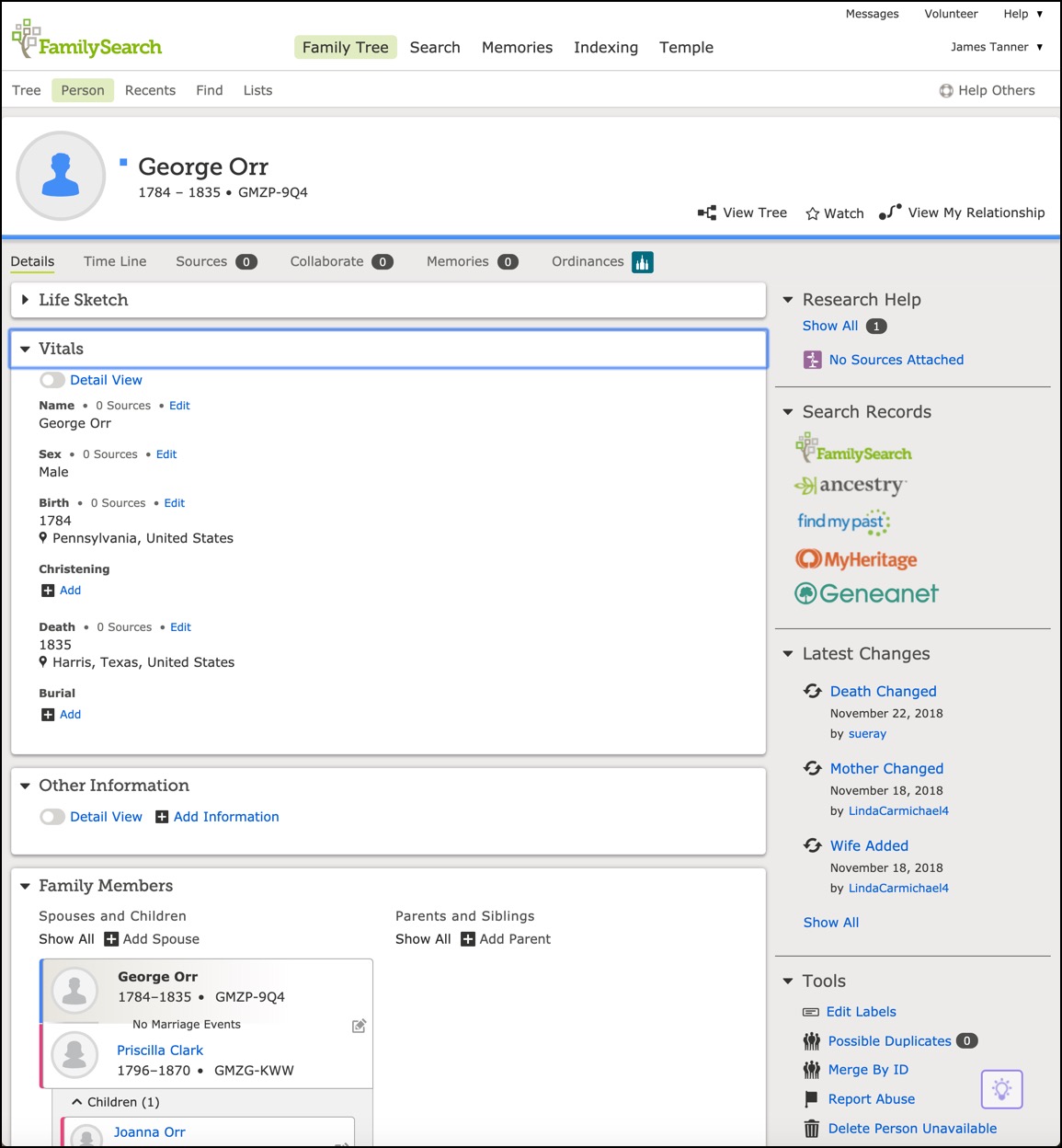
He is married to one of my distant cousins. I always spend some time looking at the way I am related to these people to determine if there is a real connection. In this case, there are ample sources documenting this family's relationship to me. Here is the individual's Detail Page.


What is interesting about this family? Well, the father, George Orr, was found and added to the family tree a short time ago and then the ordinances were shared with the Temple. That is how I got his name suggested to me from the Ordinances Ready program. What else is interesting? His wife, my cousin, was also found and her ordinances were also shared with the Temple. What is missing? There is only one child listed. Granted, George Orr died in 1835 the same year that his daughter was born, but what happened to the daughter and the wife?

All this suggests that there is some research that could be done. Why be satisfied with one name to take to the Temple? Why not do some research and find the rest of this family? All provided courtesy of the Ordinances Ready App. In fact, I have counted up over 20 available ordinances from this family. 

Sunday, March 24, 2019

Six Things You Should Know About the Ordinances Ready App

https://www.familysearch.org/blog/en/ordinances-ready/
The new Ordinances Ready app has engendered a fair amount of discussion among the active genealogist and family historians in The Church of Jesus Christ of Latter-day Saints. I have decided that a lot of the discussion originates from a lack of understanding about the app itself. I decided there are at least five major issues that underlie developing an appreciation for what the Ordinances Ready app is apparently intended to accomplish. The following are mostly my own opinion but that opinion is based on how the app works and some of the existing challenges with the FamilySearch.org Family Tree.

If you need an introduction to the Ordinances Ready App, I suggest reading "Ordinances Ready: FamilySearch App Feature Helps Find Temple Ordinances for Your Ancestors" and for further questions about the app I suggest two of my previous blog posts: "A Question about the Ordinances Ready App" and "How Reliable is the Ordinances Ready App?"

1. The Ordinances Ready App is structured to resolve two main challenges: how to get more individuals in the Church to become involved in the Family Tree and how to begin to reduce the surplus of user-submitted names waiting to be processed in the Temples. The first challenge is addressed by the fact that the app is intended to be used by each person individually to discover some ancestors or relatives that likely need the Temple ordinances. Each individual should take the time to click on the names provided and see how they are related and also learn about each of the people. To answer the second challenge the app is designed to choose names as follows (based a slide used by Ron Tanner at one of his RootsTech presentations).

1. Pulled from your own reservation list
2. Pulled from your own names that you have shared with the Global Temple List
3. Pulled names from people with whom you are related from the Global Temple List
4. Pulled from names found by searching up and down your own family lines (green icons)
5. An ancestor from the Global Temple List

In order to do this, the app will also consider the following:

  • Ignore people who are subject to the 110-year rule
  • Verify that the name qualifies for temple ordinance work
  • Verify no possible duplicates
If you do select a name and leave it on your Temple list, the names will expire after 90 days, i.e. they will go back to the Global Temple List. Further, as far as possible the names will be added from your own Temple District. 

2. One of the problems I frequently see with the Family Tree and hear about from others is that people who have little or no knowledge of how it works or what is required are making changes. If this group of people does not feel compelled to "mess with the Family Tree" in order to "find a name to take to the Temple." Although the Ordinances Ready App is not specifically designed to discourage people from working with the Family Tree, it may have the effect of cutting down on the number of people, especially young people, who feel like they have to do something without knowing what they are doing. 

3. The Ordinances Ready app works with the online mobile app called the FamilySearch Tree. Although the FamilySearch Tree app does much of what the main FamilySearch.org Family Tree can do, it is limited and adding random names is not as easily done as it is on the desktop Family Tree. In addition, the FamilySearch Tree app is available to a rapidly growing number of people who only have access to the internet with a mobile smartphone. 

4. The Ordinances Ready app opens up a whole new way to discover areas in your part of the Family Tree that may be "ripe" for research. When you find a name of a person that needs Temple ordinances, you are already in a part of the Family Tree where either work is being done to add names or where no work has been done for years, either way, you know that the family where this name was found is where some work on the Family Tree needs to be done. 

5. You no longer have to feel the burden of maintaining a long list of people in your own Temple List. You can release those names to the temples and know that they will then become priority names for all of your relatives who use the Ordinances Ready app. Also, you do not need to worry about providing names for your family members. They are supposed to go onto the Ordinances Ready app and get their own names, even the younger members of your family. Also, there is no need to feel like you are pressured to supply names for a youth group or your entire Ward. Again, each individual should log onto the program and use the app to find their own names to take to the temple. 

6. The names produced by the Ordinances Ready App are not verified by FamilySearch or anyone else including the Church. You are responsible to make sure that the person actually exists and is not a duplicate. If you do the ordinance work without checking, you may be doing a duplicate. Although the app checks for duplicates, there are still duplicates that the program cannot find but may be obvious with some work. 

If you work through all your issues with clicking on green icons or duplicates, you will see that the Ordinances Ready app is designed to avoid both those issues as far as it is possible to do so today. 


Friday, March 22, 2019

Evaluating "errors" in the FamilySearch Family Tree


Unfortunately, the situation shown above with this screenshot for John Andrew b. 1700 is quite common. The FamilySearch.org Family Tree is liberally sprinkled with red icons and the purple ones also that say "No sources attached." But does this particular entry represent an error? Yes, if we considered entering information without a source an error and we define an "error" as information added to the Family Tree either without a source or failing to properly reflect the information contained in the source. But is this particular entry an error? In this case, there is also a blue icon indicating that there is a record hint. What does the record hint say?

This entry would only be an error if there was a record that showed that the information was incorrect. As the record stands, with no sources, it is not possible to determine if the information is correct or not. So, we look at the Record Hints. Here is what the Detail page for this person looks like before checking the Record Hints.


There are four record hints altogether. Here is a screenshot of the Research Helps page for the same person.


This page shows that the items marked by the red icons are a possible duplicate (a new addition to the Data Problems world on the Family Tree) and a missing standardization. So now, if I check the Record Hints, standardize the record and add a source or two or more, the existing information may be confirmed (no error), changed (errors), or detached (wrong family connection).

First, I look at the possible duplicate. It looks like the same people with the same child. But by merging the people, I create two more duplicates with the wife and child. The merged record still has no sources, but I need to merge the other two duplicate entries. Merging the duplicate for the wife, Alice, produces more duplicates and so forth. By the way, none of the duplicate entries have sources yet.

Time passes. I finally got through the duplicates. All of the entries seem to have cleared up. Every one of the people in the Family Tree now have sources. The only problem left is that the relationship between Edward Andrews or Andrew is not established by any source. All the people lived in the same very small area of England, but that is the only connection so far. But so far, there were no errors just a lack of information. This isn't always the case but it is possible that with some additional research the entire family can be cleaned up.


Tuesday, March 19, 2019

Please train your Temple and Family History Consultants

https://www.lds.org/family-history/video/2019-family-history-leadership-session
With all the changes for the members of The Church of Jesus Christ of Latter-day Saints, it is interesting to me how little attention is being paid to the 2019 Temple and Family History Leadership Instruction by some of the local leaders of the Church. The presentation by Elder Dale G. Renlund was particularly graphic about the need for Temple and Family History Consultants to be integrated into the Ward leadership structure and to be trained about the duties of their callings. The training materials have been available for quite some time and are being updated regularly.

As I have observed many times previously, Family History Consultants now Temple and Family History Consultants have been essentially ignored in many local Wards around the United States and into Canada. Elder Renlund's comments about Temple and Family History Consultants was right on point. Family history is often viewed as a subsidiary and purely optional activity by Ward and Stake leaders. There are, of course, some outstanding exceptions but often family history is considered as just one more thing that needs to be done sometime in the future.

Because of the worldwide nature of the Church, the current emphasis is on the FamilySearch mobile apps. It is probable that not only the Temple and Family History Consultants may need training on these apps but also any older members of wards and stakes need to be trained also. I am also finding a considerable amount of misunderstanding about the introduction of the Ordinances Ready feature of the FamilySearch.org website and of the FamilySearch Tree app also.

I am certain that there will be many changes in the future and I'm hoping that the details of these changes are not lost. In case you need some links to the available training for Temple and Family History Consultants here is a partial list:

And many more. There is really no excuse for the ignoring family history in the Wards and Stakes. 


Sunday, March 17, 2019

What Has Changed on the FamilySearch Family Tree? Part One


At RootsTech 2019, I attended two presentations by Ron Tanner, the Director of Product Management at FamilySearch. He outlined a number of recent changes to the FamilySearch.org website and particularly to the Family Tree. I decided to dig into the website and see some of the changes for myself and, of course, write about them. I am sure I will miss some and find some older changes that I just didn't know about before writing. Because I use the Family Tree and the rest of the website almost daily if I haven't seen something, you might not have seen it also. So bear with me if I am being a slow observer. Also, this exploration effort will probably take a while so there will be a series.

Some of the new features may only be visible to those users who are members of The Church of Jesus Christ of Latter-day Saints. Since I am a registered user I tried turning off the link to LDS Resources in the settings menu to see what happened. But I found that it still presented everything the same except features having to do with the Temples were not visible. If you are not a member, just bear in mind that some of the things I talk about may not be visible.

One thing I can say about the subject of changes to the FamilySearch.org website is that many of the changes are unannounced and not obvious. There is a FamilySearch blog page about "What's New at FamilySearch" but those articles don't list everything. So expect some digging and some old and new features.

https://www.familysearch.org/blog/en/category/about-familysearch/whats-new-at-familysearch/
Here it goes... (in no particular order)

New Discovery Experiences

These featured experiences are based on the Family Discovery Center activities located in certain Family History Centers including a new one in Lehi, Utah and the one at the main Family History Library in Salt Lake City, Utah. Here is a screenshot from the website.

https://www.familysearch.org/discovery/
If you register and sign in, the Family History Activities are personalized to show your own family history. Presently, when you do sign in, your personalized startup page has a link to the activities. You may wish to try out each one.

New Temple and Family History Consultant Training

https://www.familysearch.org/ask/planner/calling

This page has actually been online for a while. It is part of the Helper Resources that are on the page renamed from the Consultant Planner. That page has also been redone. Here is a screenshot of the new Helper Resources page:

https://www.familysearch.org/help/helper
This page is still accessed from a pull-down menu link on the Help Center in the far upper right-hand side of each page. What happened to the fan chart? It was incorporated into the fan chart view on every detail page for the Family Tree. The fan chart can also be extended out to seven generations.


The view options are in the box on the upper left.

Tune in again for more of the new features of the FamilySearch.org website.