Genealogy from the perspective of a member of The Church of Jesus Christ of Latter-day Saints (Mormon, LDS)

Monday, April 29, 2019

Still Looking for Those Golden Years: Targeted Advertising


There is a lot of online chatter about "targeted advertising" or "targeted marketing." Here is a brief definition from Marketing-Schools.org.
Targeted marketing identifies an audience likely to buy services or products and promotes those services or products to that audience. Once these key groups are recognized, companies develop marketing campaigns and specific products for those preferred market segments.
The internet has essentially revolutionized marketing in general but targeted marketing is constantly being blamed for a significant portion of the world's ills. Those of us in our "golden years" either op out by turning off social networking and other media or learn how to ignore the floods of supposedly targeted advertisements we see and sometime hear every day.

I find it interesting that if I look at a product on Amazon.com, for example, within minutes I find advertisements for the same or a similar product everywhere I look online. There is an inherent assumption by the marketing companies, Amazon included, that looking for a product online automatically means that you are interested in buying that particular item. I am often tempted to go look at random items just to watch the advertising lockstep and produce ads for random products that I an not at all interested in purchasing. This is junk mail with a vengeance factor added.

Of course, what we call junk mail was targeted advertising all along. By the way, we have seen some interesting junk mail lately here in Provo, Utah. I am getting junk mail for my mother at my address. She never lived with us and certainly never lived in Provo. She also died more than ten years ago. I also get random junk mail for some of my children who left home long enough ago to have their own children graduating from universities. The assumption that blanket "targeted" advertising is effective is based on statistical market analysis. Here is another quote from the Marketing-Schoold.org website that illustrates this issue.
For example, Starbucks currently holds the largest market share of the coffee industry in the United States. The company focuses its advertising on women and men between the ages of 25 and 40 who live in urban areas, have moderately high income and professional careers, and demonstrate an interest in fair trade and social welfare. Starbucks bets that these key groups are more likely to spend money on specialty coffee drinks and products.
[Can you find the typo in this quote?] This is called ad hoc reasoning or after this, because of this.  Basically, targeted marketing assumes that people make decisions at the level of a herd of cows. One of my own examples of this level of marketing is what happens when I but a product. For example, let's suppose I buy a certain brand of flash drive. I immediately get advertising for the product I just purchased. Why would I want to buy another flash drive? Even if I did want another flash drive, I would probably do what I always do and compare prices and products and buy the best I could find for my next purchase. The product may or may not be the same as my original purchase.

So, are all of the people in the world just mindless consumer cows? Do we all buy exactly what our current targeted advertising says we should buy? I recently wrote a post that included a reference to hearing aids. I am now getting a flood of hearing aid advertisements. How many pairs of hearing aids am I likely to purchase?

If our society has evolved into a herd of mindless purchasers who pick up whatever is advertised on Facebook or Instagram, we are in a sorry state. By the way, I will probably write about this subject again because I am noticing a significant number of ads on Facebook for bogus products that the companies have no intent on ever actually producing and because I read the comments, I am also seeing a lot of shoddy and falsely advertised products. Caveat Emptor.

Saturday, April 27, 2019

Audio added to Photos on FamilySearch Memories


You should note that on your FamilySearch.org Memories, you can now add an audio file. You can add audio to photos you upload on both the FamilySearch.org website and the FamilySearch apps. Instructions for using the audio recordings are on this blog post.

https://www.familysearch.org/blog/en/add-audio-to-picture/

Thursday, April 25, 2019

Exploring Genealogy Series #4: Descendancy Explorer


Exploring Genealogy Series #4 Descendancy Explorer

This Exploring Genealogy Series is about all of the different concepts, ideas, apps, programs, methodologies, and hardware that goes into doing genealogical research. Some of the topics I would like to explore are almost impossible to write about. Hence, the idea of talking my way through videos. You can find what I am doing on my own YouTube Channel.

https://www.youtube.com/channel/UC4cT2_EjTMVVJgaF5Gdwl1Q?view_as=subscriber
You can subscribe to the Channel and get notified (or not) about upcoming videos. As I have already noted in previous blog posts, doing a video saves me an enormous amount of time. Doing genealogy-related videos will never get me listed as a YouTube star. If you really want to know how popular genealogy is as an activity, just look at the number of views of genealogy-related videos. There is only one genealogy entity that produces videos with more than a million views and that is the heavily advertised Ancestry.com.  The most popular video from FamilySearch.org has about 642 thousand views. But the second most popular video has 287 thousand views. These are some of the big hitters in genealogy. MyHeritage.com has two videos with over a million views. But what about the genealogists with YouTube Channels? You can check out the totals for yourself just look at the video tab and then sort the videos by popularity. 

How does that stack up to the YouTube stars? Lindsey Sterling can get over 2 million views in four months. Her videos have had over 2.5 billion views. The currently most popular YouTube Channel has over 94 billion views. 

What if I had started out with a more popular topic? Well, that is the problem about being a fanatic about a subject.

Anyway, if you think of a topic let me know what you would like me to put up on my channel. 

Wednesday, April 24, 2019

The Family History Guide adds the FamilySearch Memories App

https://www.thefhguide.com/blog/family-tree-memories-app-and-the-family-history-guide/?utm_source=The+Family+History+Guide+Association+Blog+Main&utm_campaign=71aa1a8b04-RSS_EMAIL_CAMPAIGN&utm_medium=email&utm_term=0_41be9f9d3a-71aa1a8b04-283099673
Here is the notice from The Family History Guide about the addition of instructions for the FamilySearch Memories App.
A few weeks ago we announced a new Project for the Family Tree app on The Family History Guide website. Now it’s time to introduce the Project for the sister app: Family Tree Memories. You can find this Project at the bottom of the FamilySearch learning path, in the top menu. 
Here’s a summary of the Goals in the Memories App Project:
As you would expect, there are Choices, Steps, Exercises, and Online Tracker entries for each of these Goals, as well as helpful screenshots to guide you through tasks.

We hope you enjoy the new Memories App Project in The Family History Guide. It’s a great companion to the Family Tree App, and it makes creating and uploading memories literally a snap!

Does Anyone Get Lost in the FamilySearch Family Tree?


I have been noticing that many users of the FamilySearch.org Family Tree agonize over the issue of removing a wrongfully attached child or spouse. The situation is usually that the children or one or both parents listed in a family are not supported by any records or there are records, such as a census record, that do not show them as being part of that particular family. As shown by the image above, there is always the option of removing or replacing any individual in the Family Tree. But when should you do this?

The example above is not one of those removal or replacement issues. There are several sources listed supporting the relationships. But if I work my way out on this particular line, I will inevitably run into the issue of whether or not an entry is supported by the existing sources listed in the Family Tree. Here is an example.


Samuel Linton (b. 1775) is shown as married to Margaret McBride (b. 1773). Samuel is shown as born in County Down, Ireland and his wife, Margaret, is shown as being born in County Tyrone, Ireland.  Tyrone and Down are about 100 miles apart. The only source cited for Samuel is a Family Group Record that cites "Family Records" as a source. Here is the Family Group Record (FGR).


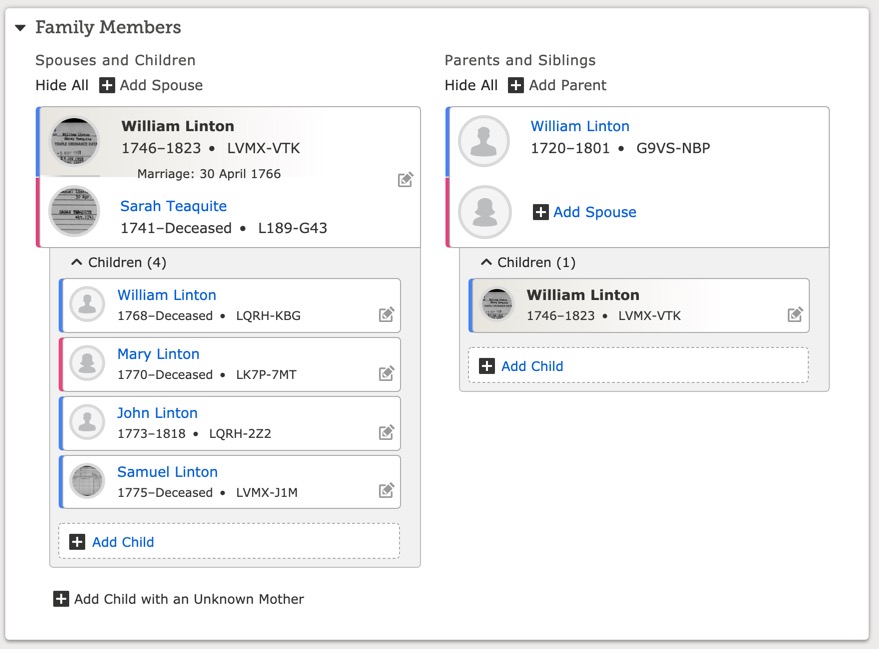
However, the birth date listed for the Samuel Linton on this FGR is about 1769. There is nothing that shows how his parents William and Sarah got together while living so far apart in the mid-1700s. William Linton (b. 1746, d. 1823) is married to Sarah Teaquite (b. 1741). William is supposedly born in County Down and Sarah is born in County Tyrone. Their four children are shown as follows:


The first child listed is supposedly born in County Derry, Ireland. The sources listed for this William Linton (b. 1768) are two marriage records showing he married Jane Mathers 30 January 1794 in Philadelphia, Philadelphia, Pennsylvania.

I could go on and on, but it appears that there are no records that support any of these marriages or child/parent relationships. But what happens if I start detaching all these people from these families? What if all of the temple ordinances have been done? (Which they have).

Well, it turns out that my direct line ancestor is the Samuel Linton (b. 1775) and there are no sources at all identifying his parents. So what if I simply detach him from this family? What about the ordinances?

Whether or not the ordinances were done for the wrong family configuration does not affect the validity of the personal ordinances done such as baptism etc. The only issue is that the sealing ordinances we need to be redone if the correct people are finally identified. If I were to detach Samuel Linton (b. 1775) from his parents as shown, then these parents would still be in the Family Tree and available if someone were to find a supported relationship. In short, no one is every "lost" in the Family Tree, an individual may not be attached to anyone or a short or long family line may not be attached, but these bits and pieces are still out there waiting for research that can show how they should be attached. If these people's individual ordinances have been done, then the ordinances are valid, but any invalid sealing ordinances would have to be redone if the correct relationships were identified. By the way, if a child is sealed to the wrong parents, the child is still technically sealed. The sealing to parents ordinance is like baptism, it is an individual ordinance. But almost always, the sealing ordinance will be redone when the correct parents are identified.

What about the mess I outline above? Well, from my standpoint, this line ends with William Linton (b. 1801) in Ardstraw, Tyrone, Ireland. Why don't I detach him from his parents as shown? The real reason is simple. I don't have any records showing anything different. So until I can find a record showing who William's parents actually were, I can either choose to detach the unsupported ancestors or not. But if I did detach them and they were later shown to be correct, they would still be out there in the Family Tree ready to be re-attached and their ordinances would still be done.

Sunday, April 21, 2019

Can there really be that many birth names on the FamilySearch Family Tree

Names blurred out 
Why do some of the entries in the FamilySearch.org Family Tree have so many entries for an individual's "Birth Name?"

The answer is somewhat complex, but before I get into the issue of multiple birth names, it is important to understand what the "birth name" should be and where it should be entered. The birth name should be the name given at birth. Hmm. This almost sounds like a new rule to add to my list. But this rule needs to be qualified to actually work. Here is the next part of the rule: If there is no birth record available, then the "birth name" used is the name appearing on the earliest known record or source. When I say "earliest" I mean in time. So, if the only record of the person's name was on a grave marker, then that would be the earliest known record.

What if the name on the birth record is wrong? Again hmm. If it is the name that is on the earliest known record why would you conclude that it was "wrong?" What if the person changed their name? What if the person didn't like the name and didn't ever use the name? All that and more. Back to the rule: The birth name is the name given on the earliest known record. If there are subsequent names in subsequent records then they should all be listed as Alternative Names or Nicknames. What if the only name recorded is Betty or Betsy? Can we assume that the person's name was Elizabeth? No. Not unless there is a record showing that the name was recorded as Elizabeth in the earliest known document.

Now, what about all these "Birth Name" entries on the FamilySearch.org Family Tree? These entries are merely a default way of recording all the differences in all the entries made for that person over the long years since people started giving records to FamilySearch and all of its predecessors. It is up to you figure out which one was the one used in the earliest record. But what if there are no sources citing records? Then all the names may be alternate spellings or even the names of other people. If alternate names show up in records and are added as sources to the Family Tree then add the records as "Alternate Names" and designate which record or document produced the alternate names.

IN EVERY CASE, THE ONLY "BIRTH NAME" THAT SHOULD BE SHOWN OR RECORDED IS THE ONE THAT IS ENTERED IN THE "NAME" SECTION OF THE VITALS SECTION OF THE PERSON PAGE.

All other names, whatever their origin, should be recorded in the Other Information Section as Alternative Names. If you do not have a source for the alternative name then explain where you got it or that you made it up but don't call it a birth name.

What do I do with the long lists of Birth Names? I delete them as duplicates unless they are supported by a record and then I change the designation to reflect why the alternate name exists.

Saturday, April 20, 2019

Exploring Genealogy Series #3: Relative Finder


Exploring Genealogy Series #3 Relative Finder

You will probably notice that this is the third video in this series. The reason is that I am adding videos to my blog posts on both Genealogy's Star blog and this Rejoice, and be exceeding glad... blog. I have decided that since I spent so much time learning how the video programs, such as Adobe's Premiere Pro 2019 work, that I would take advantage of my new skills and turn blog posts into videos.

Of course, I will still have videos in the form of webinars from the Brigham Young University Family History Library and they will be posted on the Library's YouTube Channel. In a sense, I guess I am competing with myself, but I am sure all of you out there can sort things out. But just think, I might do as many videos as I have blog posts. Maybe YouTube will collapse under the weight of all my videos.

By the way, I am also doing videos for The Family History Guide. See if you can guess which ones they are. I will give you a hint, they have a computer-generated narrator voice.

Stay tuned as I always say.