Genealogy from the perspective of a member of The Church of Jesus Christ of Latter-day Saints (Mormon, LDS)

Saturday, April 11, 2015

5 Steps to Success in Family History

If you feel the need to find a family name to take to the Temple because of a Ward or Stake challenge or simply because of your own feelings, how do you go about finding a new ancestor who has not been found before?

The answer to this question is easily stated: you identify an ancestor or other relative by searching historical records, you then add them to the FamilySearch.org Family Tree and reserve the names of those needing Temple Ordinances. You then print off a Family Ordinance Request (FOR) and take that sheet to the Temple where the ordinance cards can be printed.

Getting to the point where you find an ancestor or other relative to add to the Family Tree is the challenge. With the new tools provided by FamilySearch.org, my experience is that you can be successful in finding new names for the Family Tree if you follow these five steps. For some, the challenge is greater than others due to particular family circumstances. But some obstacles such as those ancestors who are orphans, have children born out of wedlock or other such circumstances can, with effort, may possibly be overcome.

First some definitions. We refer to those from whom we are descended as our "ancestors." It is convenient to think of these people as those in your bloodline or as direct line ancestors. The word "relatives" is a more general term that includes all of those people who are related to you through both blood lines and marriage. Currently, the rules for submitting names to the Temple include the following: (See Individuals for whom I can request temple ordinances)
You are responsible to submit names of the following individuals:
  • Immediate family members
  • Direct-line ancestors (parents, grandparents, great-grandparents, and so on, and their families).
You may also submit the names of the following individuals:
  • Biological, adoptive, and foster family lines connected to your family.
  • Collateral family lines (uncles, aunts, cousins, and their families).
  • Descendants of your ancestors.
  • Your own descendants.
  • Possible ancestors, meaning individuals who have a probable family relationship that cannot be verified because the records are inadequate, such as those who have the same last name and resided in the same area as your known ancestors.
You are also encouraged to follow the guidelines set forth in the letter from the First Presidency, which was read over the pulpit, dated February 29, 2012, it states, in part, "Our preeminent obligation is to seek out and identify our own ancestors. Those whose names are submitted for proxy temple ordinances should be related to the submitter." If you wish to perform temple work for a friend, or other person to whom you are not related, please contact Patron Services by phone, chat, or email. (See Individuals for whom I can request temple ordinances).

The key here is the term, "biological." All of those people who share a common ancestor with you are your cousins. Current policy allows you to take those individual's names to the Temple. Collateral relatives are the siblings of your direct line ancestors and their spouses and families. The definitions do not include the ancestors of the unrelated, i.e. non-blood line, family members. For example, you qualify your uncle, his wife and their children and other descendants, but you would not be related to the uncle's wife's parents.

I am setting forth the steps in an outline format. If you want a more detailed explanation of any of the steps, I suggest my blog post, "Get Help with the FamilySearch Family Tree, where I list many of the help resources available.

Here are the five steps:

Step One:
Open the FamilySearch.org Family Tree and look at the individuals shown to you in the traditional or landscape view. (FamilySearch is in the process of updated the traditional view to a new landscape view. You might see the older traditional view or the new landscape view). Examine your ancestors as shown in the family tree. Depending on when your ancestors joined the Church, you may have many generations of family members or very few. Become familiar with the families and your relation to them. Look at any photographs, read any stories and examine any documents you find in the FamilySearch Memories section. If you notice that you have any photos, stories or documents that are not already in the Family Tree Memories section, you should add them so they can be shared with members of your family. Go back, looking and examining the data for each family. Choose a family line you are interested in and go back to the first person in that line who joined the Church. For example, if your great-grandfather joined the Church, then go back one more generation to your great-great-grandfather. If you or your parents joined the Church, your search is over quickly.

Step Two: 
Examine the details page of each ancestor. Look carefully at the details shown. Ask yourself if the information is complete and accurate. Check birthdates, marriage dates and other events. Make sure all of the information makes sense. Was a child born before the mother? How old were the parents when they got married? Look to see if FamilySearch has suggested any record hints. If so, look at the records and make sure the hints apply to your ancestor. Attach the records to your ancestors. In doing this, you may find that there are family member listed in the documents who are not in the Family Tree. When you add them to the Family Tree, you should automatically search to see if there are duplicates already in the Family Tree. If there are duplicates, then merge the duplicates before reserving any names for Temple work. If your ancestral line on the Family Tree is very short, you should add sources to all of the people showing. You will very likely find additional people who are not listed.

Step Three:
View one of your ancestors in the Descendancy View. You can expand this view to see up to four generations at a time. Click through these lines and check the icons that are visible on the right. Add sources where they are suggested. Look for families that have only one or two children and verify that they really did have only these few children. Add any family members you find and search for duplicates. My experience is that with some effort, you will very likely find families that need additional research. Search for records for these families and you will find additional family members who need Temple ordinances. See my videos, Researching, How do I do it?  and Researching In-depth on YouTube.com

Step Four:
Continue to add sources to all of the people in your ancestry and their descendants on the Family Tree. Adding sources is the best and most efficient way to find relatives who are not already in the Family Tree.

Step Five:
If you find someone who needs Temple ordinances, make sure there are no duplicates of that person already in the Family Tree. It is possible that someone added in a duplicate and already did the ordinances. Check the Find Duplicates link on the individual's Detail Page, but also take a minute to search for the person using the Find link. Merge any duplicates you find. If the person still needs ordinances, reserve them immediately, even if you want to do more research before taking them to the Temple. If you add them to Family Tree, anyone working in the program can reserve their names. It is essentially first come - first served. Once you are satisfied, print the Family Ordinance Request Form and take that with you to the Temple to do the ordinances or share the ordinances with others in your family. See Sharing Ordinances with the Temple, Family, and Friends

Wednesday, April 8, 2015

Spring Break in Provo – off to the wilds of Utah

 My wife and I are going to take a  short vacation camping in southern Utah.  As a result we will be away from any connection to the Internet for the next few days. I suggest taking this opportunity to reread or read for the first time some of my previous posts. I would also suggest watching some of the videos I've made on YouTube.com and perhaps going to my blog site WalkingArizona.blogspot.com.  I will be back soon and begin posting as usual. M

Tuesday, April 7, 2015

What is the difference between a combined record and a merged record?

The question in this blog title was sent to me by email. I realize that the difference between the two types of actions can be confusing.

The idea of "combining" rather than merging records started with the introduction of the New.FamilySearch.org program (NFS). I should note that sometimes the program's title is written "new.FamilySearch.org" or (nFS), but either way, both titles refer to the same program. NFS has been taken off line and I can no longer show screenshots from that program. The idea behind combining the records was to preserve every single variation of the copies of the record for view. The duplicate copies came from the same individual being submitted multiple times in the programs that were used to seed NFS.

There were originally five large databases that were combined to form NFS: the Ancestral File (AF), the International Genealogical Index (IGI), the Pedigree Resource File (PRF), the Church membership records and the Temple records. Although it was possible that there were some unique individual entries, putting all five of these huge databases together resulted in some individuals having hundreds (over a thousand?) copies. When the NFS program was introduced, the obvious duplicates were combined into one record. There were, however, many less than obvious duplicates that were not combined. The program had a link to view the variations in the list of combined records. Unfortunately, since not all of the possible copies of an individual were initially combined and after the program was introduced, the users were allowed to find and add further duplicates to the combined records. Inevitably, there were errors made both by the program and by the users in combining records that were not duplicates. There was also a procedure for uncombining records.

Eventually, as NFS developed, there was a problem with the total number of combined records. In many cases, the number of duplicates exceeded the ability of the program to adequately process the information. An arbitrary cap was placed on the number of combined records allowed. This number was, in some instances, far less than the number of actual duplicates in the database. As a result, this left a huge number of uncombined duplicates of some individuals. These individuals came to be called "Individuals of Unusual Size" or IOUSs. These individuals were primarily those who had joined The Church Of Jesus Christ Of Latter-day Saints before 1900.

It became apparent that the NFS program was unworkable. The mechanism for "combining" records created a great deal of confusion and the fact that a cap had been placed on combining the existing duplicates created a potential for even more duplicates in the program and also created duplicate Temple ordinances being done for duplicate individuals that could not be combined. Combining the records preserved all of the duplicates in the program.

As a result, FamilySearch began the process of transitioning to a new program called "Family Tree." This program was intended to rectify the deficiencies of new.FamilySearch.org. Without going into a detailed analysis of the differences between the two programs, it is sufficient for the explanation concerning the difference between combining records and merging records to explain that Family Tree abandoned the concept of keeping all of the combined records and instituted a process of "merging" records. The idea of merging records is that only one record survives the merge process. Information from the merged record is preserved in the final version. In actuality, none of the information is lost because there is a process of unmerging the records.  However, once the duplicates are merged only the surviving record is visible in the program. Presently, the limitation on the number of combined records, a holdover from new.FamilySearch.org, limits the number of merged records. The reason for this limitation is that information is still being transferred from new.FamilySearch.org to Family Tree.

The final results of the introduction of a merging process is that "combining" is no longer available. In Family Tree records are merged not combined. When the process of transferring all of the data from new.FamilySearch.org to, Tree is complete the limitations on merging records will be eliminated and the rest of the orphan duplicates can be found in merged. The ultimate goal is to have only one individual in the program for each individual ancestor. The mechanism for doing this is present and will be fully available when the transfer of information is complete.

I realize that this is a somewhat complicated explanation but the idea is that we only have to be concerned about merging records presently. Combining records is no longer available.

Monday, April 6, 2015

A Surprising Gift -- Record Hints in FamilySearch Family Tree

One of the most surprising developments in the evolution of the FamilySearch.org Family Tree is the swift incorporation of record hints and their amazing accuracy. This past week, as usual, I had the opportunity to teach a class of people who had almost no experience with FamilySearch or the Family Tree program. In giving them a brief overview of the Family Tree. I showed the class the Record Hints. A hint came up with a reference to the Social Security Death Index or SSDI. One of the class member's father showed up in the SSDI.

The class member noted that she did not know the names of her father's parents. I immediately suggested that she order her father's Social Security Application Form that could contain the information she needed about his parents. She and the other class members were amazed that the Family Tree program would give this and other information automatically. The class member who was looking for her father commented on how much time and effort this feature would save.

In the world of technology, we have a group of people who are called "early adaptors." These are individuals who take advantage of technology as soon as it is introduced, even when it is experimental or not completely developed. The early adopters are about 13.5% of the population. People who act even before the early adopters are called "innovators" and comprise only about 2.5% of the population. Likewise, we have a significant group of people the fall in the "early majority" (34% of the population) and about the same number (also 34% of the population) who fall into the "late majority" of technological adopters. The last group, comprising about 16% of the population are referred to as "laggards." See "Innovation and Early Adopters: Beyond the Bell Curve." The problem with this analysis is that the only individuals measured are those who ultimately adopt the technology.

In the case of programs such as FamilySearch.org's Family Tree, I suspect there is yet another category that falls outside of the entire technological world. I call these the individuals, "outsiders." These are people who never even become aware that the new technology exists. They can be defined as outsiders because they lack involvement or interest in the subject of the technological development. They may also be lacking the education or economic means to acquire new technology. It is hard to determine how many people or even what percentage fall into the outsider category because, by  the very nature of the category, they are not counted in any way. For example, with FamilySearch.org and the Family Tree program. There may be huge measured increases in the use of certain parts of the program, but short of doing a huge, direct survey of people at random, there is no way to tell from the increase in usage how much of the increase is reaching into the outsider category.

When the outsider is exposed to the new technology, they reject it. Some of the people I have seen do this for the simple reason that they have no keyboarding skills and do not know how to operate a mouse. According to the publication of the National Center for Education Satistics, Adult Literacy in America, from 21% to 23% of the adult male population of the United States are functionally illiterate, i.e. demonstrated skills in the lowest level of prose, document, and quantitative proficiencies (Level 1). The challenge here is that people lacking basic information skills are not going to use or appreciate the value of a highly developed technology such as the Record Hints in Family Tree because they are not going to become aware of the technology at all.

When we talk or teach about what seem to us to be fabulous new technologies, we need to be painfully aware that there are major segments of our population who do not have the interest and/or the skills to appreciate the value of the technology, or even less the ability to adopt it. Family History should be designed to be more of a mentoring program, where those with the skills to do the research and record the names etc. help those who do not have those advantages.

Sunday, April 5, 2015

Take Time for Your Family History


We all live very busy lives. But we all make choices about how we spend our time. In the March, 1978 Ensign magazine of The Church of Jesus Christ of Latter-day Saints, Neil J. Flinders wrote an article entitled, "How Can We Make the Best Decisions?" He began his article with this analogy:
How much does a $20 pair of shoes cost? Perhaps the question sounds foolish. “The answer is obvious,” one might say. “A $20 pair of shoes costs $20.” Certainly that is one answer to the question. A $20 pair of shoes does cost $20 if you agree that the price includes taxes, travel to and from the store, and so forth. But there is another answer to the question when it is considered in a more inclusive framework than people usually use when buying a pair of shoes. This framework is closely related to a basic principle within the gospel of Jesus Christ. The second answer goes something like this: 
A $20 pair of shoes costs $20 plus everything else one might have purchased with that $20 if he hadn’t spent it for shoes. In other words, the shoes cost one the opportunity to spend that amount for something else. This principle is sometimes referred to as the “law of opportunity costs.” It is often used by economists to help them choose the wisest way to invest the funds they manage.
This is another way of expressing the Law of the Harvest: we reap what we sow.  How many times during a week do we make decisions to do things that are unproductive in an eternal sense? Brother Flinders concludes his article with this observation:
Day by day, man makes his choices and spends his time, his energy, and his resources. As Latter-day Saints we have the fulness of the gospel to guide us in our decision-making. The covenants we enter into are designed to help us make commitments, a step at a time, to spend our time, energy, and resources for the benefit of the Lord’s purposes. This costs us the opportunity of spending such time, energy, and resources on Satan and his program. Thankfully, these wise expenditures have their consequences.
Members of the Church have many opportunities to serve and do good. One of those important opportunities is to do the work of salvation for our kindred dead. According to the Prophet Joseph Smith, “The greatest responsibility in this world that God has laid upon us is to seek after our dead” (History of the Church, 6:313). If this is our greatest responsibility, why do we find it so hard to make time to fulfill that responsibility?

President Spencer W. Kimball said: “Some of us have had occasion to wait for someone or something for a minute, an hour, a day, a week, or even a year. Can you imagine how our progenitors must feel, some of whom have perhaps been waiting for decades and even centuries for the temple work to be done for them?” (“The Things of Eternity—Stand We in Jeopardy?” Ensign, Jan. 1977, p. 7.) Perhaps we should think of them as we make our plans for the days and weeks ahead. What will we do to end their patient (and maybe not so patient) waiting for us to shoulder our responsibility to do the work for our kindred dead?


Saturday, April 4, 2015

What do we mean by proof?

One of my sons, who is a graduate student in astrophysics, posted a thought-provoking article on "Using the Proper Method of Proof." Although the initial question he addressed concerned the possibility of mathematically proving the truth of the Book of Mormon, the ideas he had refer to all sorts of historical proof issues including those relating to family history. One statement he made caught my attention:
The tendency is to consider something we know to be true, and because we think we are thinking rationally, we conclude that if someone else uses a rational thought process they will always come to the same conclusion. If they come to a different conclusion then we tend to conclude that they are irrational, especially when there is *math* backing us up.
I could say exactly the same thing about family history, only I would slightly change the quote to read as follows:
The tendency is to consider something we know to be true, and because we think we are thinking rationally, we conclude that if someone else uses a rational thought process they will always come to the same conclusion. If they come to a different conclusion then we tend to conclude that they are irrational, especially when there are sources backing us up.
Family historians, especially those with some formal training and a lot of experience, tend to speak in terms of "evidence" and "proof" when what they are really saying is that they have examined a number of sources and made their own conclusions about what is correct. Any conclusion drawn from historical sources is subject to revision upon the discovery of additional historical sources. To put this into a commonly used form, I might say; any proof of an historical fact is subject to revision upon the discovery of additional evidence.

Let me illustrate this with a hypothetical situation. Let's suppose that I am a reasonably competent and experienced family historian and I am investigating an ancestor named "John Doe." I find a U.S. Census record showing that he was 10 years old in 1910. The question is: was John born in 1900? This would seem to be an immediate conclusion but since I know that the ages shown on U.S. Census records are often approximations and inaccurate, I am not inclined to put much weight on the date of John's birth using only a Census record. But then later, I find a World War I Draft Registration card for John, where he states that he was born in 1899. I also quickly discover that in the 1920 U.S. Census his age is given as 19. Later, I find another document. This is an insurance record for a claim he made where he lists his birth date in 1901. Of course, I could go on with my example, but what is the evidence and how do I prove John's "real" birthdate? Would you change your mind about the accuracy of the date you choose to record as his birthdate year if all of the documents agreed? Would your conclusion be any more accurate simply because the documents were consistent? Could I claim that any one of the documents trumps the others and that therefore I have proved the year of John's birth? Would you simply opt out of the whole question and record John's birth year as "abt 1900?"

Historical proof, if you decide you want to use that term, is always document and source dependent and is further, always subjective. By the way, my son's post refers to Bayes' Theorem. Here is the theorem:

The explanation of the theorem goes like this:
In this formula, T stands for a theory or hypothesis that we are interested in testing, and E represents a new piece of evidence that seems to confirm or disconfirm the theory. For any proposition S, we will use P(S) to stand for our degree of belief, or "subjective probability," that S is true. In particular, P(T) represents our best estimate of the probability of the theory we are considering, prior to consideration of the new piece of evidence. It is known as the prior probability of T. See Beyes' Theorem.
The theorem is a method of understanding how the probability that a theory is true is affected by an additional piece of evidence. Take my hypothetical situation above for example. If I discovered another document containing information about John Doe's birth, what is the probability that it would change the theory I had about his actual birth date?

It is my personal opinion that quantifying the proof process with a formula is not really much help at all. Because the content of any unknown document is, of course, unknown until it is found, in an historical context, we can never determine the probability of an document or source's effect on our subjective belief until the document turns up.

I see the issue of finality in family history as a major obstacle to research. The idea that you have proved a fact from documents you call "evidence" obscures the tentative nature of historical inquiry. I am advocating that family history is open ended. Sometimes the probability of finding additional sources is rather low, but there is always a chance that one more document will change our pet proofs.
 

Thursday, April 2, 2015

MyHeritage.com finds duplicates in FamilySearch Family Tree not found by Family Tree

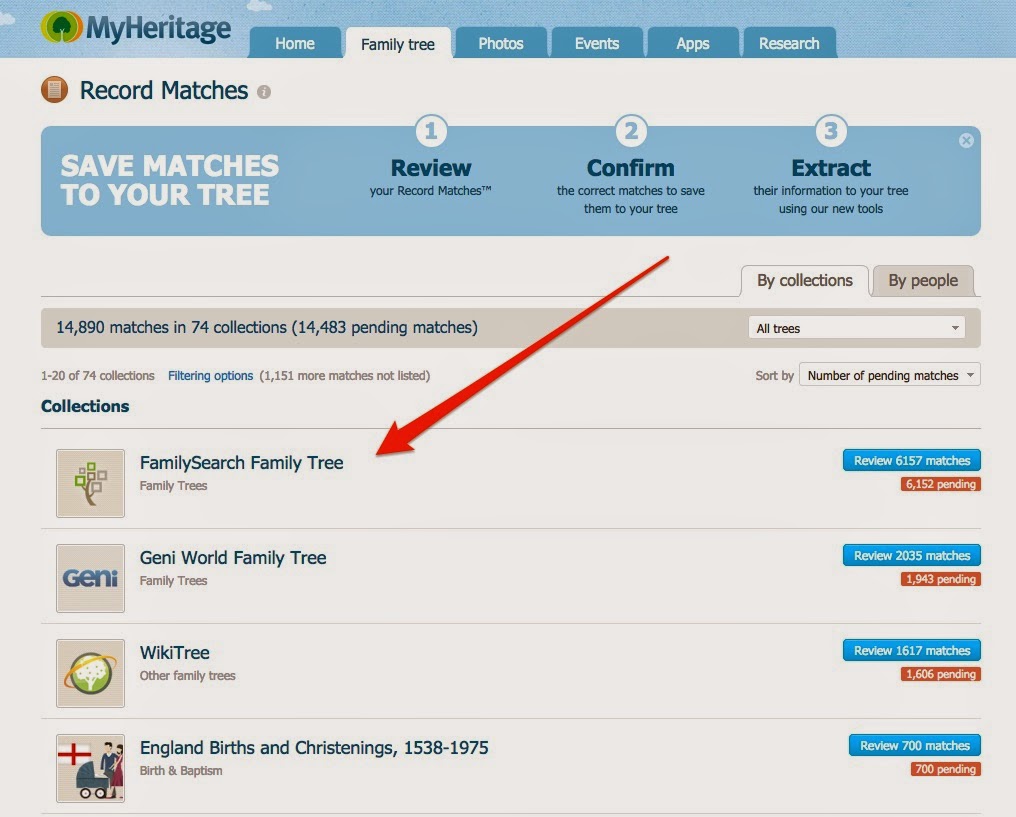
One of the most interesting developments of the recent partnerships between FamilySearch and other online companies, is the agreement with MyHeritage.com. The agreement apparently involves giving MyHeritage.com access to some of the records in the FamilySearch.org Historical Record Collections, but also, quite recently, providing the ability to search the FamilySearch.org Family Tree. Here is a screenshot of the Record Matches from MyHeritage.com showing searches in the Family Tree program.


FamilySearch users who are members of The Church of Jesus Christ of Latter-day Saints get the benefit of these searches with their free access to the program. The availability of the Family Tree matches has boosted the number of Record Matches for my family tree on MyHeritage.com into the stratosphere. I presently have over 14,000 Record Matches and an untold number of Record Detective matches.

In addition to the partnership with MyHeritage.com, FamilySearch also has a partnership with the RootsMagic software program. RootsMagic 7 has introduced a feature that searches not only the available record hints from the FamilySearch.org Family Tree, but also searches the Record Matches on MyHeritage.com. Here is a screenshot from RootsMagic showing the Pending record hints in both programs:


The combined number of record hints in both programs seems unmanageable. However, by using the features through RootsMagic, you can concentrate on just those families and family members that you are interested in working with.

One side bonus to RootsMagic ability to see records in both Family Tree and MyHeritage.com is the fact that duplicate entries in the FamilySearch.org Family Tree are showing up in MyHeritage.com's searches when they do not show up in any searches made in the FamilySearch.org Family Tree. This includes duplicates that cannot yet be merged in Family Tree.

I am not yet sure as to the advantage of knowing about these duplicates that cannot be combined, but it does give the RootsMagic/Family Tree/MyHeritage.com user an advantage in finding information that is buried in using Family Tree alone. Here is an example of some of the duplicates revealed by the MyHeritage.com Record Match:


It is apparent that FamilySearch has a long way to go before the program settles down and starts to make progress in eliminating the duplicates. This points out the fact that when you start to take advantage of this new technology, coupled with the FamilySearch partnerships, you can make some interesting discoveries, not all of which are intended.