Genealogy from the perspective of a member of The Church of Jesus Christ of Latter-day Saints (Mormon, LDS)
Sunday, December 2, 2018
Introducing The Family History Guide YouTube Channel
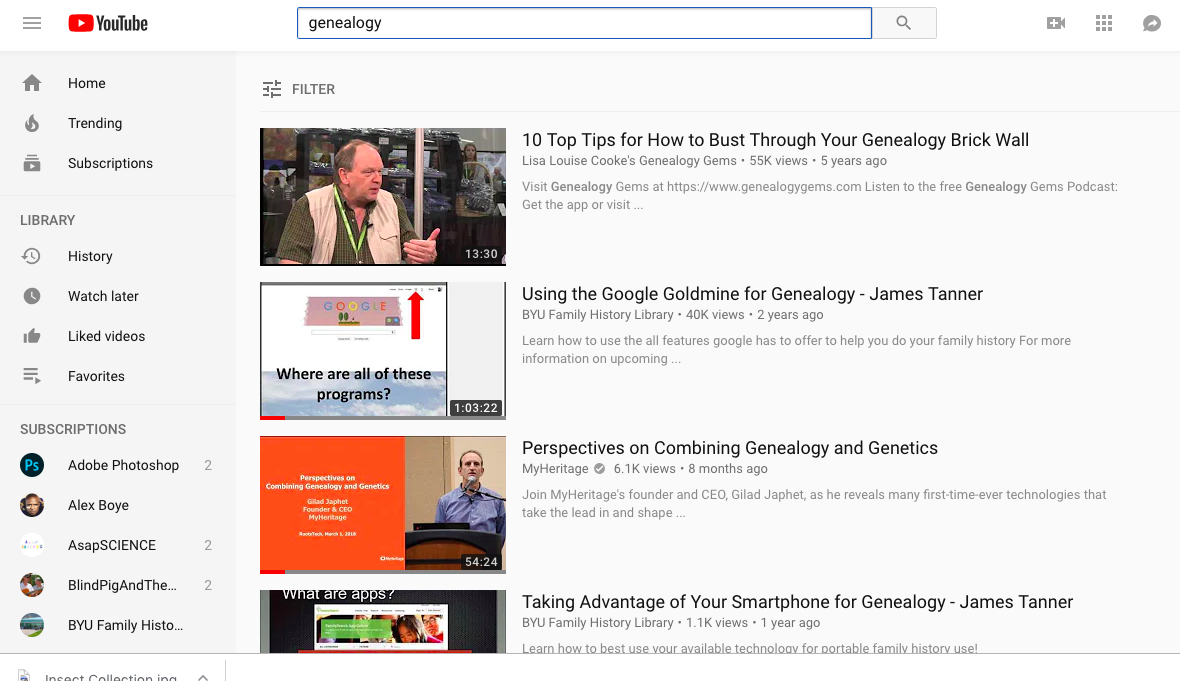
Yes, there is a YouTube.com Channel for The Family History Guide. It would help a lot of we had more subscribers but we are going to add more videos and make the Channel a genealogical destination. YouTube.com is much more than just music videos, dogs, cats, and entertainment. It is a go-to place for instruction and education in almost any subject. Genealogy only makes up a very small part of the YouTube video library but it is a significant asset. You can easily see how much information there is on YouTube by doing a search. For example, here is what you get from a search for "genealogy."
You can also search for more specific topics. It has been some years now since I realized the importance of posting periodic videos and I have maintained my "video presence" long enough to see significant benefits to the community.
The Family History Guide is one of the most valuable online genealogical assets in existence. It certainly deserves more visibility and support. To remind everyone, contributing to The Family History Guide Association will help us continue with this important educational and instructional website and even clicking on a share or subscribing to the YouTube Channel can help.
Thursday, November 29, 2018
If you have Italian ancestors, you need to know this
![]() |
| https://media.familysearch.org/familysearch-unlocking-centuries-of-italian-ancestry-records/ |
FamilySearch International announced free access to over 150 million Italian historical genealogical records—the largest online collection of its kind. The unprecedented initiative is the result of collaboration between FamilySearch, the Italian government, the Italian State Archives (Direzione Generale per gli Archivi or DGA), and many other archives. The free collections include over 200 years of digitized images of birth, marriage, death, and other significant family history records from all regions of Italy and many other repositories. Search the free Italy collections online at FamilySearch.org.If you have Italian ancestors, you need to read the entire news release linked here.
I seem to go through phases in helping people find their ancestors. A while ago at the Brigham Young University Family History Library, I went through a series of people asking about Italian ancestral research. For quite a long time, I had one after another requests for help with Italian research. This new announcement indicates that in the future, I should be able to help almost anyone with Italian research. Here is another amazing quote from the news release:
The Italy civil registration records are the most complete of FamilySearch’s collections. FamilySearch also has Church records in Italy dating back to the 1500s. Starting a little later, Italy's court (tribunali) records can be found. Civil records became available after 1806. After annexing large sections of Italy during his reign, Napoleon Bonaparte introduced civil registration and the mandatory creation of duplicate records. Copies of birth, citizenship or residency, marriage, and death documents were kept in the community, and a second set were sent to the court having jurisdiction for the area. Today, these are a gold mine for Italian family history researchers—as they continue to become accessible online.
Through agreements with Italian governments and other repositories, FamilySearch is preserving not only the civil records online, but also millions more from archives throughout Italy—essentially helping to open Italian archives to patrons all over the world, 24 hours a day, 7 days a week. The digital images are also a safety net against natural calamities and loss to human handling.Obviously, as the new release explains, if these records were indexed it would greatly facilitate the ability of researchers to search the records but having researched records from countries speaking Romance languages for years, I know that the key to finding families is identifying the location where the family originated. The records are arranged chronilogically and geographically and researchers are able to trace families back generations. We do not have to wait to do extensive research.
Please read the entire article for further information and if you can read Italian, please help index the records. Indexes make starting your research a lot easier. Go to FamilySearch.org to find the records. Here is the link to the Italian records:
![]() |
| https://www.familysearch.org/search/collection/location/1927178?region=Italy |
Tuesday, November 27, 2018
Give on Tuesday for The Family History Guide
|
|
Sunday, November 25, 2018
New FamilySearch Ordinances Ready Feature
![]() |
| https://www.familysearch.org/blog/en/temple-ordinances-familysearch/
FamilySearch has introduced a new Family Tree feature called Ordinances Ready. Here is a description of the feature from the above blog post.
For Church members, the ultimate temple and family history goal is to provide saving ordinances for their ancestors. This can happen whether you are able to serve as proxy for an ancestor in person or if you share the ordinances with the temple for someone to perform in your (and your ancestor’s) behalf. But, for various reasons, it can sometimes be difficult to identify an ancestor needing ordinances. Ordinances Ready searches FamilySearch Family Tree, as well as temple reservation and shared lists, to find available ordinances for people you are related to. It verifies that the person:
There are some important tips regarding the program also from the blog post.
Tips for Using Ordinances Ready
|
Thursday, November 22, 2018
A Family History Mission: Looking Back
![]() |
| Reading Room, Maryland State Archives |
Note: You can do a Google search for "A Family History Mission James Tanner" to see all the previous posts in this ongoing series. You can also search for "James Tanner genealogy" and find them or click back through all the posts.
The year on our mission passed slowly and quickly at the same time. Once you are well into the "elderly" category, you find that time seems to flash by at breakneck speed. After spending two weeks in the MTC, including a week of camera training, we were on our way across the United States to our new home in Annapolis, Maryland. We knew almost nothing about what to expect so we were constantly surprised from the moment we arrived. We had never been to Annapolis but many years ago we lived in Dundalk, Maryland next to Baltimore while I was serving in the US Army.
Our first impressions were of the intense traffic and narrow winding roads. We found ourselves assigned to a nice apartment and soon found out that we were serving with five other couples. We overlapped the service of two couples whose missions were soon over. Although we arrived just before Christmas, we were immediately busy learning our task of digitizing the probate records in the Maryland State Archives.
One of the first learning experience was the fact that as Senior Missionaries working in a government office, we served as "volunteers" and did not wear missionary badges or missionary apparel. We also quickly learned that preparing and digitizing records is hard work. We were quickly into the middle of the work. Our lifestyle changed dramatically. We were up at 5:30 am and to work by 7:00 am, later changed to 8:00 am. We had a short lunch break and worked until 4:30 pm or so. This was our schedule five days a week except for state holidays.
As volunteers, we served as guests in the Archives. Over the year, we did make many good friends among the employees and were well treated and welcome. But we did have to be careful to observe the administration's rules about the security and operation of the Archives. As I noted above, because of security reasons, the Archives limited our access to between 8:00 am and 4:30 pm. We were encouraged to be out of the building by 4:30 at the latest. There were exceptions, but we tried to follow the rules.
In the last 89 installments of this series of posts, I have described our work in detail so there is no need to go into that topic. Outside of our work, we were on our own time. Before arriving, we were unsure about our involvement in the other missionary activities of the Mission, but we soon learned that there was enough to keep us busy and that our contact with the young full-time missionaries was limited. Essentially, since we worked every day during normal business hours anything else, such as buying food, washing clothes, etc. had to take place after work or on Saturdays.
We were encouraged to take advantage of local cultural activities on Saturdays. My wife and I spent many of our Saturdays exploring the beautiful city of Annapolis or riding the Metro to Washington, D.C. to see the museums and monuments. We did not attend missionary district or zone meetings but we did occasionally have some enjoyable activities with the other Senior Missionaries assigned to the Washington, D.C. North Mission.
We began by attending the Annapolis Ward in the Annapolis Stake. At first, we were encouraged to help with the Military Relations Missionaries who served the Midshipmen at the U.S. Naval Academy in Annapolis. We became good friends with the Military Relations Missionaries but after a short time helping with the Academy, we began attending the Spa Creek Branch (Spanish Speaking). I have an extensive Spanish language background but Ann, my wife has very little Spanish language skills. That actually worked out perfectly because while I could work with the Spanish speaking members, Ann could work with those who spoke English and we found out that the Primary was conducted and taught principally in English because almost all the children spoke English fluently.
Since we both have extensive family history/genealogy backgrounds and since we were serving as FamilySearch missionaries, we took every opportunity to help people discover their ancestors. The Branch President and Elders Quorum President for the Branch set a goal to have trips to the Philadelphia Temple, because of the closure of the Washington, D.C. Temple for renovation, during the year we were there and encouraged the members of the Branch to let us help them find their own family names to take to the Temple. The Branch President and Elders Quorum President recruited people almost every Sunday to work with us in the Annapolis Stake Family History Center which was located in the Stake building where we attended church. They made two very successful Temple trips while we were helping the Branch where many of the members were able to perform ordinances for their own ancestors and other relatives. I also volunteered in the Family History Center on Tuesday and Wednesday evenings.
During the year, we taught genealogy classes at various locations including a Lunch and Learn session at the Maryland State Archives and several classes at the Washington, D.C. Family History Center. We also joined the Anne Arundel County Genealogical Society and attended their meetings. I also did some extensive research for people who contacted me during the year. Ann helped one of the Archive volunteers publish a three-volume book about the cemeteries in Anne Arundel County, Maryland.
Listing all our activities and experiences would be impossible. I did keep writing on a reduced schedule however and also managed to present a few webinars for the BYU Family History Library.
What are our plans for the future? Mainly survival. We are visiting some of our children's families on our way home and then we will be plunging back into our activities in Provo. I will be offering to serve again at the BYU Family History Library. We will also be attending genealogy conferences and teaching again. I will be serving again as an Ambassador at the upcoming RootsTech Conference. I will be returning to help teach and write for Family History Expos. We will both we serving on the Board of Directors of The Family History Guide Association and will be helping at The Family History Guide booth at RootsTech. Other than that we will have to see what other opportunities that might come our way.
Wednesday, November 21, 2018
Using MyHeritage to correct entries in the FamilySearch Family Tree
For some time now, I have had access to the MyHeritage.com Tree Sync program that can synchronize data with the FamilySearch.org Family Tree but unfortunately, I have not had the time in wrapping up our service at the Maryland State Archives to do much more than look at the program. I will be working on evaluating the features and benefits in the not too distant future.
What I can say now it that when you begin the process of synchronizing, you import the initial information from FamilySearch and create a new family tree in MyHeritage. So the data in this family tree is the same as the data in the FamilySearch.org Family Tree. For this explanation, I am using the term "Family Tree" with initial capital letters to refer to the FamilySearch.org Family Tree any other family trees will have initial letters in lower case.
This process only works if you have a family tree on the MyHeritage.com website and some of the same information on the FamilySearch.org Family Tree. You can do this with any family tree on MyHeritage, but it works much better with the synchronized, newly created family tree. You will also need to have the full data subscription to MyHeritage.com (equivalent to the FamilySearch Partner version that is free to members of The Church of Jesus Christ of Latter-day Saints).
To start to review the information, you go to the MyHeritage.com Consistency Checker listed in the "Family tree" menu item and choose a person to correct.
This section of the Consistency Checker shows children who are born before their parents or in other words are older than one of their parents. The first one on the list is William Hobbs. Here is the MyHeritage Essentials page for this person.
The key here is that if this error shows up in MyHeritage, it came from my imported file from the Family Tree. You might note that there is a link from this person back to the same person in the Family Tree on the left side of the image.
Here is the same person's entry in the Family Tree:
If you examine this entry in the Family Tree, you can readily see that William Hobbs is listed as being born in 1689 and his father, Richard Hobbs is listed as being born in 1695. Why was this information carried over from the Family Tree? Why haven't I corrected this information previously? The answer to the first question is simple; this MyHeritage family tree is a copy of what is in the FamilySearch Family Tree. But the second question opens up a world of issues with the Family Tree.
This particular person is from my wife's family. That is not an excuse, that just reflects the reality that because of the history of the Family Tree and the way it was created, unlike for most people who would not see their spouse's family, I am connected to my wife's entire family. Part of that reason may also lie in the fact that I am distantly related to both my wife's father and her mother on separate lines.
But the real reason this person has not been corrected is that he is too distantly related and we have yet to work our way back that far in the family lines. We can tell that it has been some time since this person was edited or reviewed by realizing that the birth date is non-standard in the Family Tree. The date should be standardized.
Now, back to William Hobbs. He has no sources listed in FamilySearch, but there is a Record Hint that seems to correct his birth date. However, here, the real problem is with the person listed as his father. Richard Hobbs. The date listed as his birth dates is actually the date of his christening which is supported by a source. Without some extensive research, there is no way to determine his birthdate. He could have been born years before his christening. The simple solution to the problem is to remove the birth date or change it to reflect that it occurs "before" the christening date. There are other issues with the entries including standardization, duplicate entries, and other issues. What may look like a simple solution, actually leads to a cascading increase in issues that may take hours or longer to resolve.
But with a few clicks from MyHeritage, I can determine a valid research point on the Family Tree. Unfortunately, there is no simple solution for this apparent data issue.
Let me give another example.
Here is another entry from the MyHertitage.com Consistency Checker.
There appears to be a problem with Thomas Selfridge's birthdate. So I can use the link to go back to his entry in the FamilySearch.org Family Tree. Indeed, there appears to be an error. But as I examine the different sources I find that there seems to be some inconsistency about his birthdate. Some of the sources, such as census records, give an estimated date of death as 1792 or 1793, if these later estimates of his birthdate are more accurate, his mother's birthdate in 1785 becomes less problematic. Since the present entry in the FamilySearch.org Family Tree is an estimated date of "about 1786" and given the differences of the birthdate in different sources, it is likely that there is no real issue. The problem can be resolved by entering a different estimated birthdate based on the sources with the later date or simply removing the birthdate altogether due to the conflicts. I chose to make the estimate correspond to the later birthdate.
Again, the tools on MyHeritage.com have been useful in correcting an entry in the Family Tree. But, in reality, both of these examples indicate the limitation of the sources already cited and the need for additional research.
I could continue to give examples because the MyHeritage.com Consistency Checker indicates that there are 775 inconsistencies in my portion of the FamilyTree. This is somewhat discouraging, but not at all unexpected. I certainly cannot say that my family tree is complete.
Sunday, November 18, 2018
Thou Gracious God, whose mercy lends
Thou Gracious God, Whose Mercy Lends - Mormon Tabernacle Choir
Thou gracious God, whose mercy lends
The light of home, the smile of friends,
Our gathered flock thine arms enfold
As in the peaceful days of old.
Wilt thou not hear us while we raise
In sweet accord of solemn praise
The voices that have mingled long
In joyous flow of mirth and song?
For all the blessings life has brought,
For all the sorrowing hours have taught,
For all we mourn, for all we keep,
The hands we clasp, the loved that sleep.
The noontide sunshine of the past,
These brief, bright moments fading fast,
The stars that gild our darkening years,
The twilight ray from holier spheres.
We thank thee, Father; let thy grace
Our loving circle still embrace,
Thy mercy shed its heavenly store,
Thy peace be with us evermore.
Thy mercy shed its heavenly store,
Thy peace be with us evermore.
As we leave Annapolis, Maryland to return home after our mission, we will be eternally grateful for the people we have met and the love they have shown to us. We are especially thankful for our opportunity to serve in the Spa Creek Branch (Spanish Speaking) of the Annapolis Stake. I thought these words of Oliver Wendell Holmes were particularly appropriate. I am not sure any of the Branch members will ever see this post, but I do hope they realize what a great experience we had working with them for nearly an entire year. We hope to see them all again sometime.
We would also like to express our thanks to all those volunteers and missionaries who worked with us at the Maryland State Archives. They made the whole experience worthwhile. I truthfully can not understand how we could have done our work of digitizing without the combined effort of all the missionaries working together to solve the challenges and problems that arose.
We will remember you always. Here is another version with the King's Singers.
Thou Gracious God, Whose Mercy Lends - The King's Singers & the Mormon Tabernacle Choir
Subscribe to:
Posts (Atom)