Genealogy from the perspective of a member of The Church of Jesus Christ of Latter-day Saints (Mormon, LDS)

Sunday, April 14, 2019

Still Looking for those Golden Years: Glasses, Water, and Hearing Aids


What do glasses, water, and hearing aids have in common? Well, you would have to be pushing your Golden Years to discover the commonality. The common issue is the cost of the items versus their selling price. Each of these three items has a ridiculously low cost and a comparatively high selling price. In addition, if you are hearing and sight challenged and need to bathe or drink water, all three of these items could be classified as necessities.

Since I have all three of these challenges, I have become interested in researching these three commonly used products. Not too long ago following a visit to my local ophthalmologist for an eye exam and the results showed I need new glasses. Since I wear regular variable vision glasses, sunglasses, and computer glasses, the total spent came to a tidy sum even when the purchase made a Costco Warehouse. We have tried online glasses and not been happy with the results. The price was within the range of what I expected since I have been wearing glasses since grade school.

Now we come to the research. It turns out that a $500 pair of glasses probably costs less than $20 to make. See "You'll be Shocked to Find Out How Much Eyeglasses Really Cost."

Hmm. This seems like a major issue. Could it be true? Time to do some more research. Here is a list of links to articles discussing the real cost of eyeglasses.

The list could go on indefinitely. So why did I pay hundreds of dollars for eyeglasses? Good question. 

Now what? Let's move on to hearing aids. The average cost of hearing aids makes high priced glasses look cheap. In looking around, it looks like the average price on one hearing aid is $2300 and of course, I have two ears. See "Is there a hearing aid price bubble?" Again, what is the actual cost of manufacturing these extraordinary electronic devices? Much less than $200. How many people go without hearing aids because of the artificially high price? In addition, I would have to have an ear test before anyone would sell me a pair. There go my Golden Years. What rankles me is that my latest hearing aids are about as dumb as a rock compared to my iPhone and I paid more than three times the cost of my iPhone for these wretched hearing aids that do not help much at all. 

What about water. Isn't that mostly pretty inexpensive? Well, actually yes unless you don't have it piped to your house or you decided to fill a swimming pool. But as we found out recently by carefully examining our water bill,  the part of the bill that applies to the sale of water is about 7%, the rest of the bill goes for taxes. I don't have a ready link for the cost of water. But if you are one of these people who buy cases of bottled water at your local supermarket, you are paying about 2000 times as much as it costs for tap water in most of the United States. See "Bottled Water Costs 2000 Times As Much As Tap Water." By the way, bottled water costs more than twice the cost of gasoline. 

Those of us who have a few years behind have been paying these prices for a long time. 

Saturday, April 13, 2019

Over 600,000 views: The BYU Family History Library YouTube Channel

https://www.youtube.com/channel/UC7hqNOQt-2AfeVEpDuc7sCA/videos
We have had over 600,000 views on the Brigham Young University Family History Library YouTube Channel. That may seem insignificant when some YouTube videos are racking up that many views in a day, but for us, it is another milestone. There are now 423 videos on a huge variety of subjects for free on this very active channel. For example, 12 new videos have been uploaded in the last month. The most popular video on the Channel has over 44 thousand views. We are slowly converting our presentations to video format and away from presentation software such as PowerPoint to increase the usefulness of the information presented. You can see a good example of the transition on this video:

Come Follow Me Companion by Ann Tanner

We encourage all who view the videos to subscribe to the Channel by clicking on the subscribe button. You might also like to know that the videos are also organized and available on the BYU Family History Library Website. Here is a screenshot and a link. The benefit of using the videos on the BYU website is that they are viewable in the chapels of The Church of Jesus Christ of Latter-day Saints when YouTube videos are blocked.

https://sites.lib.byu.edu/familyhistory/classes-and-webinars/online-webinars/webinar-recording-index/

Wednesday, April 10, 2019

Show Me coming to The Family History Guide

https://www.youtube.com/channel/UCSdEueFFI669fDBwILOCDvw
The Family History Guide is Your free learning, research, training, and activities center for family history. It is the world-class family history learning system used by learners in over 150 countries and approved by FamilySearch as an official training resource. The website links to thousands of family history resources across the internet.

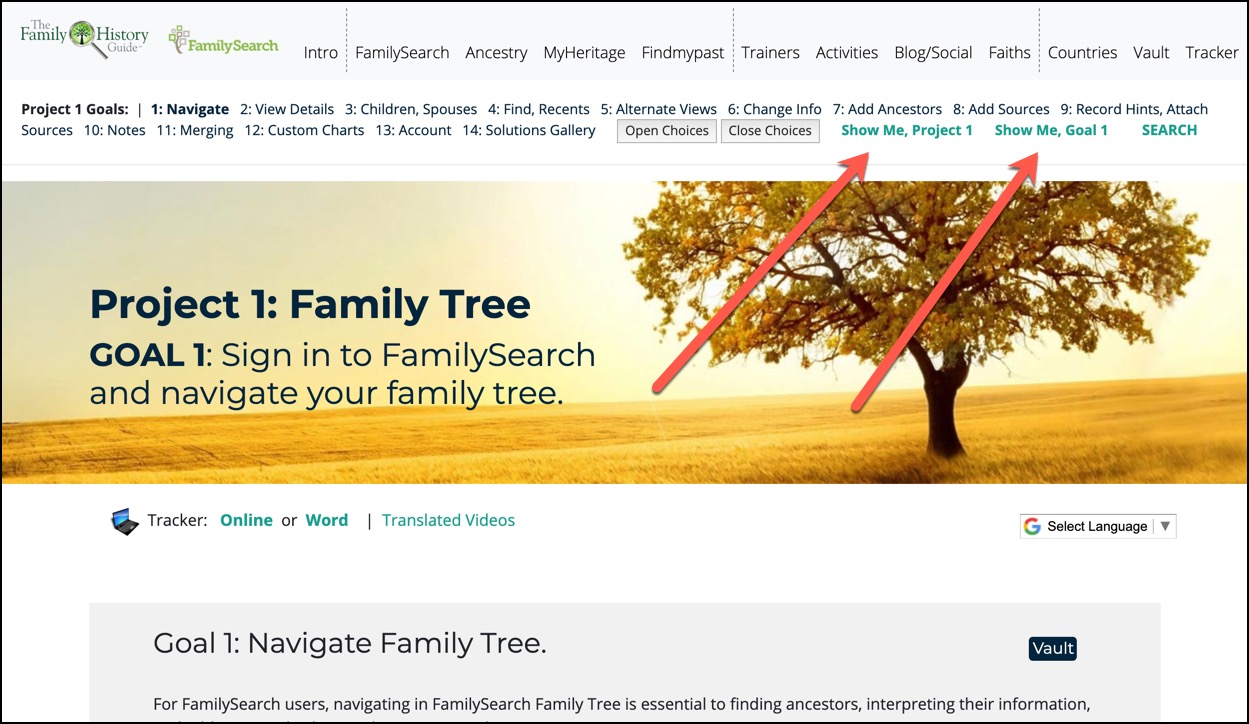
You may not know that it is a sequenced and structured learning environment that can help you attain competency in family history research. It is organized into a series of Projects which are further divided into Goals. Each Goal then has a series of choices that help you learn in manageable steps to learning all about family history. We have begun producing short "Show Me" videos that accompany each Goal to illustrate how what is described in the text looks like on the different websites. The first of these videos are being linked from Goals for learning FamilySearch.

Because of the huge number of these short videos that will be produced, the format had to be standardized as much as possible and for this reason, we are using computer-generated voice narration for the segments. You can see these Show Me videos in the context of the website for Project 1, Family Tree Goals.

https://thefhguide.com/project-1-family-tree.html
Assuming I can keep working, we hope to have most of the Goals with Show Me segments.

Discover, Gather, and Connect Your Family

https://www.rootstech.org/video/discover-gather-and-connect-your-family
You should watch this extraordinary presentation by Angelle Anderson, Scott Anderson, Merrill White sponsored by The Family History Guide and FamilySearch and the recent RootsTech Conference. As you watch this presentation, you will discover the spirit and enthusiasm behind the phenomenally growing The Family History Guide website. You can also view the videos produced by the Andersons on The Family History Guide YouTube Channel.  As you might guess, we are involved in the video world almost completely now. I am transitioning from slide presentations (i.e. PowerPoint and Keynote) to video. It has taken me about two months to make the transition since I had to relearn the video programs that had progressed so much since my last foray into video production. You can expect a lot more video offerings in the future both on The Family History Guide YouTube Channel and the Brigham Young University Family History Library YouTube Channel.

Here is another outstanding video about The Family History Guide Come Follow Me Companion from my wife, Ann Tanner on the BYU Family History Library YouTube Channel.


Come Follow Me Companion by Ann Tanner

Tuesday, April 9, 2019

The Family History Guide adds Instructions for the FamilySearch Tree App

The Family History Guide Blog
Quoting from the blog post entitled, "The Family History Guide and the Family Tree Mobile App:"

We are excited to announce a new addition to The Family History Guide: there is now a Project for the Family Tree Mobile App from FamilySearch. You can find the new Family Tree App Project at the bottom of the FamilySearch drop-down menu.
The Project is being published in two parts. Part One will include the following Goals:


  • Pedigree
  • Person View
  • Sources and Record Hints
  • Search Historical Records
  • Map My Ancestors
  • Other Tools
  • Settings 

Part Two will add the following additional Goals:

  • Memories
  • Ordinances (in the Church of Jesus Christ page)
  • “Possible Duplicates” (added to the Part One pages)
  • Task for Descendants
The link to the new FamilySearch Tree App Project is located in the FamilySearch menu items. 


Here is a screenshot of the Project page.

FamilySearch Tree App
With the dramatically increased emphasis on the FamilySearch Mobile app in various presentations and talks from both representatives of The Church of Jesus Christ of Latter-day Saints and from FamilySearch.org, these detailed instructions will give potential users a good understanding and foundation for learning to use the mobile apps. 

Sunday, April 7, 2019

Are you an orphan Temple and Family History Consultant?


Despite the Temple and Family History Leadership Instruction from Elder Dale G. Renlund of the Quorum of the Twelve Apostles on February 28, 2019, there are still Wards and Stakes that have not yet implemented the ideal Ward Temple and Family History Leadership Pattern.


Failure to implement the standard pattern makes the Ward Temple and Family History Consultant essentially an orphan. However, even without this formal organization, a Temple and Family History Consultant should be helping the Ward members individually with their family history needs. New instructions about the Temple and Family Consultant calling have been posted on FamilySearch.org. Here is the link to the first page of the instruction.

https://www.familysearch.org/calling/?page=1

Quoting from the section called "Discover, Gather, Connect:"
Personalized Family History Experiences 
A good way to engage others in temple and family history is through personalized family history experiences. 
A personalized family history experience is a meeting between a temple and family history consultant and an individual or family where the consultant shares an activity or family history information prepared especially for that meeting. This can take place in a home or another convenient location that is conducive to the Spirit.
This section emphasizes the need for the Temple and Family History consultants to help individuals one-on-one. The Ward may eventually develop a plan and include you in the implementation, but your core responsibility is to help people one at a time with finding their own family names to take to the Temple. The instructions include step by step instructions about how to go about doing this.

If you need any other help at all, please take a few minutes to review The Family History Guide. This resource will teach you what you need to know to really help others.

Do not feel like an orphan. You can learn what you need to know from the online resources. Then you can begin helping those around you. If the Ward catches up and has a plan, then you are that much further ahead.


Tuesday, April 2, 2019

What Common Errors Are Being Made in the FamilySearch Family Tree? Part One

z

All online family trees are often perceived by a certain segment of the greater genealogical community as error-ridden traps for the unwary genealogical researcher but taking that attitude immediately implies that those making that assumption have somehow achieved perfection. Valid and defensible genealogical conclusions are based on careful systematic research into historical records which by their very nature are prone to errors and omissions. It is certainly possible to assiduously follow both academic and professional genealogical proof standards and still make egregious errors.

The real basis for historical or genealogical research accuracy consists of a healthy dose of skepticism combined with the ability to see through conflicting historical records. Correct conclusions are not arrived at by being enveloped in an ivory tower of research isolation. In genealogy, accuracy will ultimately be achieved on the battlefield of the community based and compiled family tree programs such as the FamilySearch.org Family Tree.  The opinions of those who ignore this reality will ultimately be lost to obscurity.

One good example of isolationist superiority is the history of the acceptance of Wikipedia as a source of reliable information. There are still academic holdouts who condemn Wikipedia in its entirety out of hand regardless of the source citations attached to any given article. Likewise, there are those in the genealogical community that condemn the FamilySearch.org Family Tree who have not so much as registered for a look at the website and who also uniformly dismiss all other user-contributed family trees in every other program.

From my perspective, I would find it impossible to construct my own family tree relationships by basing my research solely on my own examination of historical records and academic journal articles. For example, in my own surname line, I have yet to find even one professional genealogist who has contributed anything of substance. However, the "crowdsourcing" efforts of all of my relatives have actually produced an extremely accurate family line up to the point where the records are apparently not available or are unavailable.

Of course, the FamilySearch.org Family Tree is not without its share of errors. So what are the errors or problems that continue to appear? The Family Tree is not a dead, isolated opinion in an academically oriented journal, it is a living, breathing entity that grows and changes every day. But just as beautiful gardens need to be tended and the weeds removed, the Family Tree needs constant attention.

One way that the Family Tree can grow with accurate and reliable information is for those who contribute to the Family Tree to become aware of the most common errors. Any assessment of the accuracy of the Family Tree must be based on some kind of objective criteria and fortunately, we have just such a mechanism. Some time ago, by virtue of a partnership between FamilySearch and MyHeritage, members of The Church of Jesus Christ of Latter-day Saints were able to use the MyHeritage website for no charge. One of the more recent advantages of that arrangement is the fact that those members who have actually availed themselves of the advantages of using the MyHeritage website, can now create a synchronized file between the two websites by importing up to 8 generations from the Family Tree into a new MyHeritage family tree. As a result of this importation, the MyHeritage website automatically begins to examine the contents of the imported file using the sophisticated Consistency Checker program.

Some time ago, I created a synchronized version of my first 8 generations on the FamilySearch.org Family Tree in a new MyHeritage family tree and almost immediately received a report of the number of errors in my portion of the Family Tree. The report checked 3,520 people in the imported family tree. Keep in mind that I have been working on correcting the entries in the FamilySearch.org Family Tree for over 37 years. Here is the report from the Consistency Checker:


It takes a while for the whole report to be compiled, so what this screenshot shows is only 365 errors of a usual 720. Wow! That many errors? That is about a 20% error rate. The error rate shown above with only 41% done is 24% But what is being measured? The category with the largest error rate is for photos tagged with an inaccurately reported death date, i.e. a date inconsistent with the the one showing in the individual's detail section. Other common errors are as follows:

  • Child born after death of parent
  • Fact occurring after death
  • Fact occurring before birth
  • Siblings with close age
  • Multiple marriages of same couple
  • Disconnected from family tree
  • Siblings with the same first name
There are possibly many more types of errors. Stay tuned for more information about the errors and why they occur.