Genealogy from the perspective of a member of The Church of Jesus Christ of Latter-day Saints (Mormon, LDS)

Friday, December 20, 2019

Remember The Family History Guide with Amazon Smile


AmazonSmile will donate to your favorite charity. As a genealogist, may I suggest that you sign up for Amazonsmile and choose The Family History Guide Association, the sponsoring organization for The Family History Guide as your charity. Signing up to have money donated to The Family History Guide Association will not affect the prices you pay for stuff on Amazon but it will measurably help this very worthy cause. Basically, all you have to do is sign up with this link: smile.amazon.com. Here is the link to the Amazon Smile section for The Family History Guide Association: https://www.thefhguide.com/fhg-amazon-smile.html

https://www.thefhguide.com/fhg-amazon-smile.html
When you go to buy stuff on Amazon, you log in to smile.amazon.com instead of the regular Amazon website but from there everything on Amazon is exactly the same. Amazon donates 0.5% of the price of your eligible AmazonSmile purchases to the charitable organization of your choice.

This is an entirely painless way to provide a measurable benefit to The Family History Guide. Also, remember that The Family History Guide Association is a qualified U.S. 501 c 3 corporation and also has the following connections for information and donations.

https://thefhguide.com/donate.html
See this link: https://thefhguide.com/donate.html for information about how to donate. Here is the information about the activities of the Association:

https://thefhguide.com/donate.html


Monday, December 16, 2019

Why write about genealogy, family history, and FamilySearch?

familysearch.org
According to Google Trends or trends.google.com, Google's search volume index, there has been a steady decrease in searches for "FamilySearch" over the past five years. Here is a recent (2019) graph showing the decline.


However, during the same time period, internet use has exploded into mobile devices particularly smartphones. In addition, searches for the company "Ancestry" have pretty much maintained their popularity. Here is a graph showing the relative search frequency for Ancestry in blue and FamilySearch in red.


Of course, genealogy as a search topic has also had a relative decline over time.


If you do a comparison of the terms "genealogy" and "family history" to "DNA," for example, you can see why the large genealogy companies are so interested in latching on to the interest in DNA.


Overall, people search more for "dog grooming" than they do for "genealogy" or "family history."


So why am I writing about genealogy and family history rather than some other more popular subject and why write about FamilySearch at all? The answer to that question is difficult and involves years of complex experiences.

When you decide to write something like a book or a regular blog post, you need to choose topics that you are passionate about. I hear a lot about "writer's block"  in which an author loses the ability to produce new work, or experiences a creative slowdown. See Wikipedia: Writer's block. I have yet to experience that condition and the reason is simple, I am still passionate about life, genealogy, and a lot of other things. However, there are decisions that need to be made in your life that might require you to focus your energy on something different rather than writing all day and into the night.

Writing every day does take time and as you grow older you may decide to focus more on interpersonal relationships rather than writing. But if the reason you are slowing down or quitting is that you are tired or bored with the subject or can not come up with good ideas, then the problem cannot be dismissed by claiming some vaguely defined condition called "writer's block." It may be something as simple as the fact that you no longer like to write. This is a valid choice and does not need an excuse. Also, I know absolutely nothing about dog grooming.

I have always thought I would like to write a novel but when I start thinking of topics to write about, I always come back to the fact that I enjoy doing research and writing about factual, mostly historical subjects. I haven't published a novel yet but who knows? I might start one or go back and rewrite my early attempts. As I think, I write. It also helps to read a lot.

Now, why genealogy and why FamilySearch? Well, as I take a mental inventory, there are only a few things I am more involved in and passionate about than family history and genealogy. Writing about those subjects is easy and I have a long inexhaustible list of things to write about. As far as FamilySearch is concerned, the website and the company change so regularly and frequently, it is easy to use FamilySearch as a subject. I am getting rather passionate about the challenges of old age and how that affects my life and the lives of those around me. But then FamilySearch changes something or does something strange and I am off writing about genealogy or family history again.

I do know that I will have to stop sometime, but maybe I can delay the inevitable long enough to write one more post or webinar or article or presentation.


Wednesday, December 11, 2019

What Names Can I Submit for Temple Ordinances

The question of which of our ancestors and relatives qualify for Temple ordinances comes up frequently. The FamilySearch.org Family Tree program has evolved to the point where most of these questions are answered by the program itself. Those who are available to receive the Temple Ordinances are marked with green icons when you have registered with an LDS Account. However, not all of the green icons mean that you personally can participate in the ordinances for that person. If you click on a green icon for a person with whom you are not related, you will likely get a message telling you that you are not related. But this is only the starting point for understanding the complex system of relationships and possible exceptions to this general rule. The general rule is that you can only do ordinances for individuals only if you are related to them.

To start, here is a link to the official statement from the FamilySearch.org Help Center: https://www.familysearch.org/ask/salesforce/viewArticle?urlname=Individuals-for-whom-I-can-request-temple-ordinances&lang=en (you will need to sign in to the FamilySearch.org website with an LDS account to see the article).

The biggest exception to the "related" rule says that you CAN submit names for adoptive, and foster family lines connected to your family in addition to your biological lines. So that means that despite the fact that my Great-grandfather was adopted, I can pursue submitting names for his ancestors just as if I were biologically related to him.

Another exception to the rule involves the Ordinances Ready app. In some cases, if the program cannot find a qualified relative, the suggested ordinance or ordinances will be provided for a person whose name has already been shared with the temples. Some of these people may not be relatives but they have been waiting for some time for the ordinances to be done and deserve a chance to have them done.

In addition, the green icons do not assure the users of the Family Tree that further research will not determine that there are duplicate entries. All that is assured by the green icons is that the person has a name, a date and a place for an event. Sometimes doing a little research will quickly reveal that there are one or more duplicates and that the Temple work has already been done. However, in my opinion, this is not a reason for avoiding green icons or trying to discourage others from clicking on them and taking the names to the temples.

You might view this position as a radical departure from the positions I have taken in the past on the subject of green icons but times have changed. There has been a huge increase in the accuracy of the FamilySearch program itself and the tools and features of the program are doing a reasonably good job of catching the duplicates and the alternative of discouraging users from learning more about the program likely outweighs the diminishing number of duplicates being processed. If there is still an issue with duplicates, and I am convinced that there is, then those people who have the skills to detect and merge the duplicates should be working to correct the Family Tree.

There is two other exceptions to the rules about requesting temple ordinances: the 110 Year Rule and the same area rule.

The 110 Year Rule is found at this link: https://www.familysearch.org/ask/salesforce/viewArticle?urlname=Process-for-110-year-Temple-Request&lang=en_US (likewise, you will need to sign in to the FamilySearch.org website with an LDS account to see the article).

The rule about doing the ordinance work for people in the same area has been overly used to do private extraction programs and extracting names in large geographic areas. The exception reads as follows: Possible ancestors, meaning individuals who have a probable family relationship that cannot be verified because the records are inadequate, such as those who have the same last name and resided in the same area as your known ancestors.

This is usually invoked by people who decide to do everyone with the same or similar surname in a town or parish assuming that they are all related. The issue of whether or not this is appropriate needs to be dealt with on an individual basis.


Tuesday, December 10, 2019

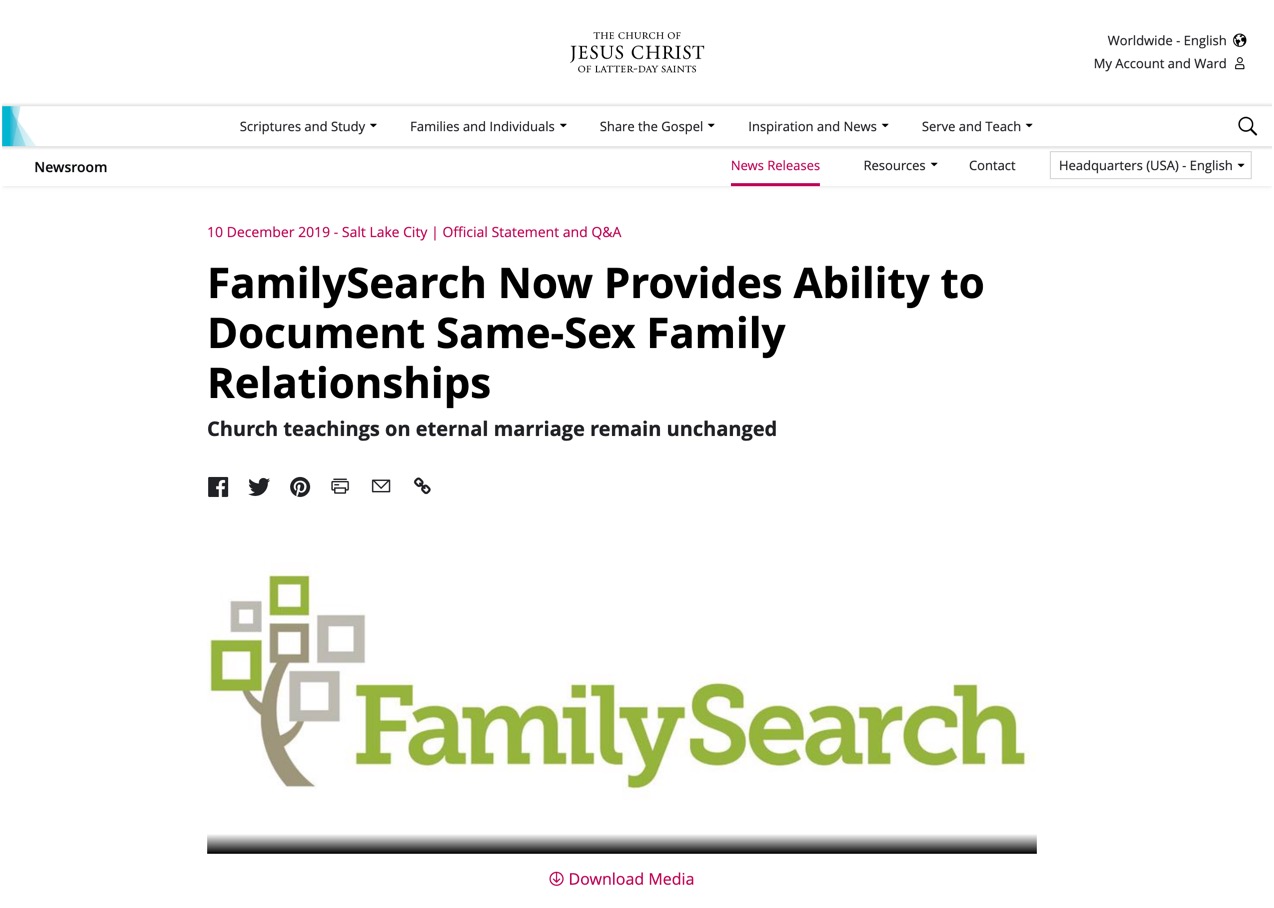
FamilySearch Now Provides Ability to Document Same-Sex Family Relationships

https://newsroom.churchofjesuschrist.org/article/familysearch-document-same-sex-family-relationships
Quoting from a press release from The Church of Jesus Christ of Latter-day Saints,
FamilySearch is one of the world's largest collections of genealogical data, drawn from civil, ecclesiastical and other sources to be assessed for their genealogical value by each researcher. 
FamilySearch Family Tree now provides the ability for users to document same-sex family relationships. Consistent with the doctrine of The Church of Jesus Christ of Latter-day Saints, only marriages between people of the opposite sex may be solemnized or sealed in the temple.
The linked press release also contains a short list of Questions and Answers about the change in the FamilySearch.org Family Tree. 

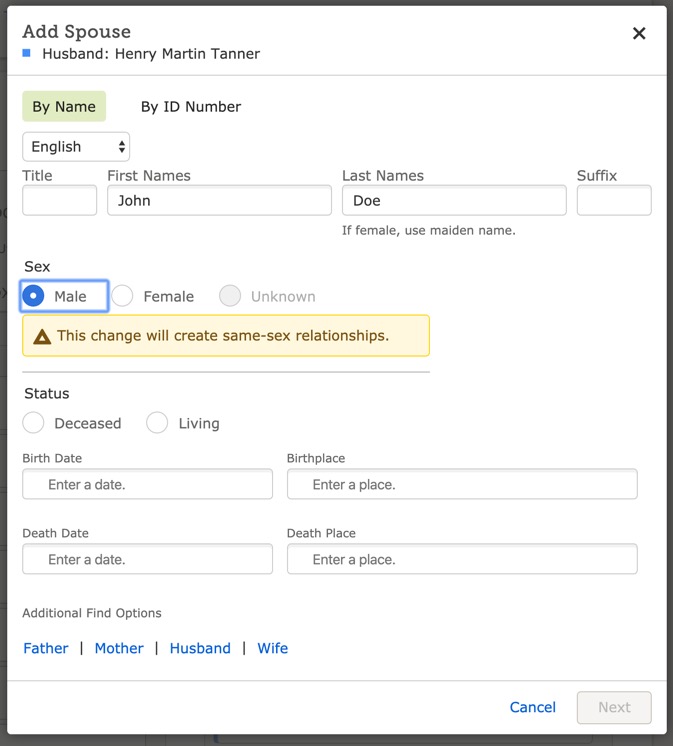
If you now go to the Family Tree and click on the "Add Spouse" link. you will get the familiar Add Spouse dialogue box. However, if you try to add a same-sex spouse that will be possible. There is a popup warning about the process, however.


I have known this was coming for quite a while and here it is.

Monday, December 9, 2019

In Defense of the Ordinances Ready Program

The Ordinances Ready app is not just another ordinance crawler. It goes well beyond the scope of the previously available programs or apps. It is interesting that some of the criticisms that I and others have leveled at the other ordinances crawlers are now being marshaled and rehashed by critics of the Ordinances Ready program. The two main issues are, as usual, duplicates and accuracy.

First of all, you cannot fault the Ordinances Ready program (or any other ordinance crawler for that matter) for either the duplicates or any lack of accuracy in the FamilySearch.org Family Tree. From a practical standpoint, neither of these issues is any better or worse because some users of the program end up duplicating temple work or doing an inaccurate name. The issues of duplicates and accuracy would be problems with or without the Ordinances Ready app or any other ordinance crawler. The duplicates come from multiple submissions of the same individuals over an extended period of time lasting over 100 years. The problem of duplicate records and the transferred problem of duplicate temple ordinances was first discussed as early as the 1890s when there were only four temples in operation. See Temples of The Church of Jesus Christ of Latter-day SaintsTemples > Chronology.

What is the problem with duplicate entries? Can the duplicate problem be resolved? Are there more or fewer duplicates than there were say about ten years ago? Would abandoning the Ordinances Ready program help solve the duplicate issue? With respect to the duplicates, it is important to understand that once a name is "submitted to the temple" the issue of duplication is moot. The only way to resolve a shared duplicate is to perform the ordinance. It is this shared file that is the main objective of the Ordinances Ready app. If the app cannot find a name related to the requesting user, the app will profer a name from the oldest part of the previously shared names whether or not the suggested name is a relative of the requesting party or not. In this way, the duplicate issue is being addressed. Ultimately, all of the names in the backlog will need to be done. Only then, can the remaining duplicate entries by resolved from a practical standpoint. Actually, there are dramatically fewer duplicate entries than there were even a short time ago. It is important that the names in the backlog be completed and any duplicates in the backlog eliminated. Meanwhile, those who can should diligently check for duplicates before submitting any names and no, abandoning the ordinance crawlers entirely would not affect the number of duplicates at all.

We also need to recognize that the duplicate problem has been addressed by the Family Tree programmers and that a huge number of reasonably identifiable duplicates have been eliminated or are marked by the program. The duplicates that are left are almost all nearly unidentifiable "dark matter" that only becomes visible when additional research is done on the names in the Family Tree. Without the additional research, the duplicates are invisible to the program's built-in duplicate detection algorithms. Numerically, there are very, very few people who can do research at the level that detects these hidden duplicates. This fact immediately raises a serious problem; if the people who have the knowledge to find the duplicates simply avoid using the Ordinances Ready app to assist in their research and rail against the app, then those additional duplicates will be processed and done by unknowing users anyway and the duplicates in the "shared with the temples" category will be there in any event.

One the other hand, the inaccuracies in the Family Tree originate from a variety of causes primarily dealing with uninstructed or negligent contributors. The reality of having a universal and collaborative Family Tree is that the inaccuracies will eventually be corrected and overall, the Family Tree will become a standard for accuracy. Allowing the vast majority of the users to rely on the Ordinances Ready program for "names to take to the temples" magnifies the efforts of those who have the knowledge to correct entries. This is the result of the Ordinances Ready app decreasing the number of people who feel compelled to comb the Family Tree for green icons and at the same time make arbitrary changes that are not based on historic source records.

Now, what about the researchers who have the capability of looking at source records and finding new people for the Family Tree? We will keep doing our job. Even with going on 200 temples, the supply of names shared with the temples will outstrip the number needed to keep everyone busy. As I have been saying from some years now: the FamilySearch.org Family Tree is the solution, not the problem and I would add that the Ordinances Ready app helps to add to that solution.

There are a number of other side benefits for using the Ordinances Ready app and I suggest that you read the following post for additional information: "How Ordinances Ready has changed my way of doing research."

Friday, December 6, 2019

We have a winner!!! Contest is already over.


We have a winner!!! Contest over. My contest for a RootsTech pass did not last long. Almost immediately we had not just one person added to the FamilySearch.org Family Tree, but an entire family. Way to go.

Thanks to all those of you out there who started looking.

The winner is Cathy Crandall and here is the family she entered into the FamilySearch.org Family Tree.


If you have submitted an entry and it is correct, way to go. I will still look at what you submitted and send you an email thanking you for your entry.

Win a free pass to RootsTech by adding a new name to the FamilySearch Family Tree


As an Ambassador for RootsTech 2020 in Salt Lake City, Utah from February 26th to the 29th, I am authorized to give away ONE complimentary RootsTech 2020 4-day pass
($299 value) to one of my lucky subscribers or followers.

The Pass includes the following:

  • Over 300 classes
  • Keynote / General sessions
  • Expo Hall
  • Evening events

It does NOT include any paid lunches or paid labs.

Hmm. So I decided I would promote the FamilySearch.org Family Tree and recognize a valuable effort on the part of one user, so this is how the winner of this FREE PASS will be decided. When I finish writing this post, I will post it online including on Blogger, Facebook, Twitter, LinkedIn, and Pinterest. To win the FREE PASS, you must do all of the following:

1. Find and post one new deceased person not previously in the Family Tree with at least two supporting verifiable sources to the FamilySearch.org Family Tree. The name cannot be a duplicate of an existing name. I will check all of the entries' sources and I will also check for duplicates.

2. Send me an email that has as the title "Contest Entry" that shows the date and time the email was sent to me at genealogyarizona@gmail.com with the name and ID number of the newly added deceased person. The email must contain your name and contact information. Note, if you have previously purchased a RootsTech Pass and you win, you can obtain a full refund of the price.

3. The first person with a verified email entry will win the FREE PASS. As soon as I can confirm the information in the Family Tree, I will announce the winner with a subsequent post. From my previous experience, I sometimes continue to get entries for a considerable period after the contest has ended and I will try to notify everyone who writes one way or another but after the end of December 2019, I may not continue to notify entrants especially if they are sending me ads for their products or websites.

4. This offer ends on December 31, 2019 whether or not a winner has been selected.

Pretty simple? By the way, I usually get only a very few entries to these annual contests so you might try and even if you don't win you will still have one new name in the Family Tree.