Genealogy from the perspective of a member of The Church of Jesus Christ of Latter-day Saints (Mormon, LDS)

Thursday, April 16, 2020

Gathering Israel on both sides of the Veil


In the Sunday morning session of the April General Conference of The Church of Jesus Christ of Latter-day Saints, President Russell M. Nelson made the following observation about the gathering of scattered Israel.
This doctrine of the gathering is one of the important teachings of The Church of Jesus Christ of Latter-day Saints. The Lord has declared: “I give unto you a sign … that I shall gather in, from their long dispersion, my people, O house of Israel, and shall establish again among them my Zion.” The coming forth of the Book of Mormon is a sign to the entire world that the Lord has commenced to gather Israel and fulfill covenants He made to Abraham, Isaac, and Jacob. We not only teach this doctrine, but we participate in it. We do so as we help to gather the elect of the Lord on both sides of the veil. See April, 2020 General Conference talk by President Russell M. Nelson, "The Gathering of Scattered Israel."
The recent emphasis on applying the concept of the "gathering of Israel" to both "sides of the veil," is a deliberate shift from our traditional view that the "gathering" applies to missionary work here on earth. Here is a link to a recent video entitled, "Families Gathering Families on Both Sides of the Veil," If you believe that missionary activity occurs after death in the Spirit World, then you should realize that the ordinances that accompany conversion will need to be performed here on the earth by those of us who are still alive. The temple ordinance work for these people who are ready because of being taught in the Spirit World has to be done, one-by-one, for each of these individuals. In addition, each of these people in the Spirit World needs to be researched and identified. A person converted in the Spirit World who subsequently receives the benefit of vicarious ordinances done here on earth has the same importance and significance as those who accept baptism while living here in the flesh.

If you need to see what to do to get started in this important work, please review The Family History Guide website.


Thursday, April 2, 2020

Check Out Your Local Public Library's Website

Many public libraries are closed because of the Coronavirus COVID-19 but that doesn't mean a lot of them are not still in operation. Many of them have extensive online resources. Our local public library here in Provo, Utah has some amazing resources. We also pay a small fee to maintain a library card at the Maricopa County Library in Arizona. With these two public library resources, we have an amazing amount of "free" information.

Across the United States, many libraries provide access to digital books and other publications through Rakuten Overdrive.com an international digital reading platform in a network of 45,000 libraries in 78 countries. Rakuten Overdrive is owned by Rakuten, a Japanese multinational corporation. If your public library has an Overdrive account, you can download the desktop or mobile app and check out digital books and movies for up to two weeks depending on your library's regulations. Here is a screenshot of the website when you sign in from a computer.


One reason we pay to keep the Maricopa County Library is that they have over 81 thousand books that are available, as I write this post, to choose from. I haven't seen too many books specifically about genealogy, but there is a lot of history books.

However, the big attraction from the public libraries is their collections of online research resources and how-to videos. I have learned how to use several applications over the past couple of years using video classes from our Provo public library. I have also gotten dozens of audiobooks to listen to while exercising or just doing repetitious activities.

I can't believe in this day and age that anyone can run out of good activities while primarily staying at home.

Thursday, March 26, 2020

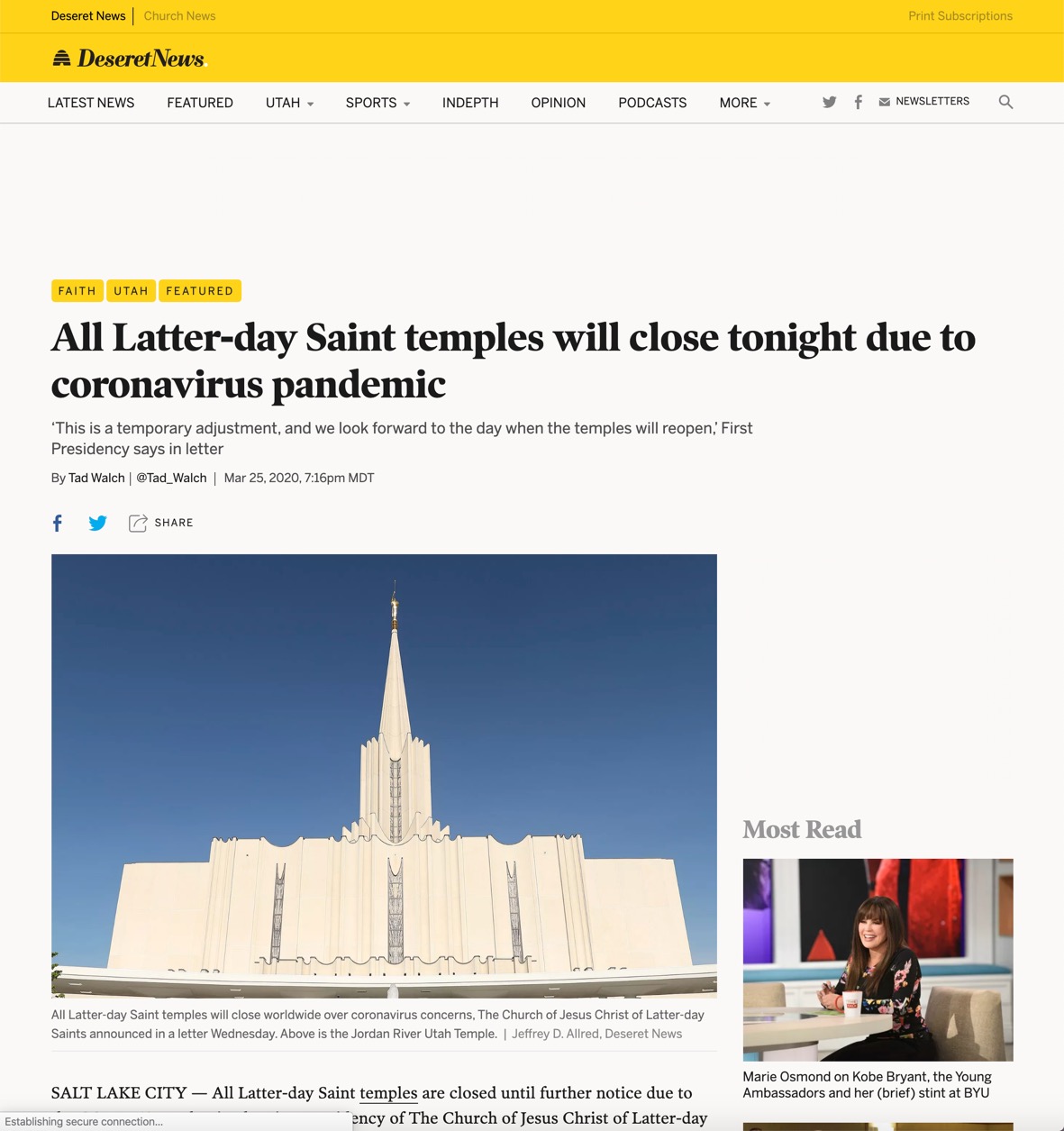
What to do when the Temples Close

https://www.deseret.com/faith/2020/3/25/21194822/coronavirus-mormon-church-temples-closed-coranavirus-covid19-lds-latter-day-saints
Notwithstanding all the dystopian books and movies,  I could really never imagined a disaster so worldwide that it would close ALL of the temples at once. Plus the fact that at the end of March, it snowed two inches today. We have been practicing "social distancing" for almost two weeks and so we have gone into a work-through the piles-mode. As genealogists and members of The Church of Jesus Christ of Latter-day Saints, we mourn the loss of access to the temples and worry about all the "out-of-work" temple workers. But we always have a lot of projects on our list that need doing.

As the Family History Libraries and other repositories shut down, we immediately went into working in the backlog mode. The first things on the agenda were the piles of documents and other papers that had accumulated over the years. In the last two weeks, we have disposed of a huge pile of old, non-history, paper. Most of which had to be examined page-by-page. The next step was to begin sorting and digitizing those documents and records that needed to be preserved (a very small percentage of the paper we threw away). We also continued cataloging the documents and putting the appropriate ones up on the Memories section of the FamilySearch.org website.

If there is any advantage to having been cloistered in our home, it is that these jobs and finally getting some attention.

If you are an active genealogist doing research, you probably have enough to keep you busy. Rest up some and then get to work and you will soon find that you have plenty to do.

Tuesday, March 24, 2020

There is Beauty All Around


During our self-imposed social distancing, one of my daughters and her family came for a surprise outside visit and spent a couple of hours putting a giant chalk-drawn family tree on our driveway. In case you can't tell, that is my wife and me at the bottom of the tree. The branches of the tree show the members of each of our children's families. The white object in the middle is the Mesa, Arizona Temple of The Church of Jesus Christ of Latter-day Saints, a symbol of our eternal family although we actually got married in the Salt Lake City, Utah Temple. Here is what the mountains looked like when they finished the drawing.


There is truly beauty all around when there is love at home.

Tuesday, March 10, 2020

FamilySearch Map of England & Wales Jurisdictions 1851

https://www.familysearch.org/mapp/
If you are doing research in England, this is one of the most valuable resources on the FamilySearch.org website. It is the England & Wales Jurisdictions 1851 map. Unfortunately, it is also hard to find since there are no apparent links to the map on the website. The only link I can find is in the Site Map at the bottom of the Home Page. Here is a screenshot of the Site Map page with the map link in the red oval.

https://www.familysearch.org/site-map
There is also a link in the Research Wiki with a page of explanations about the map.

https://www.familysearch.org/wiki/en/England_Jurisdictions_1851
The Map also seems to disappear once and a while and then reappear likely due to the users demanding it.

Here is a short explanation of the Map from the Research Wiki,
England Jurisdictions, 1851 is a powerful Internet based Geographic Information System (GIS) showing parish maps of the 40 counties in England. This mapping system simplifies research by consolidating data from many finding aids into a single searchable repository that can be accessed through the mere click of a mouse in a parish boundary. The program can be accessed at: http://maps.familysearch.org. This is a research tool provided by FamilySearch using Google Maps to visually display maps and information. For tips on using the website, look beneath the two blue buttons on the left side of the home page and click the "Find out here" link.
The information provided by the links on the Map is extensive. There is a rather extensive explanation of all the features available from a link on the Map page.


Wednesday, March 4, 2020

Search by Images on FamilySearch


The FamilySearch.org website recently added an "Images" search selection to the Search menu (shown above). This new feature is called the Historical Images Tool. The reason for adding this tool is somewhat complicated. Here is an excerpt from the FamilySearch blog post entitled, "Explore Historical Images Tool Unlocks Data in Digital Records," introducing the feature.
Explore Historical Images marks the beginning of a new and different search experience. With this tool, images produced from FamilySearch’s 300+ digital cameras worldwide is made almost instantly available. 
Explore Historical Images helps you navigate to images of historical records that could contain information about your ancestors. Although you aren’t able to search for your ancestor by name directly, you are able to narrow your search by place, date, and other information that was captured when the image was taken.
The reality of the FamilySearch.org website is that, according to the blog post, in 2018, FamilySearch added over 432 million new record images to its online collections. From the January 2020 FamilySearch.org Facts, there are 1.73 billion digital images published only in the FamilySearch.org Catalog. This means that these images are not indexed and cannot be searched in the Historical Record Collections. In fact, there are more images listed only in the Catalog than there are in the Historical Record Collections. Of course, these numbers change constantly but the percentage of records in the catalog will continue to grow at a faster rate than the number in the Historical Record Collections.

Step-by-step instructions about the Historical Images Tool are contained in the above-linked blog post. Notwithstanding the new tool, the bottom line is that the researcher (you) will still have the task of searching through the records one-by-one unless the original records happen to contain some sort of index. The main idea of the new tool is to make users aware of the treasure trove of information that is still locked up in the online images, just one step away from the original paper records or microfilm images.

I still suggest that you may wish to use the main Catalog search that has been available for a long time. You will want to try both for the information you are researching. As an interesting side note, it appears that the probate records my wife and I scanned back in 2018 in the Maryland State Archives are now in the catalog and available for searching.


Monday, March 2, 2020

MyHeritage's New Fan View for Family Trees

https://blog.myheritage.com/2020/02/introducing-fan-view-for-family-trees/
If you are one of those fortunate family historians who have discovered the advantages of using the MyHeritage.com website, you will be pleased to find out that it now offers a fan chart view of your family tree. You can read all the details of this new feature in a blog post entitled, "Introducing Fan View for Family Trees." Your experience with the fan view may be limited to the mostly static charts available from other websites but you will be surprised at all the features included in this one. This fan chart is fully editable. You can add and edit the entries and even add additional generations of ancestors. Here is a selection of a fan view chart from my own family tree.


I am not usually a fan of the fan view but this implementation of the view will probably change my mind. For example here is a ten generation chart for my Grandfather.


By starting with my Grandfather, this is effectively a 12 generation chart for working with my Tanner family lines.