Genealogy from the perspective of a member of The Church of Jesus Christ of Latter-day Saints (Mormon, LDS)

Friday, November 20, 2020

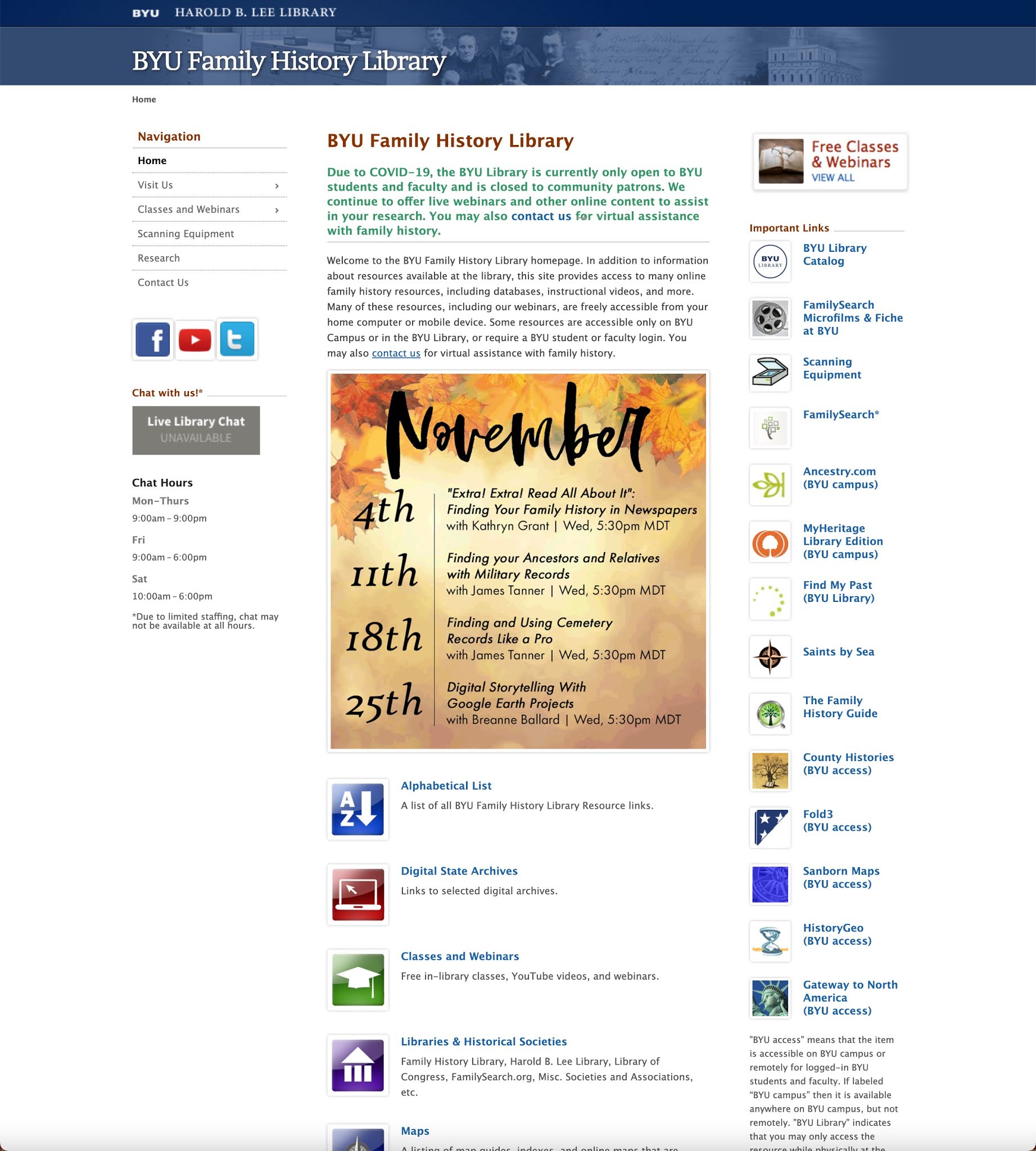
FREE Virtual Family History Classes, Webinars, and Videos from the BYU Family History Library


https://fh.lib.byu.edu/

Although the Brigham Young University Family History Library is closed to both volunteer/missionaries and patrons, we are hosting a broad offering of free online classes, webinars, and videos. All of the present offerings are outlined on our "Classes and Webinars" webpage. 

https://fh.lib.byu.edu/classes-and-webinars/

The classes and webinars include:

In addition, for the students and faculty who still have access to the Library, we have a virtual consultant video station in the Library with live, online missionary volunteers every weekday from 10:00 am to 4:00 pm. The students and faculty simply have to walk up to the video monitor and start asking questions. 

We have nearly 500 videos online on the BYU Family History Library YouTube Channel. Here is a screenshot of the Channel.

https://www.youtube.com/channel/UC7hqNOQt-2AfeVEpDuc7sCA

If you have a question or a suggestion for a new video, please let us know. The contact information for the Library is on our webpage. Here is the link: https://fh.lib.byu.edu/contact-information/

Sunday, October 4, 2020

Let God Prevail


Eugène Delacroix (1861) CC BY-SA 3.0, https://commons.wikimedia.org/w/index.php?curid=386358
Jacob wrestling with an angel

The painting above depicts an event described in the Bible in Genesis (32:22–32; also referenced in Hosea 12:4) when Jacob wrestled with an angel and subsequently, received a new name, "Israel." 

President Russell M. Nelson of The Church of Jesus Christ of Latter-day Saints spoke in the Sunday morning session of the Church's 190th Semi-annual General Conference on October 4, 2020. He began his talk by explaining that he had learned a new meaning of the word "Israel." The most common translation is "contends with God" but President Nelson indicated that Hebrew scholars also translated "Israel" as "Let God Prevail." He then gave some examples of letting God prevail including abandoning attitudes and actions of prejudice. See "President Russell M. Nelson: Let God Prevail." 

I was impressed by his comments. Most of my early life was spent in a small town in eastern Arizona and in the larger city of Phoenix. After leaving Phoenix for a few years I returned and lived many years in Phoenix, Scottsdale, and Mesa. It took me a number of years away from Arizona and living in Argentina and Panama to realize that I grew up in de facto segregated communities. None of the grade schools or the high school I attended had any significant minority students despite the fact that Arizona has a significant minority population. Currently, the non-Hispanic White population is about 54% of the population. 

As I grow older, I have become increasingly aware of the systematic and cultural racism that exists in the United States. Part of my awareness comes from speaking Spanish fluently and subsequently being involved as an attorney in the Hispanic community representing Spanish speaking clients and teaching Spanish as a second language in the local community college system. Living in Panama made me acutely aware of the prejudice harbored against the Black community. 

Now, President Nelson had some very specific things to say about racism. Here is a quote from the above-linked article.

“Brothers and sisters, please listen carefully to what I am about to say. God does not love one race more than another. His doctrine on this matter is clear. He invites all to come unto Him, ‘black and white, bond and free, male and female’ (2 Nephi 26:33). I assure you that your standing before God is not determined by the color of your skin. Favor or disfavor with God is dependent upon your devotion to God and His commandments, and not the color of your skin.

“I grieve that our Black brothers and sisters the world over are enduring the pains of racism and prejudice. Today, I call upon our members everywhere to lead out in abandoning attitudes and actions of prejudice. I plead with you to promote respect for all of God’s children.

“The question for each of us, regardless of race, is the same. Are you willing to let God prevail in your life? Are you willing to let God be the most important influence in your life? Will you allow His words, His commandments, and His covenants to influence what you do each day? Will you allow His voice to take priority over any other? Are you willing to let whatever He needs you to do take precedence over every other ambition? Are you willing to have your will swallowed up in His? (See Mosiah 15:7).” 

Although his words specifically identified Blacks as the object of racism, his words clearly apply to any discrimination of anyone because of their supposed "race." 

As a genealogist, I have learned that due to current studies in DNA testing, the concept of race can no longer be clearly defined. Here is a statement on the subject from Harvard University, Graduate School of Arts and Sciences. 

'Race’ cannot be biologically defined due to genetic variation among human individuals and populations. (A) The old concept of the “five races:” African, Asian, European, Native American, and Oceanian. According to this view, variation between the races is large, and thus, the each race is a separate category. Additionally, individual races are thought to have a relatively uniform genetic identity. (B) Actual genetic variation in humans. Human populations do roughly cluster into geographical regions. However, variation between different regions is small, thus blurring the lines between populations. Furthermore, variation within a single region is large, and there is no uniform identity.

I will have more to say on this subject in the future.  


Friday, October 2, 2020

FamilySearch has over 8 billion searchable names in historical records


A news announcement from FamilySearch recently noted the following:

Nonprofit FamilySearch published its 8 billionth free searchable name from its worldwide historic record collections online. The milestone is even more astounding when you think that each name is someone’s ancestor—8 billion family connections just waiting to be discovered. Explore the free databases at FamilySearch.org.

It’s an incredible feat when you realize that just 1 billion seconds ago, it was 1988, or 1 billion minutes ago the Roman Empire was thriving and Christianity was just beginning to spread.

“To digitally preserve and make so many names freely searchable online is impressive, but it’s the personal family connections that matter most,” said David Rencher, FamilySearch’s chief genealogical officer. “With each new record, there’s the possibility to find a missing link in the family tree. And that is soul-satisfying.” And FamilySearch adds over 1 million new records each day.

The last sentence in this short excerpt is important: "And FamilySearch adds over 1 million new records each day." Researching online is always an ongoing process. Because records are added every day, you never know if what you are looking for and could not find has recently been added to the online collections. 

Monday, September 21, 2020

New section for Youth on The Family History Guide

TheFHGuide.com

The Family History Guide has added a fabulous new section of family history information and activities for Youth; both for those who are members of The Church of Jesus Christ of Latter-day Saints and those who are not. Here are the new sections:

There are always a number of updates and surprises on The Family History Guide website. Take a few minutes to review the website and see how valuable it can be for you and your family. 


Tuesday, August 18, 2020

RootsMagic 8 is in Beta Testing


http://rootsmagic.com/


Here is an update on the progress on RootsMagic 8 from an email notice I received:

We've been so busy working on RootsMagic 8 that we've neglected to post any updates on our progress over the last few weeks. While we've been sharing videos and tidbits via email and social media, we realized that we needed to pull these recent updates into one place to better communicate with all of our users.

The Testing Continues 
We have many users who have been using RootsMagic 8, reporting bugs, and giving suggestions. In order to start testing the software, a user first agrees not to disclose to others about their experience or even that they are a tester. So for those that aren't testing, it feels like everything is very quiet in regards to RootsMagic 8 while those that are testing are actually very busy and active. We gradually add more users to our testing pool so as not to overwhelm the process. Many of you have already volunteered to test the software and- if you aren't already doing so- we hope to give you the opportunity soon.

Writing software is sometimes more of an art than a science. All of those who use RootsMagic will be happy to see the update.  

Saturday, August 15, 2020

Two Valuable Research Tools on FamilySearch: The Family Tree Map and The FamilySearch Places Tool


https://www.familysearch.org/blog/en/places-tool-family-tree-map/

There are a number of helpful tools on the FamilySearch.org website that you may never have used or even seen. The Family Tree Map is one of those relatively obscure tools. You can find it by clicking on the link to the Time Line on the detail page of each person on the Family Tree. Here is a screenshot showing the link.

Once you are viewing the timeline, the map is pretty obvious. 

What is not obvious is what the map can do for you. The reason for this is that this map is not the map for the FamilySearch Places Tool. Where is the FamilySearch Places Tool? The answer is "You can't get there from here." Astoundingly, there are no links from the FamilySearch.org website to the Places Tool. You get there by entering this link: https://www.familysearch.org/research/places. By the way, there are a number of other such tools and pages that are not linked from the main website. The only link I have found so far is in the site map located at the bottom of the startup page and a few other pages. Here is a screenshot of the bottom of the startup page showing the link to the site map.

Once you are looking at the site map, you might notice an entry named "Places." That is the link. Here is another screenshot of the site map page with an arrow to the Places link. 

Now, read the article linked at the beginning of this post to see how to use the Places Tool. It really is useful. By the way, you might want to click on some of the other links on the site map to see what other surprises await you on the FamilySearch website. 

Friday, August 14, 2020

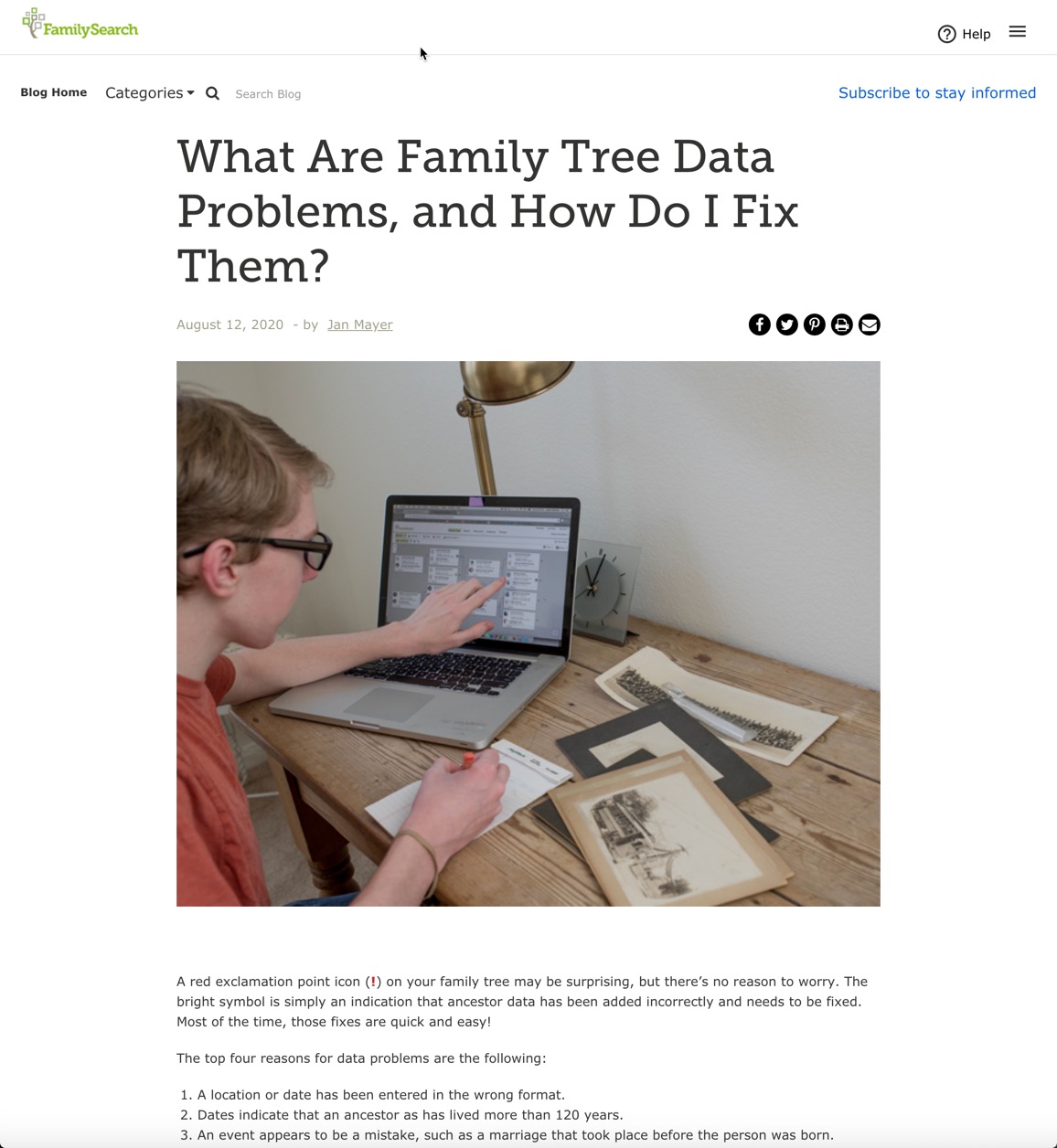
Fixing Family Tree Data Problems


https://www.familysearch.org/blog/en/familysearch-data-problems-family-tree/

Fixing problems in the FamilySearch.org Family Tree is one of my most common topics. It is always a good idea to consider alternative points of view. I thought this post by FamilySearch was timely and appropriate. You should take the time to read it and follow the well-taken suggestions.