

Gilad's Keynote Address - MyHeritage LIVE - November 2018 from MyHeritage on Vimeo.
I have posted this before, but considering that RootsTech 2019 is coming up shortly, I think it would be a good idea to review what Gilad Japhet had to say last November in Oslo, Norway. It might give you an idea about some of the things that will be talked about at RootsTech in February 2019.

Subscribe To

 Posts
All Comments
Posts
All Comments
Thursday, January 31, 2019

Wednesday, January 30, 2019
Do You Need Help With Your Family History?

What happens if you decide you want to start investigating your family history? Where do you go for help? From my own standpoint, there is an overwhelming flood of information about beginning to do family history research but the real question is do you want to do family history research, i.e. find out about your family or are you merely looking for a "name to take to the Temple." Taking a name to the Temple has just become easier with the new Ordinances Ready app. This app is available on the Family Tree App for both Apple iOS and Android. The Ordinances Ready app is also linked from your Temple Reserved page on the FamilySearch.org website. By using the app, you can quickly find a name to take to the Temple. Our experience with the app so far shows that it is fairly accurate an avoids some of the issues involved in just looking for and clicking on green Temple icons.
Now, if you are really interested in finding out about your family and helping to find additional family members to add to those already in the FamilySearch.org Family Tree, you could sign in to FamilySearch.org and click on the Help link in the upper right-hand corner of the screen.
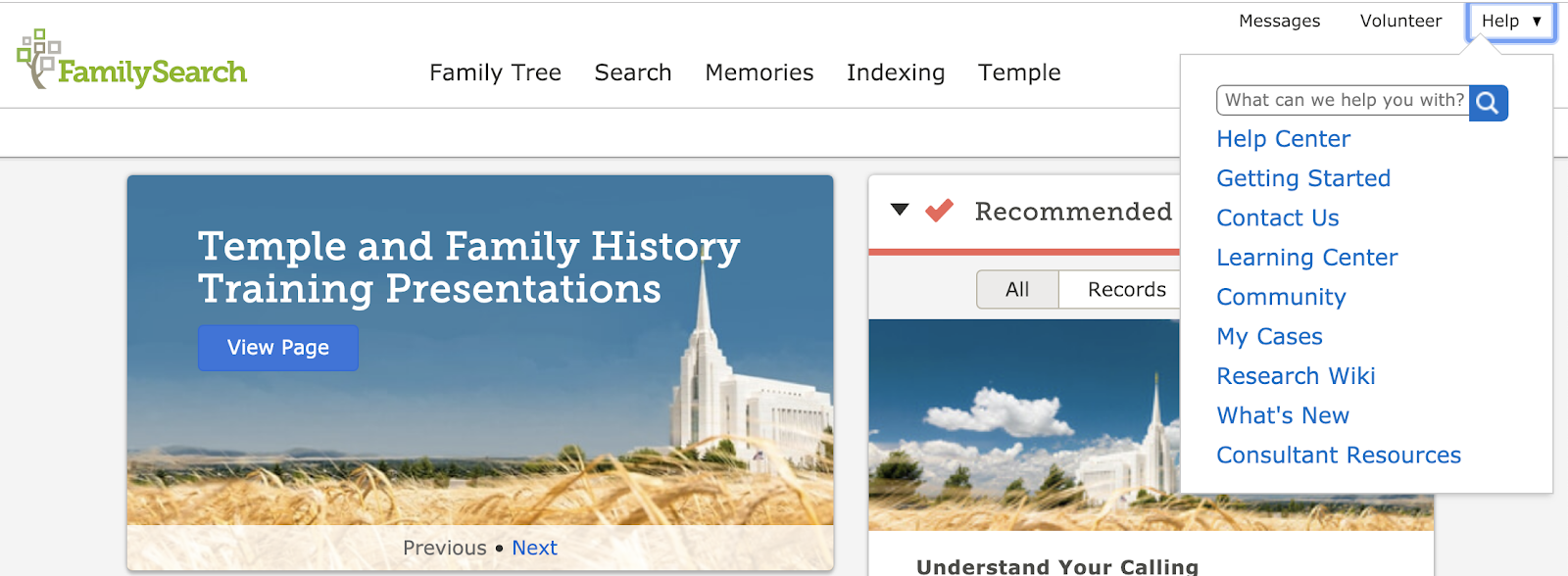
There is quite a list of links that include the following:
The Help Center

This is mostly links to places where you can find additional help. Of course, you can guess what is coming next. You can start with the comprehensive, structured, completely organized website; The Family History Guide.

Tuesday, January 29, 2019
What is missing in Family History today?

There are really many pieces missing from the process of genealogical research today and some of them are obvious and others are ignored almost completely. I spent the past week, in part, watching one of my daughters work on researching early English parish records. During the week, she spent a considerable amount of time also discussing her research with her husband and with her mother (my wife). Her involvement in the research process was time-consuming and intense. All three of them were involved in lengthy discussions about what they were finding and whether or not the documents supported their conclusions. By the way, they were searching original parish registers, not indexes or other secondary sources.
What was important about this experience was that it points out the pieces of family history or genealogy process that are mostly missing from the superficial treatment given to the subject by those who have never spent an entire week or month or year or longer researching one topic. Granted, there are many aspects of "family history" that can be done in small batches such as digitizing records and uploading them to a website such as FamilySearch.org Memories. But we need to look at what we are ultimately trying to accomplish and what is required when we talk about finding our ancestors.
Essentially, any correct information that is already in the FamilySearch.org Family Tree is literally the product of someone's research whether that research was accurate or inaccurate. During the past 100 years or so a few dedicated people spent considerable time researching their ancestry. What we have in the Family Tree and other family tree programs is the accumulation of that research. A lot of that research was dead-on accurate despite the limitations in the access to many records. Focusing on the limitations and inaccuracies of their research denigrates the effort and time it took to accumulate all the information they did preserve.
Granted, today, we have a dramatic increase in the availability to records through digitization and the internet, but the process of finding an ancestor or other relative is essentially the same as it was 100 years ago. The methodology may have changed but the fundamental process has not. Each person correctly added to the Family Tree is "produced" by someone doing research and finding that individual in a record created by someone in the past who had knowledge of the ancestor or relative or a duty to record an event in the ancestor's or relative's life. Historical or genealogical research is the process of locating those documents and discovering the information they contain.
Despite the availability of the information and the increased speed of the process of doing research, we still have to go through the process in order to produce the information needed to identify ancestors and relatives. The correct information does not magically appear simply because someone wrote a computer program to aid the finding process. We also need to remember that the percentage of records that have been digitized and are readily available is still a small percentage of the total documents created in the past and further, we need to realize that the percentage of those documents that are indexed is actually vanishingly small. Record hints are a huge step forward but not yet a replacement for traditional research methods.
Initially, all of the people in the Family Tree either performed their own ordinance work or had their work performed for them by proxy by someone else, usually a descendant or relative. When people found more names than were immediately taken to the Temples, a surplus of names was created. Today, the same process is in effect. A very small number of people are finding new entries for the Family Tree and because of their work, there is a surplus of names that are not immediately taken to the Temples. Mechanically searching through the existing entries in the Family Tree and finding these surplus people who are already recorded in the Family Tree does not add or produce a new name for ordinance work. Granted, the Temple work does need to be done, but even if the surplus seems inexhaustible, it is still finite and drawing from the surplus does not replenish the system. What happens when these, mostly older, researchers die? Think about it.
So what happens if we provide a quick and easy way for people to "find a name" to take to the Temple? Every name found is then removed from the surplus built up over the past 100+ years. What is missing? Connecting the activity of finding a name with the research necessary to actually find a person who is not already in the Family Tree. Does that seem so complicated? Why then is this process denigrated and ignored?
Well, for example, many people do not already have any family names in the Family Tree and even those that have their own name lack two or more generations of people in the Family Tree. Because of the huge number of people (even those who are members of the Church) adding those new usually easily obtainable names would add a huge number of names to the Family Tree. But because of the 110-year rule, their ordinances would necessarily be done by close family members. So even though the total number of people identified increases, the pool of surplus names would not increase substantially.
The missing piece is connecting the basic introduction of people to the concept of family history to the actual process of producing newly and correctly added names for ordinances in the Temples that then become a surplus available to those who cannot or will not do the research. In actual practice, many of the names of people in the Family Tree are duplicates. In addition, many of the relationships are inaccurately represented. A huge amount of the information is speculative or imaginative. Unfortunately, even inaccurate or imaginary people show up as potential candidates for Temple ordinances. Without the skills needed for accurate research, the overburden of inaccurate and sloppy work continues to increase.
Why am I writing this? Because personally I have been told by those in authority that my skills as a genealogical researcher are not needed and that what I tell people discourages them from turning their hearts to their ancestors. Just last night, I attended a class, ostensibly to help the participants, where the entire class consisted to showing dozens of participants how easy it was to "find names to take to the Temples." Only a token mention was made about the accuracy of the names or whether or not the people were actually related to the people they found in the Family Tree and certainly no mention was made about the process of determining whether or not the information provided by the programs was at all accurate or how to determine that accuracy. What is more important, nothing at all was said about the need to do research to "replace" the names used up by drawing on the surplus in the Family Tree.
What is needed? When we help people have a personal family history experience, we need to further provide them with a way to learn how to actually find new names to take to the Temples. We need to help people understand that when they "take a name" provided either by name extraction or by finding an opportunity in the Family Tree that they are drawing down on the surplus created by the work of others. Because those researchers do such an effective job, it really does take only a few of them to provide names for lots of people, but ignoring the need to develop competent and reliable researchers merely pushes the issue down the road.
Fortunately, we already have a tool that will help move people from having a Temple experience to helping them learn how to do research. It is The Family History Guide. But currently, there is no convenient way for a newly interested potential family historian to learn about The Family History Guide. For whatever reason, FamilySearch has not provided any direct links to the program and except for a mention in the Solutions Gallery, as far as I am aware, the program is ignored by the FamilySearch.org website. The Family History Guide is a free program operated by a non-profit charitable corporation and is not in competition with any other program.
Granted, The Family History Guide is not a cure-all for everything I am talking about in this post but it is a giant step towards providing a pathway to progress.
Sunday, January 27, 2019
Comments on Family History in the Ward, Stake, or Area
 |
| https://www.lds.org/callings/temple-and-family-history/changes-to-family-history-callings?lang=eng |
To this end it is expected that all temple and family history consultants, whether at the ward, stake, or area level, have as their primary responsibility the opportunity to assist members with a personalized one-on-one family history experience. They should prayerfully seek the Spirit as they prepare and deliver these experiences.This one statement answers most of the questions Temple and Family History Consultants may have about their callings in the Ward, Stake, and Area. Granted, there are a few major obstacles to this goal. First of all, the Temple and Family History Consultants (Consultant or Consultants) must know how to help those in their Ward, Stake, or Area. My suggestion is that Consultants should be self-starters. Between the resources on the LDS.org website, the FamilySearch.org website, and The Family History Guide website, there is essentially a full beginner to upper division set of instructions about how to go about doing family history and teaching others.
If you are called as a Consultant, it is your own responsibility to learn what you need to do. Here is the basic charge:
- 99 Wherefore, now let every man [and woman] learn his [her] duty, and to act in the office in which he is appointed, in all diligence. Doctrine and Covenants 107:99 [words in brackets added]
Do you need to wait for your leader to tell you what to do? I think the scripture answers that question. But having the cooperation and support of your leaders is helpful but not particularly necessary. It obviously helps if your leader takes the time to teach you what to do. Can you do more than work with people on a one-by-one basis? Obviously, but holding classes or organizing other activities should be done with the knowledge and consent of your leaders. Working with individuals may involve meeting with them in a Family History Center or Library or working with them in their home.
Once you get yourself trained, how do you start? You start by asking people in your Ward (etc.) if they need help. If you are in a Stake position, you start by contacting all of the Ward Consultants. What if you are the only consultant in your Ward? So, start fulfilling your calling and start talking to Ward members about family history. What if you need help? If you are a Ward Consultant, talk to your Stake Consultant. If you are a Stake Consultant talk to your Area Consultant. If you are an Area Consultant talk to your FamilySearch Advisor or your Area Authority Seventy.
From personal experience, I can say that you will have some wonderful experiences helping individuals with their family history.
Saturday, January 26, 2019
What is the roll of Family History Centers in the future?

I recently visited Mesa, Arizona where I served in the Mesa Family History Center for about 10 years as a Church Service Missionary for The Church of Jesus Christ of Latter-day Saints. [Note: the Mesa Family History Center has changed names a few times] Actually, my relationship with the Mesa Center extends back to the 1980s. For a number of years, I provided volunteer technical support for the Mesa Family History Center helping to transfer genealogy file formats between DOS and Apple operating systems. I also ran the Center's website for a while.
As I have written quite a few times, my expanded involvement in genealogy has given me the opportunity to visit Family History Centers across the United States and into Canada. Most recently, I spent a year volunteering in the Annapolis, Maryland Family History Center. I have spent weeks at a time helping patrons at the Salt Lake City, Utah Family History Library and taught classes at the Riverton FamilySearch Library. In short, I have visited and often taught at Family History Centers which could hardly qualify as a center to fully functional centers that include a Family Discovery Center.
OK, so what? Well, the times they are a changing. Many Family History Center volunteers have been using the "Sunday School time" in the three-hour Sunday meeting block that was standard for years to teach family history classes and help individuals with their research. The only comments that have been made about "losing" this valuable family history time are that the classes and help can move to other times during the day on Sunday or to other days of the week. Of course, Family History Centers have been open for patrons during the week and in the evenings, but except for some of the very large centers, attendance during the week is spotty, to say the least.
For example, the Mesa Family History Center was seasonal. During the winter, Mesa had thousands of snowbirds who regularly came to the center and the Center was extremely busy but during the summer activity slowed down considerably. For years, most of the people using the Mesa Family History Center were not members of the Church.
With the change in the Sunday Meeting schedule, individual Family History Centers are left with fashioning their own response. One message that has come through is that family history needs to be taught and supported one-on-one. This is a laudable goal and some Wards and Stakes have taken up the task of supporting members in their homes. However, this emphasis ignores the past extensive help that was being given to patrons who were not members. Staffing and providing help at a Family History Center in a "neutral" environment such as that environment that existed in Mesa, Arizona and still does at the Family History Library in Salt Lake City, Utah obviously will not be happening so much on Sundays.
The main draw of the Mesa, Arizona Family History Center over the years was a knowledgeable and helpful staff and a huge collection of books and other resources. Obviously, many of those resources have moved online and in the case of the Mesa Center the staff has been disbanded and put out of business until the "new center" is built and operational. The loss of goodwill among the winter visitors and others who were not members of the Church is irreplaceable. No matter how effective the Family Discovery Center concept actually is, it will not replace the personal help and the resources of the old Family History Center.
Expanding the view of Family History Centers around the world, some centers provide internet and computer access for patrons who otherwise would not have such access especially to equipment besides smartphones such as scanners and printers. But wherever the centers are located, staffing and support from the local Stakes and Wards is a constant background issue. For example, during its last few years, the Mesa Family History Center (FamilySearch Library) received virtually no support from its "sponsoring" Stakes. Currently, some Family History Centers are receiving mixed messages from their sponsoring Stake about their function in the future.
So here are some questions.
Are Family History Centers as presently constituted and supported a viable concept?
This question arises, in part, from the continued rapid digitization of the basic documents needed for research and the continued movement of other genealogically related resources online. In the not too distant past, statements have been made by Church leaders that the future "family history center" is in the home. However, this concept, if carried to its ultimate end, would eliminate the use of these home-based family history centers by those who are not members of the Church.
Does the concept of one-on-one support for family history obviate the need for a family history center?
Once again, carrying this concept to its ultimate conclusion also excludes most of those people who do genealogical research in a family history center who are not members of the Church. Most members of the Church are unaware that the largest number of people with an active genealogical interest in the world is among those who only have a very vague if any idea of the Church's involvement in genealogy. Additionally, those outside the Church who are aware of Church's involvement are mystified by the lack of interest of the general Church population in family history and genealogy given our religious beliefs. Family History Centers have been acting as a bridge between the large and active genealogical community outside the Church and those few members inside the Church who have become competently active in genealogical research. Are we ready to lose that bridge? Family Discovery Centers do not provide a way for those outside the Church to interact with members in serious genealogical research.
Does the Stake sponsored model of a Family History Center adequately provide the resources needed for genealogical research?
Over the years, some local Family History Center, such as the Mesa Center, have amassed important and very valuable genealogical research resources. Some of the volunteers at these local centers have served for many, many years and are irreplaceable resources in their community. Are we now saying to these valuable individuals that they now have no place in our family history program? This was done a few years back in Salt Lake City at the main Family History Library when most of the "professional level" staff were fired and replaced by untrained volunteers with little or no experience. However, the Stake sponsored model does not necessarily create either the atmosphere or support for long term volunteers.
Is there a place for serious genealogical research in the future of Family History Centers?
Many of the comments made about family history and genealogy such as expressing the fact that you don't have to be a genealogist to do family history have denigrated those who have spent years acquiring the skills necessary to do genealogical research. Those of us who feel hurt by these comments are not going to abandon our work simply because we are no longer supported by the "system." But the reality of genealogical research is that it is not easy and it does require some special skills. Do we want to advance serious, accurate, genealogical research or are we willing to accept a superficial view of a Family History Center as a fun place to come and gain an appreciation for your heritage? As I have recently written, there is a vast gap between entertainment and serious research. Do Family History Centers have a place for those who are will to learn how to do Swedish/Russian/etc. research?
Those of us doing serious research will find a way to do our work with or without Family History Centers. However, those who feel the need to make their way through the difficult process of learning how to do that research may or may not benefit from what happens to Family History Centers in the future.
Thursday, January 24, 2019
Can Family History Bridge the Gaps?

Over the past few years, the large online genealogy companies have spent millions of dollars selling their products. Recently, some of the largest companies have created a new market for genealogy related products by selling DNA tests. Ultimately, however, all of the companies face the gaps in the demographics of the genealogy community: age and technological sophistication. For example, do the companies dumb down their products to increase their appeal to a larger audience or do they risk losing the hardcore genealogical community entirely by directing their products to the 18 to 20 something crowd who could care less about history and ancestry. As it is, almost none of the websites or advertising used by large online companies visually represent the main users of their products.
Underneath, these superficial manifestations of gaps between an anticipated, ever-expanding genealogical market and the reality of the demographics of those who are actually interested in genealogy, is a more serious problem: there are real gaps between those who are willing and able to do genealogical research and those who the large genealogical companies assume are their target markets. The success of selling DNA test kits has accelerated the widening of these gaps and will ultimately result in a crash in sales when the potential market for DNA test kits becomes saturated. The sale of DNA test kits is currently a classic example of a marketing fad. A fad product usually doesn't have much actual utility, which is one of the reasons sales drop quickly after the initial public fascination subsides. See "Fad: Definition & Examples." The utility of a DNA test lies in direct proportion to the amount of actual genealogical research done by the recipient of the test.
Long term, the only companies that will expand their genealogical customer base are those that can bridge the gap between serious genealogical research and the products they offer. For example, FamilySearch has introduced the concept of a "Family Discovery Center." This is a quasi-entertainment experience tied to some very basic genealogical concepts. The main challenge for the long term utility of the concept depends on whether or not FamilySearch is able to add value to the experience by adding technology. Once someone has visited a Family Discovery Center, what is the possibility that they will repeat the experience multiple times? Aren't the Family Discovery Centers in the same position as DNA testing in that repeat sales are unlikely?
But in both the DNA test example and the Family Discovery Center, the real gap is that between the initial experience and the utility of the experience considering the need for educated, serious genealogical research to take advantage of both. Herein lies the challenge. Can genealogy as a persuasion create a bridge over the gap between passive interest and valid research? Presently, there is no clear path to the bridge much less a bridge to cross absent an extensive and lengthy education process. If you want an easily observable metric for measuring the gap, we already have one: The Family History Guide. This one website encapsulates the basic instruction and knowledge that will begin the process of learning how to do adequate genealogical research. Rather than present essentially limited, dead-end experiences such as an isolated DNA test or a single trip to a Family Discovery Center, the path to the bridge is a systematic, structured and fully educational experience such as The Family History Guide. But as long as there is no clear connection between the needed education, i.e. The Family History Guide website, and the limited experiences, many potential genealogists will get stopped at the gaps. Simply put, The Family History Guide website is an excellent example of what the bridge between passive interest and competent research looks like.
Wednesday, January 23, 2019
What is The Family History Guide?
 |
| thefhguide.com |
What I find almost every time I give genealogical presentations is that many people are "interested" in genealogy but either have no idea how to get started or do not know how to progress past the "casual interest" stage. I often talk to people who pull out a stack of paper and say something to the effect of what should I do now? The answer to both these questions and many others is simple: The Family History Guide.
So many people out there in the larger genealogical community are, in a real sense, remaking the wheel. They are talking and teaching about "how to get started in genealogy" when the blueprint for success is already free, online and readily accessible. But before going further in answering the question in the title of this post, I need to explain my interest and involvement in The Family History Guide website.
Almost five years ago, I was introduced to the newly developed website of The Family History Guide at a meeting of the UVTAGG or Utah Valley Technology and Genealogy Group. I immediately recognized the value of a comprehensive approach to teaching family history or genealogy in a concise, sequenced, and comprehensive way. Subsequently, I volunteered to help the developers with publicity and over time, both my wife and I became even more involved and both of us presently serve on the Board of Directors of the sponsoring organization, The Family History Guide Association. Why would we do this? Basically, because we are interested in advancing genealogical knowledge around the world and see this website as a major solution to this challenge.
We do not get paid. We are volunteers. The entire website and all the development and support is provided through donated funds handled by the 501 (c) 3 non-profit corporation known as The Family History Guide Association. By the way, you can donate to the Association through the website. Detailed information about the corporation is on the GuideStar.org website. See https://www.guidestar.org/profile/82-1081685. GuideStar.org is the world's largest source of information on nonprofit organizations.
How effective is The Family History Guide?
Well, it has been used now for years to teach the missionaries at the Brigham Young University Family History Library and some of the missionaries at the Salt Lake City, Utah Family History Library. It is used now by thousands of people around the world to advance family history and genealogy in a major way. It is an official training partner of FamilySearch.org. See FamilySearch Solutions Gallery.
Another challenge to the larger genealogical community is involving younger people in their families. There are numerous online articles about the lack of knowledge of the youth about their grandparents. Significant percentages of today's youth do not even know the identities of their grandparents and even fewer know the identities of their great-grandparents. The Family History Guide has a whole section of activities to help families, youth, and children learn about family history.
 |
| https://thefhguide.com/act-family.html |
 |
| https://thefhguide.com/countries.html |
1. Take a second to like this post and share it with others.
2. Take a few minutes and visit The Family History Guide Association website and donate to support The Family History Guide.
3. Become involved by becoming a Trainer and teach The Family History Guide to others.
 |
| https://thefhguide.com/trainers-home.html |
Subscribe to:
Posts (Atom)