Genealogy from the perspective of a member of The Church of Jesus Christ of Latter-day Saints (Mormon, LDS)

Sunday, December 9, 2018

Still Waiting for the Golden Years: Serious Thoughts on Retirement


Some of the most persistent images of retirement are those used in "retirement community" ads. They uniformly show older couples sitting on the beach or walking along a path. I am not aware that my wife and I have ever sat on the beach or anywhere else and that opportunity never entered my mind. What are we supposed to look forward to in becoming a retired person? Why does our society and culture mandate that we must stop working at some point in our lives?

However, there are definite statistics that show that in the United States, male mortality has a discontinuous increase at age 62 when men begin to retire and claim Social Security. See "The mortality effects of retirement: Evidence from Social Security eligibility at age 62." In short, retirement can be lethal. Why is this the case?

Before getting too far into this topic, I need to define retirement and distinguish it from disability. Of course, you can be both retired and disabled, but the United States has increased the legal protection for the disabled but protection from age discrimination lags far beyond. Looking back in history, retirement as a concept did not exist until the life expectancy level raised because of the industrial and technological revolutions. People did not retire, they died. Those who lived to a "ripe old age" just kept working mostly out of necessity. Germany was the first country to recognize retirement and introduced retirement benefits in 1889. Presently, the concept of retirement has passed from being a novelty to become a fundamental right. National systems such as Social Security in the United States are mandatorily imposed on all workers and until very recently workers were penalized for working past the arbitrary "retirement age."

For the purpose of this post, I am using the term "retirement" to mean the "withdrawal from one's position or occupation or from one's active working life." See Wikipedia, Retirement. This definition of retirement includes both voluntary and involuntary retirement. By this definition, it would be impossible for me to retire, although I do qualify for Social Security benefits. If you think about this system for even a few minutes, you will likely realize that many of the people who pay into the system never live to receive the benefits. Hmm. This is actually part of the planning of the system and as the life expectancy age increases, the ratio of old people to young people changes and if you maintain an arbitrary "retirement age" then you start having more people drawing out of the system then you do paying into the system. This disparity is further ascerbated by a decrease in the maternal reproduction rate.

Granted, I am not making as much money as I did while I was working fulltime as a trial lawyer but I still make money and it then becomes due to the vagaries of the tax system that I do not continue to pay additional self-employment or social security related taxes. In some cases, however, you could pay income taxes on your Social Security benefits. OK, so the system seems arcane and arbitrary is there anything that can be done?

Well, here is what I think. The problem is the way we define work. If I am employed by a company and they set my hours and my pay level, I suppose you could call that work. But what if I set my own hours and my pay level is based on my productivity. Is that work? Let's suppose that I like to write. I would write all day almost every day even if no one paid me for doing so. What if through some stroke of luck or whatever, I actually get paid to write, i.e. I write a book and it sells. Is that work? Do I look forward to retiring from my writing all day? Actually, I use the time that I worked all day as an attorney to write. So is my writing work or not work? So what do I dream about doing when I retire? See, by definition, I can never retire. If I were one half of the couple sitting on the beach, I would have a laptop and be typing or a camera and be taking photographs of the beach and the sunset.

This is where the whole idea of retirement including retirement communities where the idea is to play golf and sit around a drink and play cards has created an artificial view of what life should or could be like. So, you say, but I don't like to write and I don't like to take photographs. Well, there is another issue here altogether. I just got through looking at a website called JustServe.org. That website is tailored to provide you with a long list of places where volunteers are needed to benefit the community and the nation.  I suggest that inactivity and lack of involvement lead to depression, illness, and ultimately death. I am not arguing against Social Security but I am arguing against age discrimination and a wasted, idle, old age. If you spent your life at a job you hated, take advantage of your age to do something meaningful.

Friday, December 7, 2018

What is happening with the Mesa FamilySearch Library?

Former Mesa FamilySearch Library building
During a recent short visit to Mesa, Arizona, we took the opportunity to visit the site of the renovation of the Mesa, Arizona Temple of The Church of Jesus Christ of Latter-day Saints and included checking out the status of the building formerly used by the Mesa FamilySearch Library. The building is still standing and enclosed by a construction fence. The area in front of the building is being used for construction materials storage.

Former Mesa FamilySearch Library Building
Meanwhile, construction on the Mesa Temple renovation is proceeding. The entire grounds of the Temple have been removed including the Visitors Center. Here are two photos of the construction.

Looking at the Temple from the southeast side where the Visitors Center once stood
Another view of the Temple from the Southeast side showing a few trees have been preserved
We walked around the entire Temple block and took photos.

Mesa Arizona Temple East Side 1
The vacant lot south of the Mesa FamilySearch Library building is being used for the storage of trees removed from the Temple Lot.

Looking north towards the Mesa FamilySearch Library Building
Construction on the Southeast corner of the Temple includes what is likely a new heating and cooling structure.

Construction on the southeast corner of the Temple Lot
Mesa Temple Construction from the south
The Family History Training Center building on the east side of the Temple is also being renovated.

Family History Library Training Center
The reflecting pool and stairway on the east side of the Temple are also gone.

East side of the Mesa Temple
In the above image, you can see the FamilySearch Family History Library building in the distance. One tiny spot of plants and flowers has survived so far.

Plants and Flowers Mesa Temple
On Main Street, across from the Temple to the east, the entire section of houses and buildings have been removed for the construction of a new Visitors Center and Family History Center. There will also be some commercial space and some apartments or condos.
Construction on Main Street to the west of the Temple
One last view of the Temple Lot from the north side on Main Street looking south where the Visitors Center was previously visible.

Mesa Temple from the north along Main Street
If you are wondering, yes, it was sprinkling a little and the weather was perfect. We are planning on returning periodically to the area and so we might be able to provide an update sometime.

Thursday, December 6, 2018

Place Research by FamilySearch


It is impossible to understate the importance of identifying the exact place where events occurred in your ancestors' lives. Names are unreliable identifiers. Dates are often vague and/or inaccurate. Places associated with an exact location on the face of the earth give you a firm starting point for valid research. Can I say that any more emphatically? The very first step in identifying an ancestor or other relative should be to focus on the places where events may have occurred in their lives.

Now, this takes us to maps. One relatively obscure feature of the FamilySearch.org website is the Places Research web page. For example, the web page does not show up on the website's Site Map and there are no obvious links to the web page. It does show up in the FamilySearch Solutions Gallery as an app.

The web page does have a number of search options as shown by this screenshot:


Why is this helpful? One reason is that the Standardized Places used by the FamilySearch.org Family Tree are tied to specific geographical coordinates and you can see those coordinates used by searching for the standard place names using Place Research web page. You can also use the Place Resarch web page to see any places that are included within a particular location such as all the counties in a state or place names within a county.

One example of why exact place names and descriptions are important is illustrated by this screenshot:


If your ancestor was from "Arizona" you might think that is fairly obvious what place is being referred to. But if you look at the map above, you can see many places in the world that are called by the name "Arizona" including six in the United States. This is a very simple example but place names and locations can become a major issue in deciding where to search for an ancestor.

In addition, place names change over time. Fortunately, FamilySearch is taking the initiative to provide time frames for the use of some place names. This is particularly true when standardizing a place name while using the Family Tree.

There are a huge number of other tools that can be used to establish the location of an event and these should not be overlooked. I write about maps and location finding devices and tools from time to time so stay tuned for further posts.


Sunday, December 2, 2018

Introducing The Family History Guide YouTube Channel


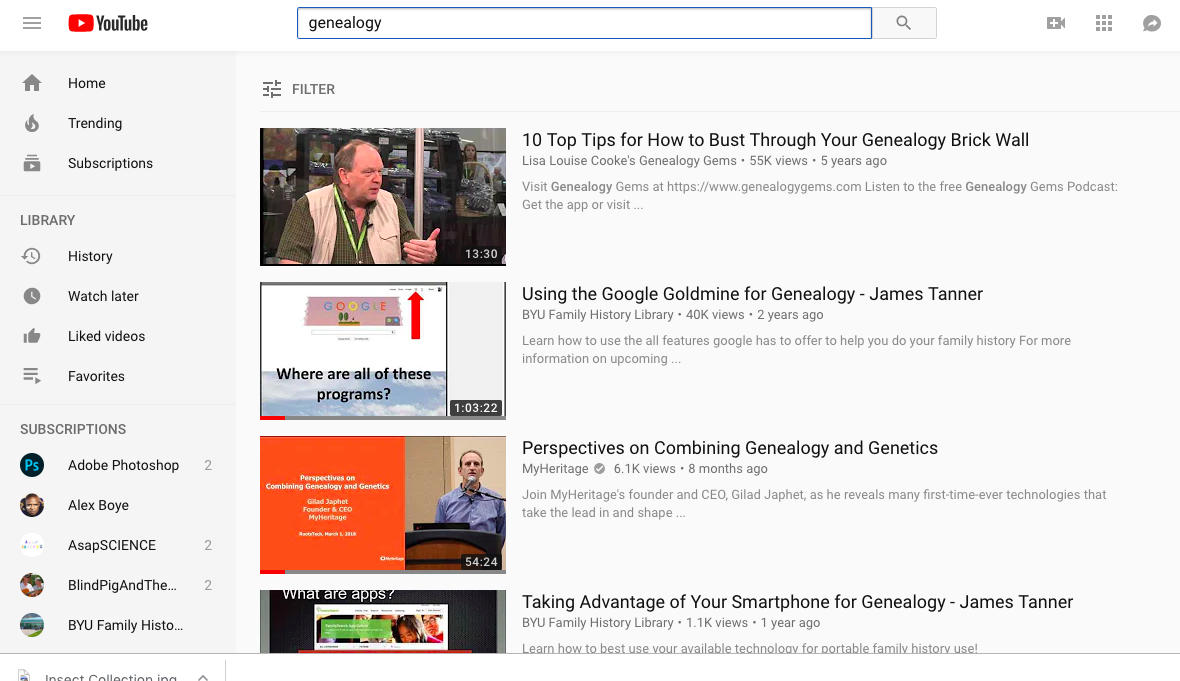
Yes, there is a YouTube.com Channel for The Family History Guide. It would help a lot of we had more subscribers but we are going to add more videos and make the Channel a genealogical destination. YouTube.com is much more than just music videos, dogs, cats, and entertainment. It is a go-to place for instruction and education in almost any subject. Genealogy only makes up a very small part of the YouTube video library but it is a significant asset. You can easily see how much information there is on YouTube by doing a search. For example, here is what you get from a search for "genealogy."


You can also search for more specific topics. It has been some years now since I realized the importance of posting periodic videos and I have maintained my "video presence" long enough to see significant benefits to the community.

The Family History Guide is one of the most valuable online genealogical assets in existence. It certainly deserves more visibility and support. To remind everyone, contributing to The Family History Guide Association will help us continue with this important educational and instructional website and even clicking on a share or subscribing to the YouTube Channel can help.

Thursday, November 29, 2018

If you have Italian ancestors, you need to know this

https://media.familysearch.org/familysearch-unlocking-centuries-of-italian-ancestry-records/
Quoting from a recent news release from FamilySearch.org:

FamilySearch International announced free access to over  150 million Italian historical genealogical records—the largest online collection of its kind. The unprecedented initiative is the result of collaboration between FamilySearch, the Italian government, the Italian State Archives (Direzione Generale per gli Archivi or DGA), and many other archives. The free collections include over 200 years of digitized images of birth, marriage, death, and other significant family history records from all regions of Italy and many other repositories. Search the free Italy collections online at  FamilySearch.org. 
If you have Italian ancestors, you need to read the entire news release linked here.

I seem to go through phases in helping people find their ancestors. A while ago at the Brigham Young University Family History Library, I went through a series of people asking about Italian ancestral research. For quite a long time, I had one after another requests for help with Italian research. This new announcement indicates that in the future, I should be able to help almost anyone with Italian research. Here is another amazing quote from the news release:
The Italy civil registration records are the most complete of FamilySearch’s collections. FamilySearch also has Church records in Italy dating back to the 1500s. Starting a little later, Italy's court (tribunali) records can be found. Civil records became available after 1806. After annexing large sections of Italy during his reign, Napoleon Bonaparte introduced civil registration and the mandatory creation of duplicate records. Copies of birth, citizenship or residency, marriage, and death documents were kept in the community, and a second set were sent to the court having jurisdiction for the area. Today, these are a gold mine for Italian family history researchers—as they continue to become accessible online.  
Through agreements with Italian governments and other repositories, FamilySearch is preserving not only the civil records online, but also millions more from archives throughout Italy—essentially helping to open Italian archives to patrons all over the world, 24 hours a day, 7 days a week. The digital images are also a safety net against natural calamities and loss to human handling. 
Obviously, as the new release explains, if these records were indexed it would greatly facilitate the ability of researchers to search the records but having researched records from countries speaking Romance languages for years, I know that the key to finding families is identifying the location where the family originated. The records are arranged chronilogically and geographically and researchers are able to trace families back generations. We do not have to wait to do extensive research.

Please read the entire article for further information and if you can read Italian, please help index the records. Indexes make starting your research a lot easier. Go to FamilySearch.org to find the records. Here is the link to the Italian records:

https://www.familysearch.org/search/collection/location/1927178?region=Italy

Tuesday, November 27, 2018

Give on Tuesday for The Family History Guide


We are raising money for The Family History Guide Association and your contribution will make an impact, whether you donate $5 or $500.  Every little bit helps.  And on Giving Tuesday, Nov 27, Facebook and PayPal will match a total of $7 Million in donations. 
Simply go to our Facebook page by clicking HERE 

Thank you for your support!! 
Your donation will be automatically MATCHED TODAY ONLY by Facebook and PayPal!!                      
We've included information about The Family History Guide Association below. 

The mission of The Family History Guide Association Charity (501c3) is to greatly increase the number of people actively involved in family history worldwide and to make everyone's family history journey easier, more efficient, and more enjoyable.
 
Find Out More About This giving opportunity and The Family History Guide

Sunday, November 25, 2018

New FamilySearch Ordinances Ready Feature

https://www.familysearch.org/blog/en/temple-ordinances-familysearch/

FamilySearch has introduced a new Family Tree feature called Ordinances Ready. Here is a description of the feature from the above blog post. 
For Church members, the ultimate temple and family history goal is to provide saving ordinances for their ancestors. 
This can happen whether you are able to serve as proxy for an ancestor in person or if you share the ordinances with the temple for someone to perform in your (and your ancestor’s) behalf. 
But, for various reasons, it can sometimes be difficult to identify an ancestor needing ordinances.
The new Ordinances Ready feature in the FamilySearch Family Tree app can help. Here’s how it works: 
Ordinances Ready searches FamilySearch Family Tree, as well as temple reservation and shared lists, to find available ordinances for people you are related to. It verifies that the person:
  • Is related to you.
  • Was born at least 110 years ago.
  • Has chronologically consistent birth and death dates as compared with family relationships.
  • Is not a duplicate, based on the information available in the tree.
In the near future, the Ordinances Ready search will expand to include ordinance reservations from the temple inventory, ensuring that anyone that uses it will be able to find and request ordinances to perform in the temple.
There are some important tips regarding the program also from the blog post.
Tips for Using Ordinances Ready 
  • If you request ordinances using the new feature, be sure to take them to the temple on your next visit or give them to family, friends, or ward members. Under certain circumstances, ordinance reservations might expire after 90 days or longer.
  • The Ordinances Ready feature will help generate just a few ordinance reservations at a time to make them easier to sort through and use for each new temple trip. If you need more ordinance reservations than you find on your first search, consider encouraging others try the feature for themselves for a fun family history experience.
  • The first step when using Ordinances Ready is to select the ordinance type you are looking to perform. Notice if the results include other remaining ordinances for that person. Depending on the circumstances, these other ordinances can be shared with a family member or the temple, so others may do them. You can also unreserve the ordinances to make them available in Family Tree.