The LDS Media App is available for both iOS and Android devices. You can download the app to your smartphone or tablet or iPad from the Apple App Store or the Google Play store for free. The LDS Media App page on LDS.org (see above) has links to Guides for both versions of the app. Quoting from the webpage:
Wherever you teach, the LDS Media Library app gives you complete and searchable access to the Church media library. Complement Sunday lessons, Family Home Evenings, or missionary discussions with easy-to-find videos, images, and music content.
The resources on the LDS Media App can also be downloaded for use without an internet connection. Items are downloaded automatically so they can be used for lessons and other presentations. One very important point is that the videos of conference talks or other videos can be trimmed down to play only the portion you want to present. Cable adapters can also connect your device directly to a monitor, TV or projector for use in a class.
You will be surprised at what you might find for use in family history classes or for talks about family history. A search for media will result in dozens of images and videos.
Large wall plaque in the Missionary Training Center, Provo, Utah
No. 7
I could not help but reflect back on my experiences years ago in the Language Training Mission held in the old Knight-Mangum Hall on the Brigham Young University Campus and compare my original experiences with those we experienced in the Missionary Training Center or MTC this past week.
Previously serving as a women’s dormitory, the Knight-Mangum Hall on the southeast edge of BYU’s campus became the central office for what became known as the Language Training Mission on June 16, 1963. All missionaries learning a foreign language were sent to the LTM, with similar facilities eventually established at Ricks College (for Dutch and Scandinavian languages) and at the Church College of Hawaii (for Polynesian and Asian languages). Through August 1976, the Knight-Mangum Hall served as a place for missionaries to live, eat, learn and worship.
My mission experience as a young man began with a trip to the Salt Lake Mission home on North Main Street in downtown Salt Lake City, Utah. We were there for one week before being transported to the LTM in Provo. You can get an idea of our life there from an article entitled, "A Day in the LIfe of a Language Training Missionary," published in the New Era in March of 1971. Our experience in the LTM was vastly different than the one experienced today in the MTC. In fact, in talking to senior missionaries this past week who have served missions previously in the past few years, they also said that today's program is vastly different than it was just a few short years ago.
When I started at the old LTM in 1964, they were only teaching a few languages. Today, the MTC teaches 55 different languages. But the main differences come from the emphasis and the training offered to the new missionaries. The current MTC experience is centered on teaching the Gospel of Jesus Christ from the Preach My Gospel publication. Our instruction during the week was a mixture of practical lessons including using electronic devices and the apps available to testimony building activities in actually presenting lessons to others.
The experiences I had at the LTM were intensive and life-changing, but I can tell from our short first week at the MTC, that today's missionaries are vastly more prepared to serve than we ever were.
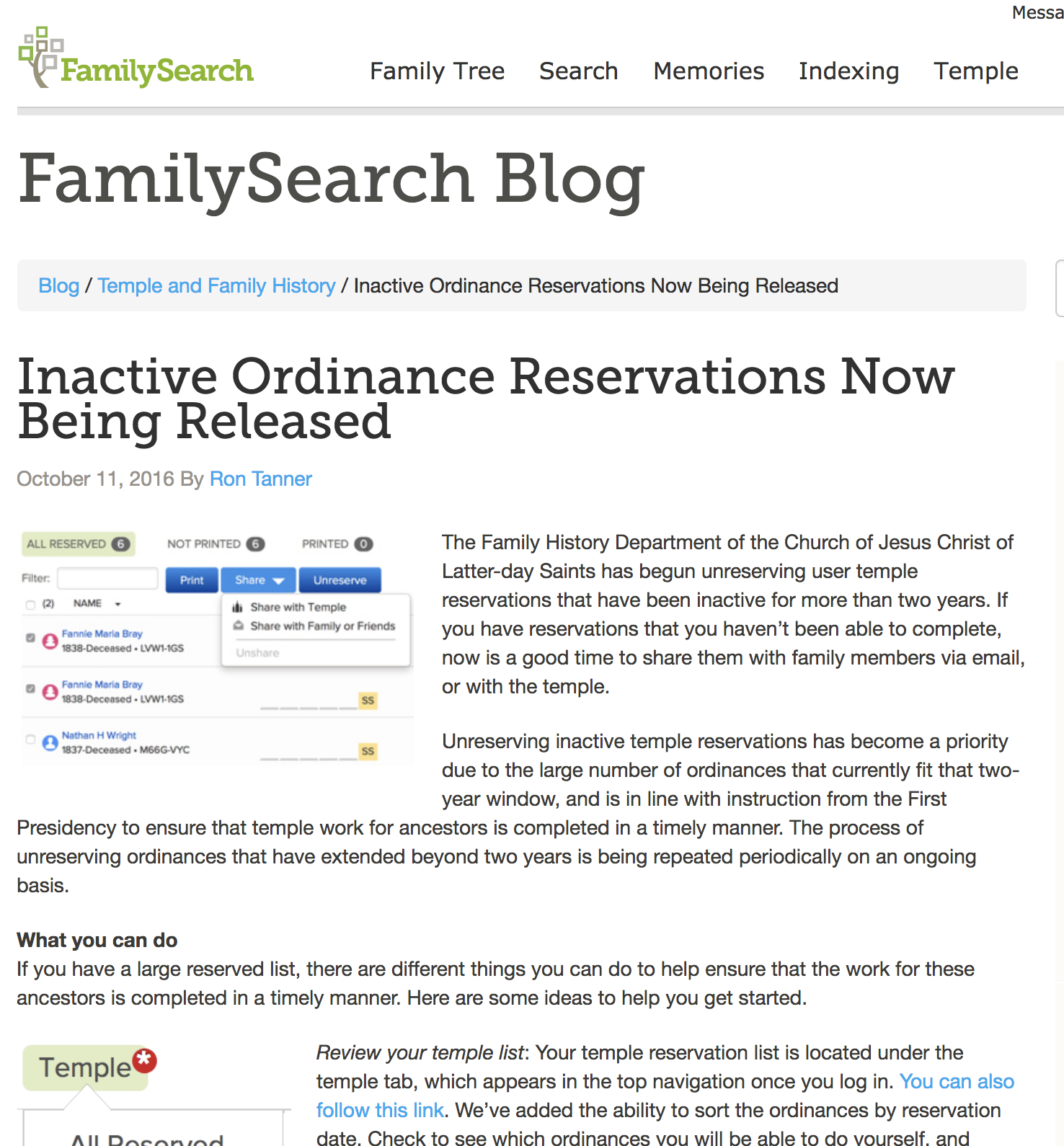
The Family History Department of the Church of Jesus Christ of Latter-day Saints has begun unreserving user temple reservations that have been inactive for more than two years. If you have reservations that you haven’t been able to complete, now is a good time to share them with family members via email, or with the temple.
Unreserving inactive temple reservations has become a priority due to the large number of ordinances that currently fit that two-year window, and is in line with instruction from the First Presidency to ensure that temple work for ancestors is completed in a timely manner. The process of unreserving ordinances that have extended beyond two years is being repeated periodically on an ongoing basis.
The issue behind this action is the simple fact that some people are hoarding temple ordinance reservations. The limit for maintaining a long list of reserved ordinances is two years. The reserved ordinances will not "go away" they will just become "unreserved" and return to the Family Tree as "Green Temple Icons." This will give other family members the opportunity to do the temple work.
Some users reserve far more ordinances than they could ever do even if they attended the temple every day it was open, all day long. Realistically, there is a physical limit to the number of reservations that could be accomplished by a single individual.
What you can do If you have a large reserved list, there are different things you can do to help ensure that the work for these ancestors is completed in a timely manner. Here are some ideas to help you get started.
Review your temple list: Your temple reservation list is located under the temple tab, which appears in the top navigation once you log in. You can also follow this link. We’ve added the ability to sort the ordinances by reservation date. Check to see which ordinances you will be able to do yourself, and which might be good candidates for sharing.
Share with family members via email: We have added the capability to share temple ordinances with family members and friends through email. This is a convenient, “cardless,” way to share the blessings of the temple with the living, and the dead. Click here to learn how this works, or read about someone’s experience with this feature on the FamilySearch Blog.
Share with the temple: If you don’t have family members that are able to perform temple ordinances, you can also share the ordinances with the temple. This is a great way to ensure that ordinances are performed expeditiously, as there are members all over the world who regularly attend the temple and need proxy names.
Un-reserve/re-reserve: If an ordinance has been on your list for two years, and, for personal or research reasons, it needs to stay there, you can unreserve the ordinance and then re-reserve it to restart the clock.
Do nothing: A final option is to just do nothing. The ordinances on your list that exceed the two years will automatically be unreserved and other family members will be able to snap them up.
I have not been waiting for the automatic un-reserving to occur, I have been creating my own unreserved list. See "My Unreserved List."
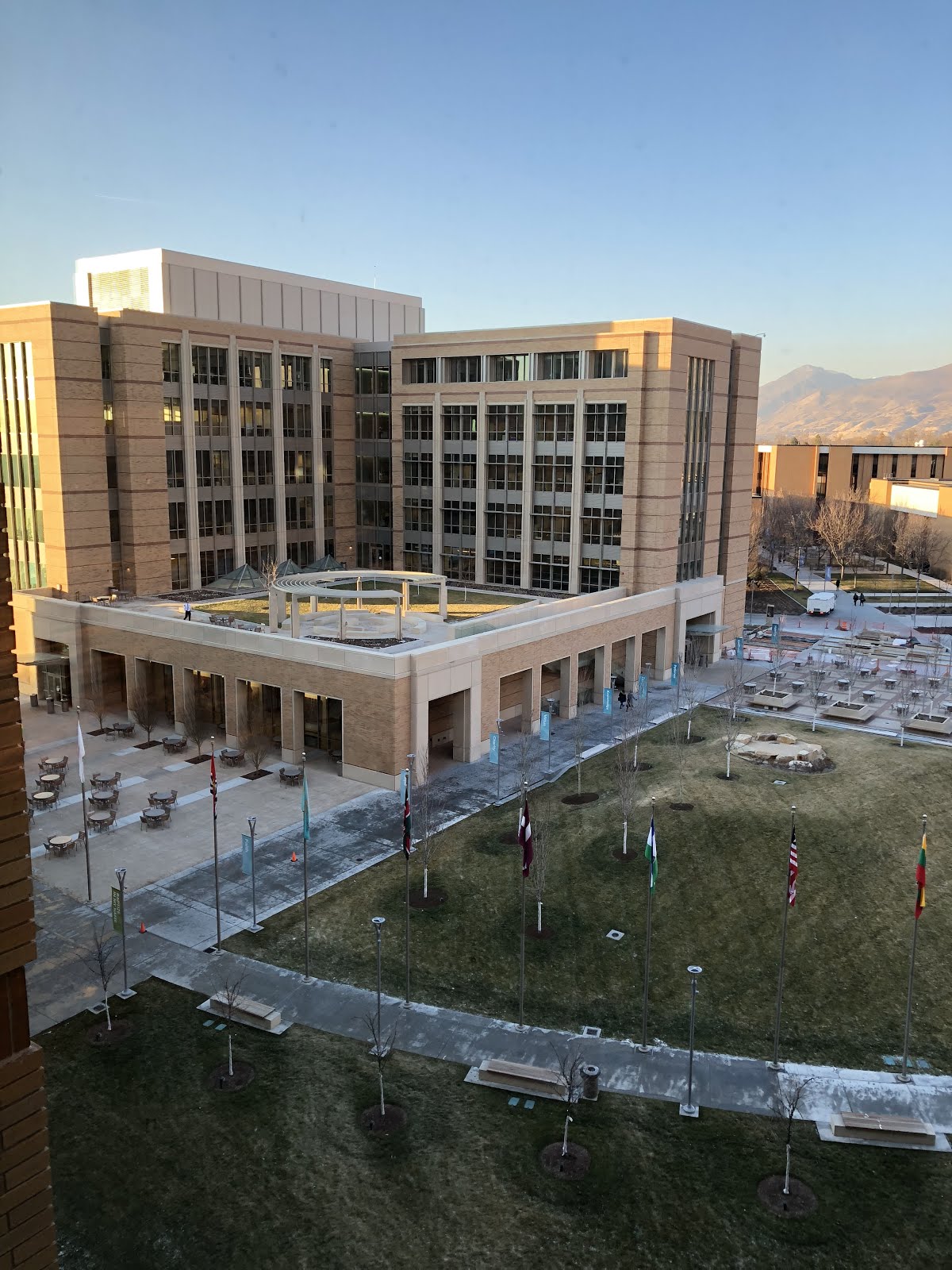
The Provo, Utah MTC showing one of the new high-rise classroom buildings.
No. 6
My wife and I have finished the first of our two weeks in the Provo, Utah Missionary Training Center or MTC. It would be an understatement to say that the week passed quickly. Since we live close to the MTC, we stayed at home all week rather than staying at the MTC, but we were there all day, Monday through Friday, and in the evenings on Monday and Tuesday. Overall, we felt that the MTC experience was wonderful and rewarding. We met some wonderful people and had an exceptionally good time.
The roots of the Provo Missionary Training Center (MTC) go back to the earliest years of this dispensation. Starting in 1832, the School of the Prophets was organized so elders could 'teach one another' the gospel and other subjects and 'be prepared in all things' in their missionary callings (D&C 88:77–80, 118).
Since that time, the Church has trained missionaries in several different locations, including
The Brigham Young Academy (1894)
The Ricks Academy (early 1900s)
The Latter-Day Saint University (1902)
The Salt Lake Mission Home (1924)
The Missionary Language Institute (1961)
The Language Training Mission (1962; located in Utah, Idaho, and Hawaii)
And finally, the Provo Missionary Training Center, which began serving missionaries in 1978.
The MTC’s campus has 19 buildings on a 39-acre site, with a capacity of housing and training 3,700 missionaries. Over 600,000 missionaries from nearly every country in the world have come to the MTC for training. The MTC trains missionaries for all of the Church’s missions and gives instruction in 55 languages.
On my earlier mission to Argentina in 1964, I was sent to the Language Training Mission or LTM at Brigham Young University. I was in the LTM for about twelve weeks to learn Spanish and wait for an entry visa into Argentina. Today's missionaries stay variable time periods for language training, but not 12 weeks.
Our days passed quickly and we had a wonderful time. Highlights of our time at the MTC were the young BYU instructors and the opportunity to associate with and talk to missionaries going to all parts of the world. We had classes primarily focused on our Savior Jesus Christ based on the contents of the Preach My Gospel handbook for missionaries. Although we did not see the visits by General Authorities that were the rule when I entered the Mission Home in Salt Lake City back in 1964, we had wonderful classes and testimonies. Some of the practical experiences we had turned out to be extraordinary opportunities to meet and talk to special people.
The food at the MTC was generally good and it was an experience to see hundreds of young adults consume mountains of food. We ate only lunch at the MTC and ate dinner at home in the evenings. The facilities are spotlessly clean and modern and the entire physical facility is beautifully maintained and accommodating.
We have really enjoyed our total experience so far.
In addition, there is a section on the FamilySearch.org Consultant Planner:
As The Family History Guide continues to evolve and become more valuable, it has become the go-to place for both individual and group training for genealogy around the world.
We have now spent our first few days in the Missionary Training Center (MTC) in Provo, Utah. We had one day with a little bit of snow and it turned very cold. Because we live very close to the MTC, we are living at home and driving a few blocks every day. There is a large map of the world and all the missionaries have their picture taken pointing to their mission assignment.
There are hundreds of missionaries in the MTC at all times. They come and go by rotation. Right now, there are about 80 or so senior missionaries. They are going to all parts of the world. For example, we have met missionaries going to Africa and to New Zealand. There are about a dozen Record Preservation Missionaries going to different parts of the world to help FamilySearch digitize records. We are the only ones going to the Washington DC North Mission. The missionaries going to countries other than the United States are usually called for 18 months or two years.
Our time at the MTC consists primarily of classes teaching us about our upcoming missionary service. The classes are taught by young returned missionaries attending BYU. It is amazing to see how mature and knowledgeable they are. On our first evening in the MTC, we had a joint meeting with all of the senior missionaries. Almost all of the senior missionaries are married couples except for a few single sister missionaries.
The Church of Jesus Christ of Latter-day Saints' missionary program is one of its most recognized characteristics. Mormon missionaries can be seen on the streets of hundreds of major cities in the world as well as in thousands of smaller communities.
The missionary effort is based on the New Testament pattern of missionaries serving in pairs, teaching the gospel and baptizing believers in the name of Jesus Christ (see, for example, the work of Peter and John in the book of Acts).
The article goes on to explain,
More than 70,000 full-time missionaries are serving missions for The Church of Jesus Christ of Latter-day Saints. Most missionaries are young people under the age of 25, serving in more than 400 missions throughout the world.
Missionaries work with a companion of the same gender during their mission, with the exception of couples, who work with their spouse. Single men serve missions for two years and single women serve missions for 18 months.
Missionaries receive their assignment from Church headquarters and are sent only to countries where governments allow the Church to operate. Missionaries do not request their area of assignment and do not know beforehand whether they will be required to learn a language.
Prior to going to their assigned area, missionaries spend a short period of time at one of 15 missionary training centers throughout the world. There they learn how to teach the gospel in an orderly and clear way and, if necessary, they begin to learn the language of the people they will be teaching. The largest training center is in Provo, Utah, with additional centers in Argentina, Brazil, Chile, Colombia, Dominican Republic, England, Ghana, Guatemala, Mexico, New Zealand, Peru, the Philippines, South Africa and Spain.
Like all of the other missionaries serving the Church, our service is voluntary and self-funded. We pay all of our own expenses while we are serving except travel expenses to and from our mission assignment. We even pay for our food while attending the MTC. Here is a link to a short video further explaining the missionary process.
The Consultant Planner is a marvelous tool for assisting others in discovering their family connections and participating in the Find-Take-Teach program. It allows those with more experience in using the FamilySearch.org Family Tree to find temple opportunities to help those who have not yet had that opportunity. If you need help with the Consultant Planner, please see the following video on the Brigham Young University Family History Library YouTube Channel.
When you start using the Consultant Planner to assist someone, you are provided with a fan chart, such as the one above, showing the countries of origin as they are shown on the Family Tree. This is the problem: some of the countries are duplicated or inaccurate. These problems reflect the status of the entries on the Family Tree. If the entries are standardized and/or corrected, then the fan chart will be more accurate. Of course, those helping others to find their own ancestral opportunities are not expected to make the corrections, but everyone should be encouraged to “clean up” their portion of the Family Tree.
Here is an example of what happens when the places are not standardized.
The list includes Utah USA and the United States as well as the United Kingdom and Wales. It also has Denmark and De. For help with Standardization, see the following video from the Brigham Young University Family History Library YouTube Channel.


 Posts
Posts