Genealogy from the perspective of a member of The Church of Jesus Christ of Latter-day Saints (Mormon, LDS)
Wednesday, December 14, 2016
Am I really related to Pope Benedict XIII?
The Relative Finder app and the new 15 generation, ancestral linkage in the FamilySearch.org Family Tree, will likely generate a lot of new relatives for you. As the screenshot above illustrates, Relative Finder indicates that I am a 13th cousin, 6 times removed of Pope Benedict XIII whose name was Pietro Francesco Vicenzo Mari Orsini. In this case, when I examine the pedigree showing the relationship, there are at least two of the individuals listed who did not have spouses and so it is interesting how they might have had children.
Going back on the line that is supposed to establish this relationship, I see the following:
The person at the bottom of this part of the line is David Shepherd, LC8T-DB3 who doesn't exist in the program. He was merged with David Shepherd LLM7-LKV as is shown in this screenshot:
Here is the real pedigree for David Shepherd as it stands today:
In short, the whole pedigree going back to royalty is not mine at all. The line ends with David Shepherd. No one, so far, has found his parents with cited sources. This includes my own efforts.
You might want to know that many of my own lines that extend back into antiquity are in exactly the same condition. As soon as I get around to it, I will be terminating all these lines at the appropriate place and most of these very speculative ancestral relationships will end unless Relative Finder keeps adding in the merged people as it seems to be doing.
Tuesday, December 13, 2016
How Am I Related Expands on the FamilySearch Family Tree
The ability to view relationships on the FamilySearch.org Family Tree has just been dramatically expanded. Thanks to my online friend, David McLean for alerting me to this expanded feature.
Now, according to this notice, you can trace your relationship back as far as 15 generations. Please take seriously the notice that the relationships are only as accurate as the data in the Family Tree. Going back 15 generations in any family line involves a lot of assumptions and very little factual content.
This link to "View My Ancestors" appears on every person's detail page on the FamilySearch.org Family Tree.
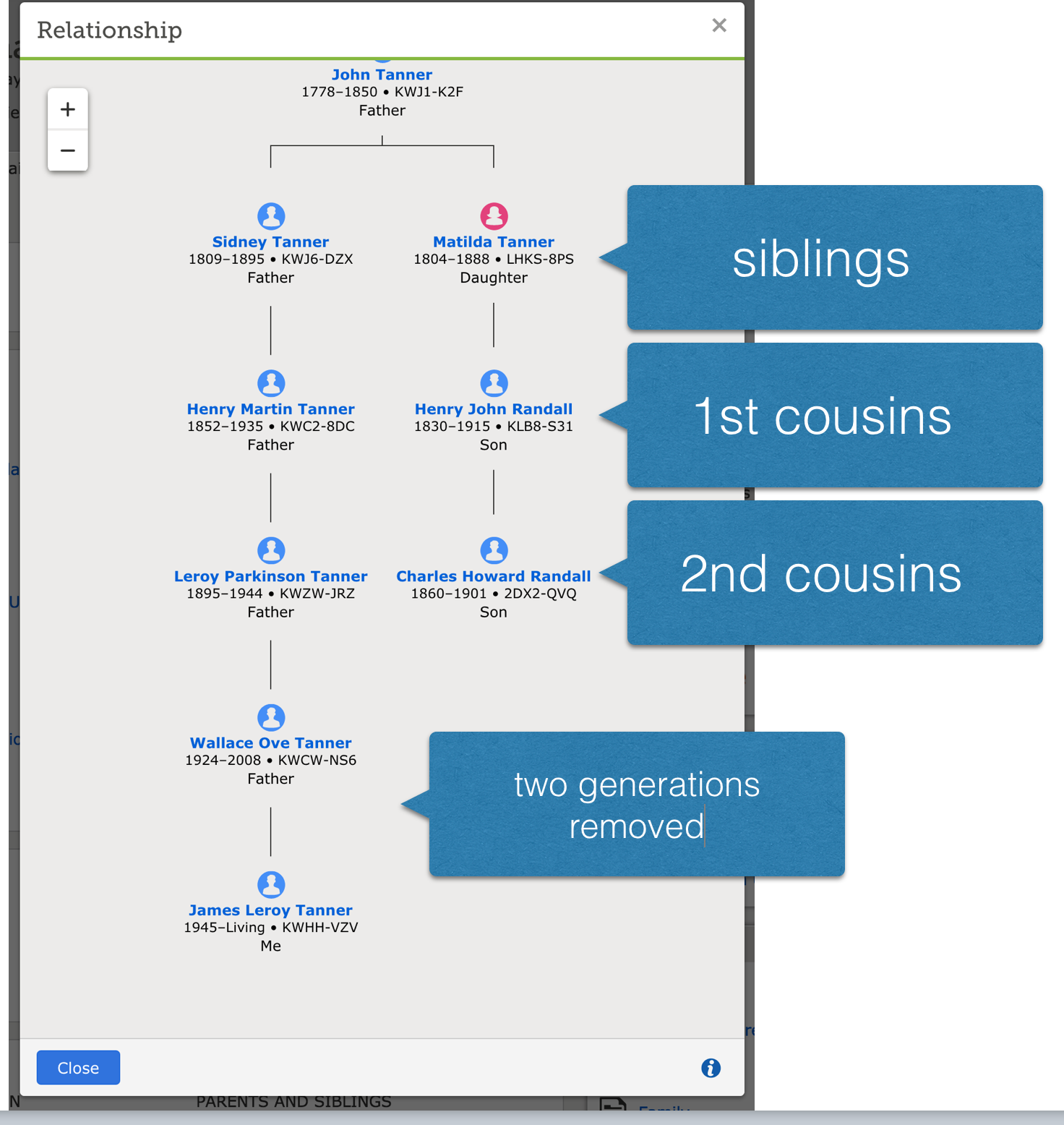
David McLean also sent me some notes about how we describe the relationships that the new features will reveal. For someone like me, working through relationships has almost been second nature. I was always being required to figure out how I was related to someone or another. Let's take this relationship chart for an example. How am I related to Charles Howard Randall?
So here is how I am related:
As David explained in his email to me, if you count back from the related person, until you reach the common ancestor the number of grandparents equals the number of the cousin. So here, Charles Howard Randall's father is Henry John Randall. His first grandparent is Matilda Tanner and the second one is shared and is John Tanner. That makes us 2nd cousins, but there are now two extra generations to count. We refer to these extra generations as "removed." So, in genealogical jargon, I am a 2nd cousin, two generations removed to Charles Howard Randall.
You can extend this as far out as you wish to go. Here is another example:
How am I related to Aurelius W. Brandt? This is a trick question. I am not related. He is the spouse of my 1st cousin, four generations removed on my side. OK, so this isn't as easy as some of us would like to think. It does help to have a chart and when you are working on descendency research, you can use the link to remind yourself how you are related to the person you are working on.
David McLean gave me a good way to refer to these relationships and with his permission, I will quote him.
When I teach it, I say “to be related we must share a common ancestor . . .” Once this is established I go on to say; “ if we share a parent, we are siblings; if we share a 1st generation grandfather, we are first cousins; if we share a 2nd generation grandfather, we are second cousins; if we share an X generation grandfather, we are Xth cousins." People usually catch on to this very quickly.I think it is the term "removed" that causes some of the confusion. We are so many generations removed when we aren't in the same generation. My father's brother's children are my first cousins. But those same people are my children's first cousins and there is a "removed" generation that is missing on the cousins' side so my first cousins are my children's "first cousins, on generation removed." Be sure to count yourself in the "removes."
I then say, “Just start with the shortest ancestry and count up parent, 1st, 2nd, 3rd, and then count the extra hops."
Don’t say “times-removed” (what is a “times” anyway); it is a “generation” removed.
By the way, an uncle/aunt is nothing more than a sibling X generations removed.
Thanks to FamilySearch for finally clearing all this up.
Monday, December 12, 2016
New Popular Videos on the BYU YouTube Channel
The Timeline Grid: An Easy Way to Track, Organize, and Use Your Research - Kathryn Grant
Jumpstart Your Family History in Ten Steps - James Tanner
The Ins and Outs of Standardized Places and Dates in the FamilySearch Family Tree - James Tanner
We have wrapped up our webinar series for 2016 and are already planning a whole new set of videos for 2017 at the Brigham Young University Family History Library. One more video will be posted for 2016 and then we have the semester break and no new videos until after the holiday season. All of these videos will continue to be posted on the BYU Family History Library YouTube Channel as usual. We will end the year with a total of 225 videos. I expect that we will upload more than a hundred new videos next year.
We now have 2,597 subscribers and over 111,000 views. As I have noted previously, this isn't very impressive in the context of the stuff usually featured on YouTube.com, but for family history and the BYU Harold B. Lee Library, this is a major accomplishment. We hope you enjoy watching all the new and old presentations. Remember to subscribe.
Sunday, December 11, 2016
Afterword to How to Actually Find New Names to Take to the Temples
When I wrote this series of posts about how to find names to take to the temples on the FamilySearch.org Family Tree, I had a remarkable confirmation of the efficacy of the program. When I published the last image in the series, I indicated that the next step included standardizing the dates and place of the person I had found to use as an illustration. The next day, I found someone had already completed all the work that same day and, in addition, had added some names to the Family Tree. It turned out that this was a researcher in England acting entirely independently of anything I was doing. But the remarkable thing was that the Family Tree was functioning exactly as it was designed to do.
Since the user in England had been doing research and correcting the same entries that I was working on, we both avoided duplicating the effort. He benefited from what I was doing and I benefitted from what he was doing. We were able to communicate directly through the Family Tree and coordinate efforts.
This is how the Family Tree was supposed to work and it is very comforting to find out it works exactly as planned. Hurray for FamilySearch and Hurray for the Family Tree.
How to Actually Find New Names to Take to the Temples -- Part Five
In this installment about finding new people to add to the FamilySearch.org Family Tree, I have progressed to the point where I have selected my first family for research. I am not directly related to James Turner, b. 1825. He is married to one of my cousins. But this is the family I have chosen to start with. My first step is to standardize all the dates and places. This gives the Family Tree program a better opportunity to find Record Hints. I will also look at and evaluate the places and the see if the Record Hints that are already showing are accurate and that the places listed for the children's life events are consistent.
Well, surprise. I guess by doing this in public and online, I get the benefit of the collaborative nature of the Family Tree. Someone, obviously identified by the link in the Family Tree, has done most of what needed to be done for James Turner.
There is still some work to do with the children listed in the family, but James Turner's christening record was found by my helpful Family Tree associate and there is now a temple opportunity to seal James Taylor to his parents. When this happens, you always wonder if the other user is a relative on your line or the line of the unrelated spouse. But here, either way, new individuals have been added to the Family Tree and as a result, there are additional temple ordinances that need to be done. Here are the newly added people.
The rule here is that I can seal the husband of my cousin to his parents, but the present rule does not allow me to do additional temple work on his line because he is not a bloodline relative.
Essentially, this is the end of my example. My next step would be to work on adding the families of the children of James Turner and Anne Bryant. They and their descendants are my cousins and as I add in their families I will very likely find additional names to take to the temple.
Everything I did to get to this part of the Family Tree is necessary to increase the likelihood that I am related to the people I find (or someone else working on the same family finds).
Past posts in this series:
http://rejoiceandbeexceedingglad.blogspot.com/2016/12/how-to-actually-find-new-names-to-take_10.html
http://rejoiceandbeexceedingglad.blogspot.com/2016/12/how-to-actually-find-new-names-to-take_9.html
http://rejoiceandbeexceedingglad.blogspot.com/2016/12/how-to-actually-find-new-names-to-take_6.html
http://rejoiceandbeexceedingglad.blogspot.com/2016/12/how-to-actually-find-new-names-to-take.html
Saturday, December 10, 2016
How to Actually Find New Names to Take to the Temples -- Part Four
I am continually surprised at the lack of interest I find in participating in the process of finding ancestral names to take to the temples. You would think with all the emphasis put on searching out our kindred dead that people would be anxious to learn how to do this. But the opposite is generally the results of my offers to help. Most of those I approach acknowledge that it might be a good idea, but converting that "good idea" into some action seems to be almost nonexistent. OK, so there is my comment for the day for what its worth.
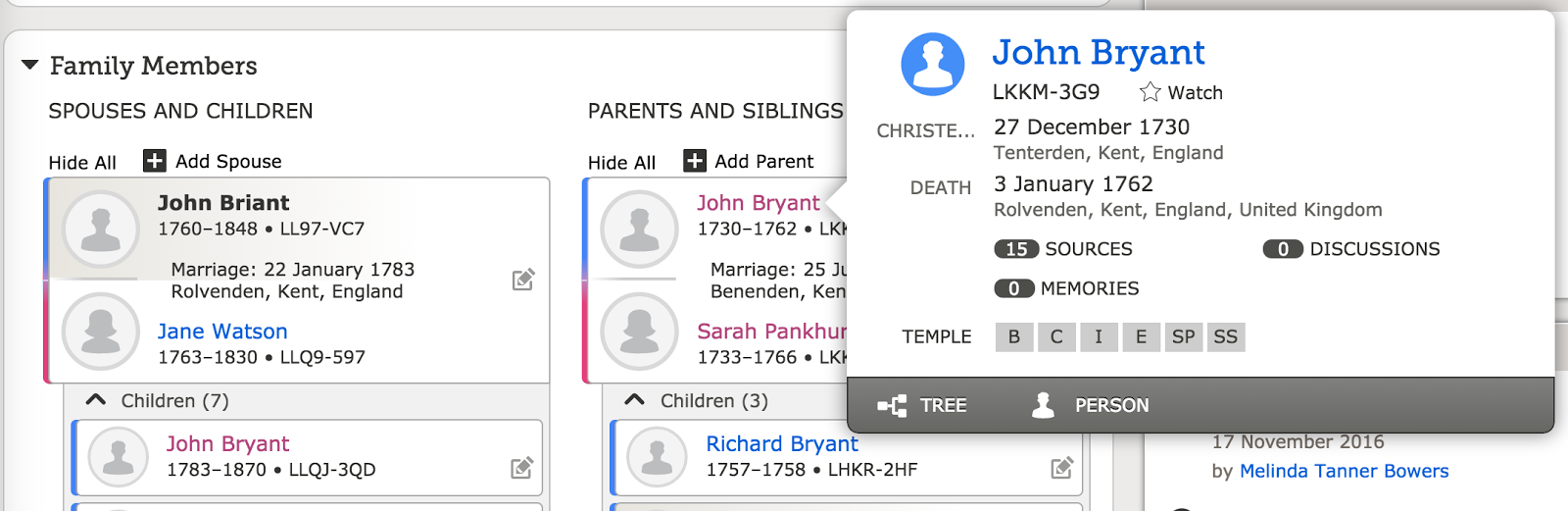
In this installment, I have finished examining the existing entries in one of my ancestral lines in the FamilySearch.org Family Tree back to an ancestor who was not a convert to The Church of Jesus Christ of Latter-day Saints. When this is possible, the ancestor should also be reasonably identified and well documented. The image above shows the Descendancy View for John Briant, b. 1730, d. 1762. Even with this remote date, we have 15 sources for this person. I suspect that there are some missing children or perhaps his wife died and he remarried, but these possible issues are only speculation. As I noted, there are still many years' worth of records to search in both Rolvenden, Kent, England and the nearby parish of Tenterden.
The traditional tendency among family history researchers is to try to extend family lines. The main challenge is that the records have not been readily available and few researchers have the skills to accurately evaluate the entries that do exist. This family has a common issue with very common surnames and equally as common given names. It is tempting at this juncture to try to match the family to similar names that appear in adjoining or even geographically distant parishes. But the simple fact of life in this time period was that these people did not move around much unless there was an overriding external cause such as a war or other such disturbance. It is inevitable that at some time in the past, the records will stop and the lines will end, but as long as entries can be found and documented, the lines can continue to be extended.
For this example, I chose to stop pursuing the line into the past with his John Briant born in 1730. The date gives me adequate room to do descendency research before running into the 110-year limitation. The next step is to review the overall accuracy of the descendants of this particular ancestor. I click on the generations link to extend the descendency list to two generations, then three and then four. This gives me an overall view of where there might be problems already recorded in the Family Tree.
With a four generation extension, I only find two red exclamation point issues. This is, by the way, a reflection of the careful research that has heretofore gone into this particular line. In most cases, there are either very few entries or there are an overwhelming number of red warning icons. Here are the two red warning entries.
In this case, the child listed as William Bryant born in 1840 is supposedly born when the mother was 57 years old. Also, there is a ten-year gap between this William and the previously recorded child. It is very likely that research will show that this particular child is not a child of the recorded marriage or couple.
This next warning indicates that the dates recorded are wrong and that more research is needed. I also note that there are no green temple icons in this view. There are a few dark blue temple icons indicating that someone (perhaps me) has already reserved some of the ordinance work that was available previously. It is becoming increasingly difficult to find green temple icons and get, in a sense, a free ordinance card. This does not mean that there aren't a lot of opportunities, it just means that anyone looking at this particular line will have to do some serious research to find additional entries.
Where do I go to look? I have three main criteria to find additional areas in which to do immediate research:
- People who show a birth date, no marriage, and no death date
- People who show a marriage and no children
- People who are married but have only one or two children listed
Usually, if any one of these conditions is present, there is a substantial opportunity to do research and find additional, previously unrecorded, individuals, in the families. There is one other possible avenue for expanding the family lines and that is to resolve the red warning icons. Usually, additional research in these families will disclose other, more serious, issues with the existing research and correcting the families usually produces additional temple opportunities.
At this point, there is a serious issue. anyone approaching this situation must have a basic understanding of doing genealogical research in England. If you get to this point and are not familiar with parish registers, the England and Wales Census records and so forth, it is time to take a break and start learning. I suggest you go to The Family History Guide at thefhguide.com and start learning about English research. You can also ask for some help at your local Family History Center or watch one or more of our online videos on the BYU Family History Library YouTube Channel.
Beginning English Research: Introduction to the Records - James Tanner
Here is where the tire hits the road. You really do have to know something to do genealogy. What a surprise.
Back to the descendency list, I have been working on this family line for a while and have already done a bit of research with positive results. In looking down the four generation descendency list, I see a lot of blue icons indicating Research Hints from FamilySearch. These are usually quite accurate and helpful. I could spend some profitable time adding Research Hints, but for this particular example, I will focus on a family. Here was my first choice:
The blue icons indicate Research Hints and the two purple icons indicate a possible missing child and that no sources are attached to Emma Turner. These people are supposedly my cousins. I say "supposedly" because, without further research, I cannot really be sure the information in the Family Tree is accurate. If you are facing this type of situation, you should realize that the information already contained in the Family Tree may or may not be accurate. My next step is to open the detail page for Anne Bryant and look at each of the entries for this family in detail. I have already worked on this family a bit and so I can already say that
I will come back to this family in my next installment.
Past posts in this series:
http://rejoiceandbeexceedingglad.blogspot.com/2016/12/how-to-actually-find-new-names-to-take_9.html
http://rejoiceandbeexceedingglad.blogspot.com/2016/12/how-to-actually-find-new-names-to-take_6.html
http://rejoiceandbeexceedingglad.blogspot.com/2016/12/how-to-actually-find-new-names-to-take.html
Friday, December 9, 2016
How to Actually Find New Names to Take to the Temples -- Part Three
In this series, I am working through each step in the process of finding additional people to add to the FamilySearch.org Family Tree in detail. I am using some of my own research and correction work on the Family Tree to illustrate the process. I suggest that you may want to read the previous posts to understand the complete process. Your own experience with the Family Tree may differ considerably from mine. If you or your recent ancestors joined The Church of Jesus Christ of Latter-day Saints in the last 100 years or so, you may have many more opportunities to find family members with different challenges. But fundamentally, the processes are all the same. Your research challenges may be easier or much greater than my own, but the process of using the Family Tree as an aid in directing your research is also the same.
I left off in the last installment with my Great-great-grandmother, Mary Ann Bryant. She was born in England and died in Utah. She joined the Church in Australia and was married to John Porter in Maitland, West Maitland, New South Wales, Australia. Only part of the Bryant family joined the Church and there are Bryant descendants, my cousins, who live in Australia today. A considerable amount of research has been done on the family. There is a surname book as follows:
Parkinson, Diane, and John Parkinson. Samuel Charles Bryant of Rolvenden: His Roots and His Branches : England, Australia, America : A Biographical History and Genealogical Record of the Family of Samuel Charles and Sarai Stapley Bryant. Austin, Tex.: Published for the Samuel Charles Bryant Family Association by Historical Publications, 1993.
Later, after her conversion, Mary Ann Bryant married my Great-great-grandfather, Thomas Parkinson, either on the ship coming to America from Australia or in California when then arrived. At this point, we can see that there may be some members of either of these families who did not join the Church and either remained in Australia or were still in England. In any event, the lives of both Mary Ann Bryant and her husband, Thomas Parkinson, are well documented.
As you are going back through your family on the Family Tree, it is extremely important to review and understand and evaluate the information already contained in the Family Tree. It is also important to standardize the entries and correct the names, dates and places cited.
I now move back one more generation. The idea here is to get to the point where we reach the first families to join the Church. I can assume at least some of the descendants of the families who joined the Church do not need additional ordinances. This may not always be an accurate assumption, but for the purposes of illustrating the process, I will make that assumption at this level. Mary Ann Bryant's father was Samuel Charles Bryant, the subject of the book cited above.
Samuel Charles Bryant had twelve children. Most of the children died in Utah. This is one way to quickly determine which of the children joined the Church and which didn't. But the real question at this point is whether or not I can move back one more generation and still feel confident that I am considering people who were actually related to me. One consideration is the 110 Year Rule. That is that you must obtain permission from living relatives to do the temple ordinances for anyone born within the last 110 years. See "Reserving ordinances for an ancestor born within the last 110-years."
The reason for the 110 Year concern is that when I begin to look for descendants of an ancestor, it helps to have some time in the 1800s when the most records are available to search for new people. One of Samuel Charles Bryant's children died in 1930 so there will be only two or possibly three generations to search and research. So I look back another generation to John Briant. You might notice the spelling change in the name. As we go back in time, the names were often recorded from the way they sounded rather than relying on any standard spelling. Names recorded before about 1850 can likely have spelling variants.
John Briant (or Bryant) was christened in 1760 and died in 1848 in Rolvenden, Kent, England. Rolvenden is a very small village and at this point in my investigations, I need to focus on the places where these people are reported to have lived. During the 1700s people did not have any transportation options other than horses or walking. Subsequently, they were born, married and died in a very restricted area. My rule is to question anyone who is recorded to have lived more than about ten miles from the identified parish in England as being very suspect.
At this point, I am also looking for documentation. I can see that John Briant is rather extensively documented. As it happens, almost all of this documentation is due to my own research, so I am very confident that I have the right person. This confidence is essential to this entire process. You do not want to spend a lot of time looking at and researching a family just to discover that you are not related. All except for two of John Briant's children died in England. Samuel and Sarah joined the Church and eventually ended up in Utah where they died.
I decided to go back one more generation to another John Bryant christened in 1730 and who died in 1762. He is also adequately documented with reliable sources.
I checked the FamilySearch.org Catalog to see when the earliest records are available for Rolvenden, Kent, England and the nearby village of Tenterden. The earliest parish registers date from 1558 and in Tenterden, they date from 1544. I could still go back quite a ways, but I will stop and begin looking at the descendants of John Bryant, b. 1730. I click on the link to show his part of the Family Tree by putting him in the primary position.
I am now ready to switch to the descendency view and see John Bryant's descendants.
You might think that I am taking a long time to get to this point and you would be correct. It is only by very careful and meticulous evaluation of the records and all of the sources that you can begin to have any confidence in the accuracy of the entries. You do not have to do all the work to verify your ancestors. The entire idea of the Family Tree is that the users (family members or cousins) will work together to do this work of verification and documentation. But as it happens, you may find yourself being the lone person working on these particular family lines.
In the next installment, I will begin by looking at the descendants and doing some research.
Past posts in this series:
http://rejoiceandbeexceedingglad.blogspot.com/2016/12/how-to-actually-find-new-names-to-take_6.html
http://rejoiceandbeexceedingglad.blogspot.com/2016/12/how-to-actually-find-new-names-to-take.html
Subscribe to:
Posts (Atom)