Genealogy from the perspective of a member of The Church of Jesus Christ of Latter-day Saints (Mormon, LDS)

Tuesday, July 7, 2020

Online Volunteer Opportunity: Help Improve Place-Names: A good idea with some unforeseen consequences


Crowdsourcing can accomplish some tasks that are overwhelming when viewed on a one-by-one basis. The Family Tree is an excellent example of crowdsourcing. Although there is a downside for those people who excessively focus on the changes without understanding the process of correcting information that is inaccurate the overall achievement is adding a huge amount of information in a universally accessible venue. 

On the other hand, this idea of looking briefly at a geographic location and then changing it to match a preselected "standard" place is rife with the possibility of error and loss of data. Sadly, geographic knowledge is sadly lacking in many countries and cultures of the world. For example, in my experience helping people in the United States with research around the country and in Great Britain, I have found almost no knowledge of the geography of the United States or England down to the county level not even looking down to the city and town level. Choosing a preselected standard place name has always been an extremely controversial topic in the genealogical community. Software programmers love standards. Researchers find constant place name designations that do not fit in a standard mold. 

Here is one example of the variations in the place names for the same location in one family entry in the FamilySearch Family Tree. You might note that Kentucky did not become a state until June 1, 1792. I should also mention that Nicholas County, Kentucky was not created until June 1, 1800. Here is the list.
  • Birth abt 1780 Lincoln, Kentucky, United States
  • Birth 1787 Of,,,Ky
  • Birth abt 1787 of Nicholas Co., Ky.
  • Birth about 1789 Kentucky District, Nicholas, Virginia, United States
  • Birth 1791 Carlisle, Nicholas, Kentucky, United States
  • Birth 1793 Ky
  • Birth 1795 Of,,,Ky
  • Birth 1797 Of,,,Ky
  • Birth 1799 Of,,,Ky
  • Birth abt 1801 of Nicholas Co., Ky.
  • Birth 1802 Nicholas, Kentucky
  • Birth abt 1804 of Nicholas, Ky.
As a matter of fact, most of these place names are incorrect and I would ask you, as a reader of this blog post, can you tell what is wrong with each entry? Even assuming you read my comments on the dates?

Recently, I have had a situation where a Family Tree user absolutely refused to standardize the place names even when they were exactly the same as suggested standards. 

If we move out of the United States, we have so even more complex problems. The place names in Denmark may contain elements of territories, waters, settlements, cultivated areas, streets and roads, houses, farms, and shops, and many other things. Another complication of this naming system is the Danish “Farm Name.” Quoting from Nordic Names:
Farm names were usually added to the given name and the patronym and originally functioned as an address rather than as a surname. 
When name laws were introduced in the 19th and early 20th century and hereditary surnames became mandatory, many people decided to keep their farm name as a surname. 
In Denmark many people who use a secondary patronym chose to take a farm name as a middle name.
Can someone by looking at the following type of entry make any of the temporal or geographic judgments necessary to have a correct, not just standard, place name?


These are the choices offered by the new app that is supposed to standardize the place. Here is a quote about the Caddo Tribe and the Kiowa Agency from the FamilySearch Research Wiki article "Kiowa Indian Agency (Oklahoma)."
The Kiowa Agency [also called: Anadarko Agency, the Kiowa and Comanche Agency, and the Kiowas, Apache, and Comanche Agency] was established in 1864. The tribes assigned to it -- Kiowa, Apache, and Comanche -- had been previously assigned to the Upper Arkansas Agency, and before 1855, to the Upper Platte Agency. Even after the establishment of the Kiowa Agency, it was closely associated with the Upper Platte Agency. The Kiowa Agency also has some responsibility for some Caddo Indians during the Civil War and for some Comanche Indians living in Texas.

There was no fixed location for the Kiowa Agency during its early years. It was supposed to have its headquarters at Fort Larned, Kansas, but due to the nomadic life of the tribes assigned to it, the agent spent most of his time moving about. By the Treaty of Medicine Lodge Creek in 1867, the three tribes agreed to settle in an area south of the Washita River in Indian Territory. An agency headquarters was located on Cache Creek near Fort Sill.

From May 1869 to July 1870, the Wichita Agency was consolidated with the Kiowa Agency, but in 1870, the Wichita Agency again became independent. The two were again consolidated on 1 September 1878 and the combined agency became the Kiowa, Comanche, and Wichita Agency
This discussion continues in the next article, "Kiowa, Comanche, and Wichita Indian Agency (Oklahoma)."
The Kiowa Agency and the Wichita Agency were consolidated 1 September 1878 and became the Kiowa, Comanche, and Wichita Agency. It was still commonly called simply the Kiowa Agency and some of the records are filed under that name. The Agency headquarters for this agency was located at Anadarko, Oklahoma and became the forerunner to the Anadarko Agency
So, where was this person born? Where are the records located is there are any? If a user chooses any one of the standardized places, they are wrong.  

This new app will create a massive clean up problem for those standardized entries that lose valuable information. 

The common approach to place names views them in a hierarchal order from smallest to largest or most restrictive to most inclusive in the form of “town/township, city, county, state, country.” This simplistic view can readily be shown to be inadequate when you begin to record places in a country such as Denmark. In order to uniquely identify people with the same or very similar names, it is important to understand the origin and development of the Danish place names which take a two-part form. 

Quoting from the University of Copenhagen, Names in Denmark, from the Department of Nordic Research, here is a list of common place name types:

Names in -inge
Names in -um
Names in -løse
Names in -lev
Names in -sted
Names in -by
Names in -toft(e)
Names in -torp
Names in -bøl(le)
Names in -rød
Names in -tved
Imperative names
Abstract names
Names that look old

To see more information, here is a further quote from the section on “The publication of place-names in Demark.

There is no complete list or database containing all the Danish place-names but the series Danmarks Stednavne, Danske sø- og ånavne and Sydslesvigs Stednavne each cover a large proportion of the country with a thoroughly researched and interpreted corpus of names. The handbook Danske stednavne provides a brief explanation of over 7,000 place-names – first and foremost settlement names – in Denmark.

The place names in Denmark may contain elements of territories, waters, settlements, cultivated areas, streets and roads, houses, farms, and shops, and many other things. Another complication of this naming system is the Danish “Farm Name.” Quoting from Nordic Names:

Farm names were usually added to the given name and the patronym and originally functioned as an address rather than as a surname.
When name laws were introduced in the 19th and early 20th century and hereditary surnames became mandatory, many people decided to keep their farm name as a surname.
In Denmark many people who use a secondary patronym chose to take a farm name as a middle name.

The point of these examples is that naming places is more than designating a series of blank places to fill in with names. 

I cannot begin to imagine what will happen to Danish place names with this new program. Here is just one example of a suggested standard for a Danish place.
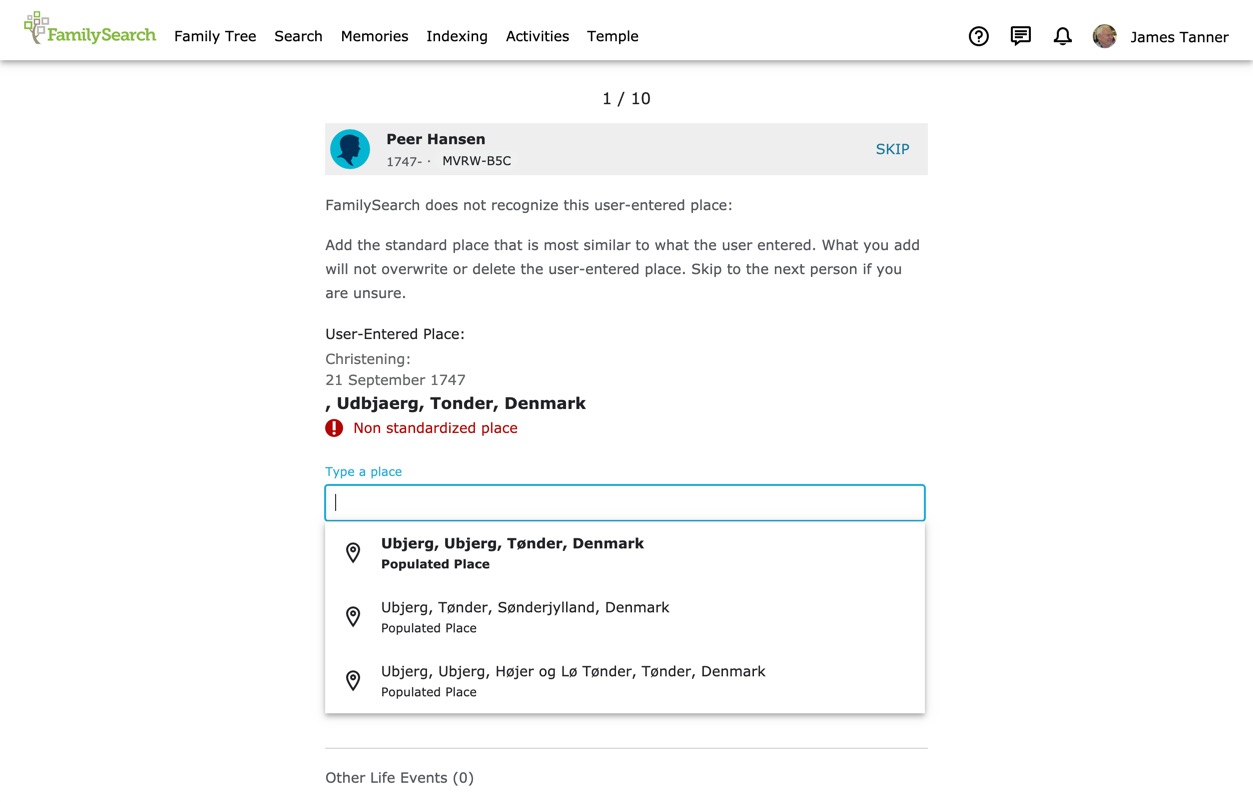

Which of the three suggested places would you choose? What if the information in the non-standard place name is simply wrong? I can go on for pages and pages, but I will leave my further comments for another day.

Monday, July 6, 2020

Updates on FamilySearch to Temple Ordinance Reservations


https://mail.google.com/mail/u/0/#inbox/FMfcgxwJWhwHMdwfpqffggsrrvmVZJGb

There have been a number of significant revisions to the FamilySearch.org Family Tree, Temple Ordinance Reservation system. These updates are summarized in a blog post entitled, "Updates to Temple Ordinance Reservations." The list of the featured revisions is as follows:
  • Update: June 11, 2020—Help Others on Temple Pages
  • Update: June 11, 2020—Request Shared Names Using the Family Tree or Ordinances Ready
  • Update: June 11, 2020—Simplified Temple Reservation Lists
  • Update: June 11, 2020—Fewer Temple Icon Colors
  • Update: July 29, 2019—Ordinances Ready: A Convenient Way to Find Ordinance Reservations
  • Update: July 29, 2019—Expiration of Ordinance Reservations
  • Update: July 29, 2019—Date Required to Reserve Temple Ordinances
  • Update: July 29, 2019—Easier Ways to Print Ordinance Reservation Cards
All of these are linked and explained by this one blog post. At the time of this post, the temples of the Church are closed because of the COVID-19 pandemic so it had been a while since the June 11th announcements and changes. Sorry to be late in bringing this to your attention. 

Wednesday, June 24, 2020

Juneteenth Live with Thom Reed


It is important to realize that there are a broad spectrum of cultures and nationalities in The Church of Jesus Christ of Latter-day Saints and we need to be open to both learn about those in the Church and respect their history and culture. Here is a link to President Russell M. Nelson, President of the Church's recent statement on social media condemning racism and pleading for peace. 

https://www.thechurchnews.com/leaders-and-ministry/2020-06-01/president-nelson-addresses-race-in-social-media-post-185657


Wednesday, June 17, 2020

The Future of Family History Centers and Libraries in the Years of the Pandemic


Copper engraving of Doctor Schnabel [i.e Dr. Beak], a plague doctor in seventeenth-century Rome, with a satirical macaronic poem (‘Vos Creditis, als eine Fabel, / quod scribitur vom Doctor Schnabel’) in octosyllabic rhyming couplets. See https://en.wikipedia.org/wiki/Plague_doctor

As the number of daily new cases of the COVID-19 virus around the world continue to increase rapidly as of the date of this post, logical questions arise about the future. Family History Centers and Libraries have been closed because of the pandemic since the middle of March, now about 3 months ago. 

As I have noted many times, my wife and I have been serving at the Brigham Young University (BYU) Family History Library for the past six years (including a year spent in Maryland, United States at the Maryland State Archives digitizing records for FamilySearch.org but continued to participate in webinars and other presentations). This is the longest period in my life for the last sixteen plus years that I have not been serving regularly in a Family History Center or Library. 

My experience with serving at the Mesa FamilySearch Library came to an interesting conclusion when I moved to Provo, Utah, and began serving at the BYU Family History Library. Shortly after we left Mesa, Arizona, the Mesa FamilySearch Library was closed for "temporary remodeling and repairs." Unfortunately, the building housing the Library was never used again. There were many Church Service Missionaries of The Church of Jesus Christ of Latter-day Saints serving at the Library at the time it closed. See "What is happening with the Mesa FamilySearch Library?" and "The Plight of the Mesa FamilySearch Library" and other previous posts including the final one: "The End of an Era: Mesa FamilySearch Library is Closing Completely."

Shortly after we arrived in Provo, Utah, we witnessed a similar situation when the Orem FamilySearch Center/Family History Training Center was closed and many Church Service Missionaries were released within a very short time. I am still hearing stories about the closure of the Training Center, now closed for almost five years. 

The situation that occurred with the Mesa FamilySearch Library has become a prime example of the problems associated with the closing of a busy and well-attended family history facility. From the time of the Library's closure in the late Fall of 2014 until its final closure in 2018, the Church Service Missionaries continued to serve where and when the could. The missionaries moved the function of the Library to an older (original) building after a long wait for information about when and if the Library would reopen. Finally, the issue was resolved when it was announced that the Mesa, Arizona Temple would be closed for renovation and both the older and newer Family History Library buildings would eventually be torn down. It was also announced that a new Family History Discovery Center and Family History Center would be included in the Temple's Visitor Center. With the pandemic, the Mesa, Arizona Temple's reopening, and the opening of the Visitor's Center are likely dependent on the progress of the pandemic. 

Now we come to the closing and future possible reopening of the BYU Family History Library. There are some major differences between the BYU facility and the one in Mesa but there are a lot of similarities. Both Libraries were busy, well-attended, and staffed with many Church Service Missionaries. All of the missionaries in Mesa were put into a state of indecision about the future of their service. Likewise, the BYU missionaries are now in a similar situation. Most of us are well into the age considered to be at an increased risk for the virus. Even if limited use of the BYU Family History Library were allowed, we would not be able to return to serve at the Library because of our susceptibility. 

No firm announcements about the opening of the Family History Library have been yet released but I have heard that even if the Library is opened, use of the Library would be limited to students and university staff and educators. We may be excluded from the Library for as long as a year or even more. 

Now this problem is not confined to the BYU Family History Library, the same problem exists with the Salt Lake City, Utah Family History Library, and all of the other Libraries and Centers around the world. 

We need to get on with our presently very limited lives. We should not be put in the same position as were the missionaries in Mesa; waiting for word of whether or not they could go back to serve and ultimately told that they were essentially out of work. Many of us have struggled with how we should respond to this situation. However, we are not alone. This is the situation with Church Service Missionaries of all kinds waiting to serve around the world. But there are also Family History Center Directors and volunteers who are not missionaries and who are also in the same circumstances. How many of us will wait and wait and then ultimately find out that our Centers have been closed permanently or that the Libraries no longer need senior missionaries to serve?

There has been a continued background of discussion about how many of the existing centers are still needed and used. There have been other discussions about centers being closed and consolidated into a more central location such as was done with the Riverton Family History Library in Utah. This pause in the service of so many missionaries would be a good time to make those decisions and let the missionaries, Center Directors, and volunteers know that they will not be needed. 

Both my wife and I have talked about alternatives. In our case, we have plenty of our own family history work to do but it is a shame that people with extensive family history and genealogy experience, some of who have spent years learning, helping, teaching, and serving will be lost to the greater genealogical community. 

What if we just wait around to see what happens? Not a good idea. When you are as old as we are, there are not a lot of realistic years in the future to plan. If we are going to do something we need to do it now. 

To anyone who can make a decision in this matter, take a lesson from Mesa and Orem and BYU and let us get on with our lives. 

Monday, June 8, 2020

Arm In Arm | President Russell M. Nelson and Reverend Amos C. Brown


In light of recent events, Russell M. Nelson, President of The Church of Jesus Christ of Latter-day Saints shared the following message on his social media accounts:

We join with many throughout this nation and around the world who are deeply saddened at recent evidences of racism and a blatant disregard for human life. We abhor the reality that some would deny others respect and the most basic of freedoms because of the color of his or her skin.

We are also saddened when these assaults on human dignity lead to escalating violence and unrest.

The Creator of us all calls on each of us to abandon attitudes of prejudice against any group of God’s children. Any of us who has prejudice toward another race needs to repent!

During the Savior’s earthly mission, He constantly ministered to those who were excluded, marginalized, judged, overlooked, abused, and discounted. As His followers, can we do anything less? The answer is no! We believe in freedom, kindness, and fairness for all of God’s children!

Let us be clear. We are brothers and sisters, each of us the child of a loving Father in Heaven. His Son, the Lord Jesus Christ, invites all to come unto Him—“black and white, bond and free, male and female,” (2 Nephi 26:33). It behooves each of us to do whatever we can in our spheres of influence to preserve the dignity and respect every son and daughter of God deserves.

Any nation can only be as great as its people. That requires citizens to cultivate a moral compass that helps them distinguish between right and wrong.

Illegal acts such as looting, defacing, or destroying public or private property cannot be tolerated. Never has one wrong been corrected by a second wrong. Evil has never been resolved by more evil.

We need to foster our faith in the Fatherhood of God and the brotherhood of man.

We need to foster a fundamental respect for the human dignity of every human soul, regardless of their color, creed, or cause.

And we need to work tirelessly to build bridges of understanding rather than creating walls of segregation.

I plead with us to work together for peace, for mutual respect, and for an outpouring of love for all of God’s children.
Because I have lived through the years of the Civil Rights Movement and because I have lived in both South and Central America, I have strong feelings about the need to repent of any prejudice against any group of God's children especially prejudice toward another race. I would hope those of you who have such feelings pay heed to this message. 

Wednesday, June 3, 2020

GenealogyBank Added as New FamilySearch Partner


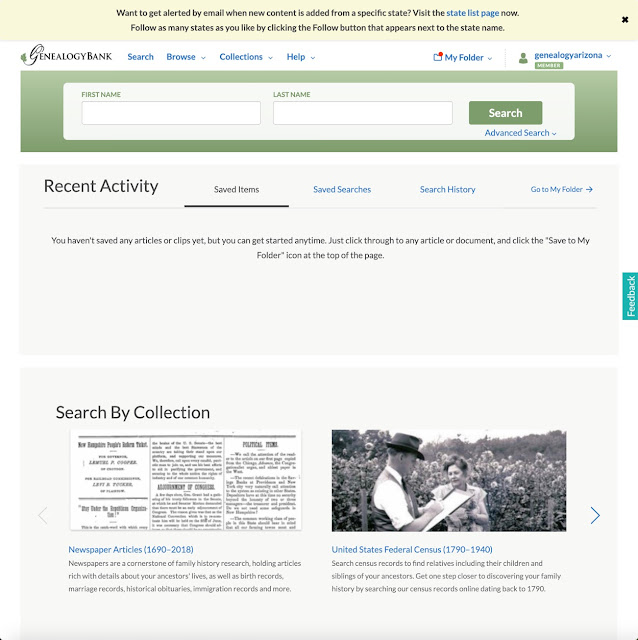
FamilySearch sent out an invitation to me announcing that as a FamilySearch LDS member, I now have a free GenealogyBank.com account. Quoting from the GenealogyBank.com website:
GenealogyBank is a leading online genealogical resource from NewsBank, inc. Featuring a wealth of exclusive material-including modern obituaries and historical newspapers, books, pamphlets, military records, government documents and more-GenealogyBank helps you discover fascinating information about your family history.

GenealogyBank's 13,000+ historical newspapers include letters, speeches, opinion pieces, advertisements, hometown news, photographs, illustrations and more. These unique primary documents go beyond names and dates, providing first-hand accounts that simply aren't available from census or vital records alone. With GenealogyBank, you'll get a glimpse into the triumphs, troubles and everyday experiences of your American ancestors.
Look for an invitation in your email. I can't yet find GenealogyBank listed as a FamilySearch partner. Maybe I am the only one invited? You can try this link: Get Account Access

President Nelson Shares Social Post about Racism and Calls for Respect for Human Dignity


https://newsroom.churchofjesuschrist.org/article/president-nelson-shares-social-post-encouraging-understanding-and-civility

In this time of social unrest, pandemic, economic depression, and natural disasters, it is a good idea to remember kindness, civility, obedience to God's commandments, and other basic principles of a Christ-like life that may not determine our circumstances but will certainly determine how we react to those circumstances. Whether or not you are a member of The Church of Jesus Christ of Latter-day Saints, take a moment to read what President Nelson has to say and reflect on how you might improve the area immdiately around you.